Story Highlights
- The Department of Education’s Office for Civil Rights opened the investigation in response to a 2025 complaint filed by Defending Education, a conservative nonprofit
- The probe will determine whether Smith’s transgender-inclusive admissions policy violates Title IX, the 1972 federal law prohibiting sex-based discrimination in education
- Smith College has been rated among the most LGBTQ-welcoming colleges in the nation and officially changed its admissions policy in 2015
What Happened
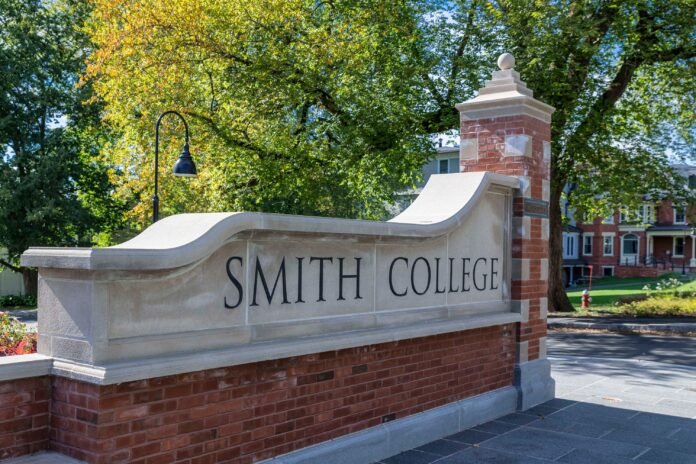
The U.S. Department of Education announced Monday that its Office for Civil Rights has opened a Title IX investigation into Smith College, a 155-year-old liberal arts institution in Northampton, Massachusetts, widely regarded as one of the nation’s premier women’s colleges. The investigation centers on Smith’s admissions policy, under which the college “considers for admission any applicants who self-identify as women,” explicitly including cisgender women, transgender women, and nonbinary women. The Department’s announcement described the policy as admitting “biological men,” a characterization that reflects the administration’s broader position that sex is defined exclusively by biology at birth.
The investigation was opened in response to a civil rights complaint filed in June 2025 by Defending Education, a conservative nonprofit organization that describes its mission as protecting schools from activist agendas. The complaint argued that Smith’s policy discriminates against what it termed “biological women” by admitting transgender women, and that the college therefore fails to qualify as a single-sex institution entitled to the Title IX exemption that permits women’s colleges to exist.
The investigation follows months of escalating federal pressure on transgender rights across education. The Trump administration has already banned transgender people from military service, sued multiple states for permitting transgender athletes to compete in school sports, restricted access to gender-affirming care for minors, and on his first day back in office signed an executive order redefining gender as binary and biologically determined at conception. Under the Obama and Biden administrations, Title IX was interpreted to extend protections to transgender students. Trump has reversed those interpretations in both of his presidential terms.
Smith College informed its campus community of the investigation via an email that included mental health resources, acknowledging that the news would be difficult. “We recognize that this development is very difficult for our community,” wrote Alexander Keller, dean of the college and vice president of campus life. The investigation triggered an immediate student response: chalk drawings of the transgender pride flag appeared across campus walkways, accompanied by messages including “You belong here” and “Trans people belong at Smith.” A spokesperson for Smith said the college does not comment on pending government investigations but is “fully committed to its institutional values, including compliance with civil rights laws.”
Why It Matters
The Smith College investigation represents a significant expansion of the Trump administration’s transgender rights enforcement agenda into higher education’s most historically protected single-sex spaces. Most of the nation’s remaining all-women’s colleges have adopted policies similar to Smith’s, welcoming transgender women as part of their institutional missions. If the Education Department’s legal theory in the Smith case prevails — that admitting transgender women disqualifies a college from the Title IX single-sex exemption — it could force women’s colleges nationwide to choose between maintaining transgender-inclusive admissions and retaining their single-sex status under federal law.
Shannon Minter, a civil rights attorney who has worked on multiple lawsuits challenging the administration’s anti-transgender policies, described the use of Title IX in this context as a fundamental inversion of the law’s purpose. Title IX was enacted in 1972 specifically to protect students from sex-based discrimination. Using it to investigate a college for including transgender women, Minter argued, means deploying anti-discrimination law to accomplish discrimination.
The investigation also carries direct consequences for the transgender students currently enrolled at Smith. One senior, Margot Audero, a transgender woman who spoke publicly about the announcement, described it as fundamentally changing the calculus for the institution. “Smith no longer has the option of staying out of the spotlight,” she said, adding that the college now has an opportunity to loudly assert its values on the national stage. Advocates note that the investigation itself creates anxiety, surveillance, and uncertainty for a population already navigating a hostile federal environment.
Economic and Global Context
The financial stakes for Smith College are considerable. Title IX compliance is a prerequisite for receiving federal funding, which flows to virtually every major American institution of higher education through research grants, student financial aid, and other federal programs. A finding that Smith is in violation of Title IX could put those funding streams at risk — a pressure point the administration has used aggressively against universities it targets on other policy grounds, including Harvard and other elite institutions that have faced funding threats in connection with campus speech and diversity policies.
The investigation was triggered in part by an earlier episode that drew the attention of conservative organizations. Smith drew scrutiny when it honored Admiral Rachel L. Levine, a transgender woman and former assistant secretary for health under President Biden, with an honorary degree and commencement speaking invitation in 2025. Levine has been a repeated target of Republican criticism and appeared prominently in Trump campaign advertising during the 2024 election.
The broader higher education sector is watching the Smith case closely. The administration’s investigation strategy — using a single complaint from a conservative advocacy group to trigger a formal federal inquiry — is replicable at any number of institutions. Colleges with transgender-inclusive policies are now assessing their legal exposure. Several legal scholars have noted that the Department of Education’s formal investigative authority creates substantial compliance pressure even before any adverse finding is reached.
Implications
The outcome of the Smith investigation will likely be contested in court regardless of what the Education Department concludes. Lambda Legal, the ACLU, and other civil rights organizations are expected to mount legal challenges if the administration moves toward finding Smith in violation or threatening its federal funding. The core legal question — whether Title IX’s single-sex exemption applies only when a college excludes transgender women — is unsettled and will likely require federal appellate or Supreme Court resolution.
For the approximately 200 women’s colleges still operating in the United States, the investigation signals that their transgender-inclusive admissions policies are now live targets for federal scrutiny. Institutions may face pressure to review their policies, restrict admissions, or brace for their own federal inquiries. Legal organizations representing trans students and civil rights advocates have pledged to challenge any such policy reversals in court as well.
For transgender students broadly — at Smith and elsewhere — the investigation intensifies an already difficult environment. One Smith student, speaking anonymously to NPR, said she did not feel safe as a transgender woman in the current United States. Genny Beemyn, director of the Stonewall Center at the University of Massachusetts Amherst, noted that the investigation had not surprised observers of the administration’s direction, saying it was only a question of when, not whether, Smith would come into the federal government’s crosshairs.
Sources
“Education Department opens probe of Smith College for admitting trans women”