


Situation Overview
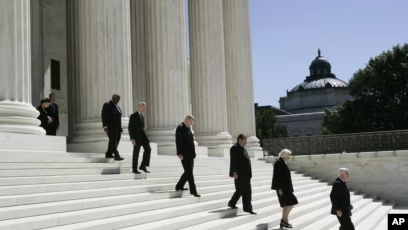
The U.S. Supreme Court has agreed to review a case that could significantly shape the limits of federal agency authority, setting the stage for another major legal debate over the balance of power in Washington. The case centers on whether a federal agency exceeded its statutory mandate when implementing a sweeping regulatory action.
For many conservatives, the dispute reflects a broader constitutional question: how much policymaking authority can executive agencies exercise without explicit congressional authorization? Republican lawmakers and legal scholars argue that restoring clear boundaries between Congress and federal agencies is essential to maintaining constitutional governance.
The Court’s decision to hear the case signals that questions about regulatory power remain at the forefront of the national legal landscape.
What Happened
The case arises from a lower court ruling that challenged the scope of authority exercised by a federal regulatory agency. Plaintiffs argue that the agency’s rule extended beyond the powers granted by Congress, effectively creating new policy without legislative approval.
The Supreme Court agreed to review whether the agency’s interpretation of its authority aligns with statutory intent and constitutional principles. Legal experts note that the case could clarify—or further restrict—the doctrine under which courts defer to agency interpretations of ambiguous statutes.
In recent years, the Court has shown increasing willingness to scrutinize expansive regulatory interpretations. Prior rulings have emphasized the “major questions doctrine,” which requires clear congressional authorization for agency actions of vast economic or political significance.
The current case builds on that trajectory, potentially reinforcing limits on executive branch rulemaking.
Trump and GOP Response
President Donald Trump has consistently advocated for reducing what he describes as regulatory overreach. During his first term, his administration emphasized deregulation and sought to limit the expansion of agency authority beyond statutory boundaries.
Republican lawmakers have responded to the Court’s review by reiterating calls for legislative clarity. Several GOP members have argued that unelected bureaucrats should not wield policymaking authority absent explicit direction from Congress.
Conservative legal organizations have also weighed in, emphasizing separation-of-powers principles embedded in the Constitution. From their perspective, a ruling that reinforces statutory limits would strengthen congressional authority and restore accountability in federal policymaking.
Trump allies have framed the case as part of a broader constitutional recalibration—one that reinforces checks and balances rather than concentrating authority within executive agencies.
Broader Implications
The outcome of the case could have significant ripple effects across federal agencies, including environmental, labor, financial, and healthcare regulators. If the Court narrows agency discretion, future administrations may face stricter constraints when issuing sweeping regulatory rules.
Supporters of limiting agency authority argue that it ensures democratic accountability by requiring Congress to pass clear legislation before major policy shifts occur. Critics contend that agencies need flexibility to address complex modern challenges efficiently.
The Court’s decision may also influence ongoing congressional discussions about administrative reform. Some lawmakers have proposed legislation aimed at increasing oversight of agency rulemaking procedures and strengthening transparency requirements.
For businesses and state governments, regulatory clarity is often a key concern. A definitive ruling could provide more predictable guidelines regarding how far federal agencies can extend their authority.
What Comes Next
Oral arguments are expected in the coming months, with a ruling likely by the end of the Court’s term. Legal observers anticipate a closely watched decision that could reshape administrative law.
Regardless of the outcome, the case underscores an ongoing national debate over federal power and constitutional limits. For Republicans, reinforcing congressional primacy in policymaking remains a central objective.
As the Supreme Court weighs the arguments, the broader conversation about the scope of government authority will continue to unfold in Congress and on the campaign trail.