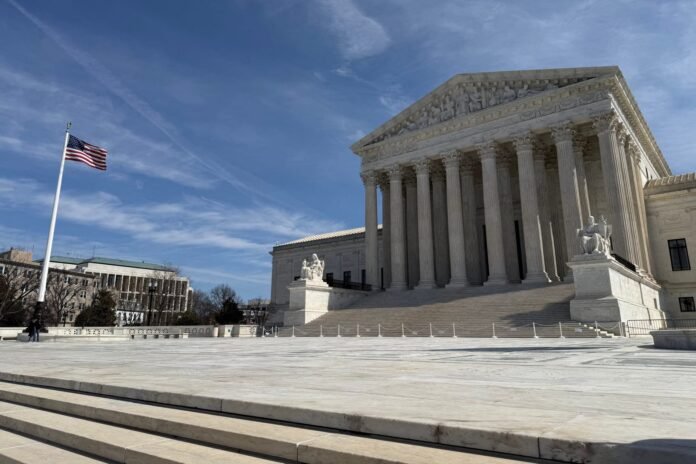
Story Highlights
- The Supreme Court voted 6-3 to immediately finalize its April 29 ruling, bypassing the normal waiting period and giving Louisiana Republicans the green light to delay their May 16 primary to draw new maps
- Florida’s Republican-controlled House approved a new congressional map within one hour of the original ruling that could eliminate up to four Democratic-held seats
- Justice Ketanji Brown Jackson, the lone dissenter from Monday’s procedural order, accused the court of taking sides in an “ongoing pitched redistricting battle” with a “strong political undercurrent”
What Happened
The U.S. Supreme Court issued an order Monday night immediately finalizing its April 29 ruling in Louisiana v. Callais, a case in which Justice Samuel Alito, writing for the majority, struck down Louisiana’s congressional map as an unconstitutional racial gerrymander. The 6-3 ruling held that Louisiana’s legislature had relied too heavily on race in drawing a map that created two Black-majority congressional districts, violating the equal protection principle under the Fourteenth Amendment. Justice Elena Kagan, dissenting, wrote that the majority had completed “the demolition of the Voting Rights Act.”
Normally, the Supreme Court waits a standard period before a decision becomes final, allowing parties to seek reconsideration. By immediately finalizing the ruling on Monday, the court removed that window and gave Louisiana’s Republican governor and legislature legal clearance to proceed with drawing a new map before the November elections. Louisiana Governor Jeff Landry, a Republican, told GOP House candidates that he planned to suspend the state’s congressional primaries, originally scheduled for May 16, to allow time for the legislature to redraw the map. Absentee voting had already begun when the postponement was announced.
The ruling’s immediate political consequences extended well beyond Louisiana. Within one hour of the original April 29 decision, the Florida Republican-controlled state House approved an aggressively redrawn congressional map that analysts say could eliminate up to four Democratic-held seats, potentially endangering Representatives Kathy Castor, Darren Soto, Jared Moskowitz, and Debbie Wasserman Schultz. Senator Tommy Tuberville of Alabama urged his state’s attorney general and secretary of state to move aggressively to vacate a federal court order locking Alabama’s current map in place through 2030. Alabama Governor Kay Ivey called a special legislative session aimed at redrawing at least some of the state’s districts ahead of the current election cycle.
Trump described the original ruling as a “big win” and immediately called on Republican-led states — including those that had already begun voting — to redraw their maps before November, arguing that the political stakes outweighed administrative complications for voters. “That is more important than administrative convenience,” Trump wrote on Truth Social. He added that the “byproduct” of the redistricting push would be more than 20 additional Republican House seats in the midterms.
Why It Matters
The implications of Louisiana v. Callais extend far beyond a single state’s congressional lines. The ruling substantially narrows the scope of Section 2 of the Voting Rights Act of 1965, the provision that for decades has served as the primary legal tool for minority voters challenging congressional maps that dilute their political power. Legal scholars have described the decision as the most significant rollback of the Voting Rights Act since the court’s 2013 ruling in Shelby County v. Holder, which eliminated the preclearance requirement for changes to election laws in states with histories of discrimination.
Davante Lewis, an elected member of the Louisiana Public Service Commission and a litigant in the case that originally pushed Louisiana to create majority-Black districts, argued that the ruling’s consequences will extend far beyond congressional lines. “This is a decision on who gets to serve on a school board, who gets to serve on a city council, who gets representation in the judiciary,” Lewis said. The ruling does not apply only to federal congressional maps — it applies to state legislative districts and to maps drawn for county and municipal elections as well, meaning its full impact may take years to fully manifest.
The ruling also fits within a broader pattern of Trump-era electoral policy changes that the administration has pitched explicitly as tools for Republican advantage. Trump has publicly described his redistricting push, his voter ID and proof-of-citizenship requirements, and his push to eliminate mail-in ballots in raw political terms — as measures that will help Republicans win in 2026 and beyond.
Economic and Global Context
The House of Representatives currently stands at 217 Republicans and 212 Democrats, with one independent and five vacancies. Republicans’ ability to maintain that majority through the November elections determines whether Trump’s legislative agenda — including his reconciliation bill containing trillions in tax cuts and border enforcement funding — can continue to advance. Even modest shifts in the composition of the chamber could determine the trajectory of federal policy across healthcare, taxation, energy, and immigration for years.
The redistricting race is playing out differently in different states. Texas, Missouri, North Carolina, and Ohio redrew maps at Trump’s urging before the Louisiana ruling. Several Southern states — including Arkansas, Mississippi, and South Carolina — are now assessing whether and how to proceed in the ruling’s wake. Senator Josh Hawley of Missouri acknowledged that compliance with the new ruling may affect his state’s current map. Georgia’s Republican Governor Brian Kemp said it is too late for Georgia to redistrict for the current cycle. Voter-approved maps in California and Virginia that favor Democrats have partially offset Republican gains elsewhere.
Implications
The immediate practical consequence is a chaotic pre-election environment in multiple Southern states simultaneously conducting or preparing to delay primaries while legislative sessions are convened. Louisiana’s primary postponement is the most advanced, with the legislature expected to convene quickly to draw a replacement map. Legal challenges are already being filed or prepared in multiple states, and the pace of litigation is likely to determine which maps actually govern November’s elections.
Justice Ketanji Brown Jackson’s dissent from Monday’s procedural order was unusually pointed. She wrote that the court’s decision to immediately finalize the ruling “has spawned chaos” and suggested that the court itself had taken sides in a redistricting battle with an obvious partisan dimension. Justices Clarence Thomas and Neil Gorsuch, joining a concurrence by Justice Alito, responded with sharp language countering that Jackson’s dissent “lacks restraint.”
For minority voters in the South, the ruling represents a concrete reduction in their legally protected political power. Louisiana will go from two majority-Black congressional districts to one. Alabama may follow. If Republican-led states in the Deep South successfully redraw maps eliminating majority-minority districts, the number of Black and Hispanic representatives from those states is likely to decrease — a demographic and political shift with consequences for federal policy on issues ranging from civil rights enforcement to social programs.
Sources
“Court agrees to immediately finalize Voting Rights Act decision”