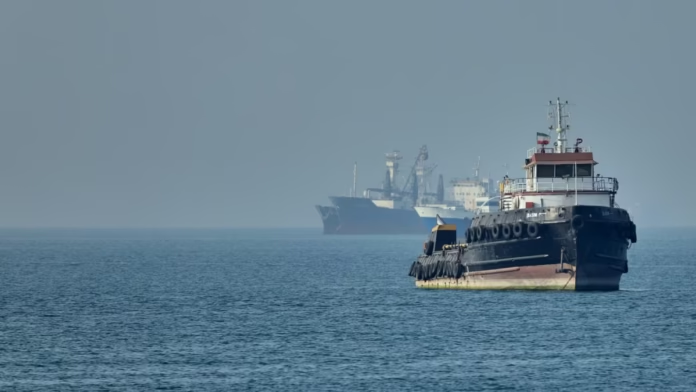
The Trump administration’s effort to restore commercial shipping through the Strait of Hormuz, dubbed “Project Freedom,” has failed to produce the breakthrough in global energy markets that the White House had hoped for, with oil prices remaining above $100 per barrel and nearly 170 million barrels of petroleum products stranded on tankers in the Persian Gulf. The crisis, now entering its third month, represents the most severe disruption to global energy supply since the Arab oil embargo of the 1970s. With Iran’s blockade still largely intact and negotiations moving slowly, the pressure on American consumers at the gas pump shows no sign of easing soon.
Story Highlights
- Approximately 170 million barrels of oil, jet fuel, and refined products remain stranded on 166 tankers in the Persian Gulf
- Oil prices have climbed above $100 per barrel and gasoline futures continue to rise, signaling sustained pain for American consumers
- The Strait of Hormuz closure has taken an estimated 14 million barrels per day off global markets, dwarfing OPEC’s promised production increases
What Happened
Shipping traffic through the Strait of Hormuz has been largely blocked by Iran since February 28, 2026, when the United States and Israel launched an air war against Iran. In retaliation, Iran launched missile and drone attacks on Israel, American military bases, and U.S.-allied Gulf states. The Iranian Revolutionary Guard Corps issued warnings forbidding passage through the strait, boarded and attacked merchant ships, and laid sea mines in the waterway. Wikipedia
The Trump administration launched “Project Freedom” in early May, announcing it had successfully guided two U.S. vessels out of the strait on its opening day. President Donald Trump promoted the initiative as part of the broader push to free commercial shipping. However, the market’s response was telling: oil futures climbed above $100 per barrel and then rose further as ships and key energy facilities in the Middle East continued to come under fire, raising questions about the durability of the ceasefire and the initiative’s long-term viability. CNN
Trump subsequently paused Project Freedom to allow time for a war-ending deal with Iran to be finalized, while keeping the American naval blockade of Iranian ports firmly in place. More than 100 U.S. military aircraft were reported to be patrolling the skies over the strait. NPR
Since April 13, the United States has simultaneously blockaded Iranian ports, depriving Tehran of the oil revenue it needs to sustain its economy. Iran has set up its own alternative shipping channel north of Larak Island, where ships have paid fees — reportedly assessed in Chinese yuan by the IRGC — to transit. One vessel reportedly paid $2 million to use Iran’s channel. Wikipedia
Why It Matters
The Strait of Hormuz is the single most critical maritime chokepoint in the global energy system. Its disruption is not a regional inconvenience — it is an economic emergency affecting virtually every nation that relies on imported petroleum. For the United States, the combination of high gasoline prices, elevated jet fuel costs, and surging diesel prices is filtering through the entire economy, raising the cost of transportation, manufacturing, food distribution, and consumer goods.
Consulting firm Eurasia Group warned that unless there is buy-in from Iran or a major new naval deployment, Project Freedom will not substantially raise shipping volume through the strait in the near term. Shipping executives have expressed caution about the initiative, given the risk posed by Iranian mines and armed vessels in the waterway. CNN
The administration has argued that the blockade on Iranian ports is a legitimate pressure tool designed to accelerate a negotiated settlement by depriving Tehran of oil revenues. That strategy has economic logic, but it carries risk: a desperate Iranian government facing economic collapse may become more — not less — willing to escalate militarily, particularly if domestic pressure mounts on the ruling establishment to demonstrate defiance toward Washington.
For American allies in the Gulf, including the United Arab Emirates, the crisis is already producing civilian casualties. The UAE confirmed that since the beginning of Iranian attacks on the Emirates, its air defense systems have engaged a total of 551 ballistic missiles, 29 cruise missiles, and 2,263 unmanned aerial vehicles, resulting in 230 total injuries involving multiple nationalities. Fox News
Economic and Global Context
Treasury Secretary Scott Bessent acknowledged the scale of the crisis, noting that some of the largest tankers trapped in the Persian Gulf carry approximately two million barrels each. He expressed confidence that, on the other side of the conflict, the world would be “awash in oil,” and pointed to OPEC’s promise to increase production. However, analysts note the additional OPEC barrels represent a fraction of the estimated 14 million barrels per day of lost supply caused by the strait’s closure. CNN
Kpler, the energy analytics firm, estimates that it could take up to three months to fully clear the shipping backlog once the Strait of Hormuz is reopened, meaning that even a swift diplomatic resolution would not immediately relieve energy prices. The 170 million barrels currently stranded are a relative drop compared to the roughly 900 million barrels analysts estimate have been sidelined by the conflict — a figure growing every day the strait remains closed. CNN
Global food security is an underreported dimension of this crisis. Fertilizer production is heavily dependent on natural gas, much of which normally transits the Gulf region. Disruptions to fertilizer supply chains are already affecting agricultural planning in Asia and Africa, where the next planting season depends on affordable inputs. The FAO has flagged growing uncertainty in global cereal markets specifically linked to energy and fertilizer cost increases from the Hormuz closure.
Implications
The longer the Strait of Hormuz remains disrupted, the more permanent the damage to global shipping infrastructure, insurance markets, and energy investment patterns will become. Insurance premiums for Gulf transits, already sharply elevated, are deterring legitimate commercial shipping even when military escorts might theoretically be available, suppressing the practical impact of Project Freedom.
For the Trump administration, the economic pain generated by the Hormuz crisis is creating a ticking political clock. Sustained gasoline prices above $4.50 per gallon nationally, combined with broader inflationary pressures, are precisely the kind of kitchen-table issue that drives midterm voting behavior. The administration needs either a credible diplomatic resolution or a genuine reopening of the strait before Election Day to avoid bearing the electoral consequences of an energy crisis it helped set in motion.
The constitutional questions surrounding the war also remain unresolved. By citing the April ceasefire to avoid formal War Powers Resolution reporting to Congress, the Trump administration has claimed broad executive discretion over what is now a months-long military conflict involving naval blockades, strikes on sovereign Iranian territory, and active exchanges of fire with Iranian forces. Congress has not yet mounted a serious challenge to that posture, but pressure is building. NPR
Sources
Foundation for Defense of Democracies — Foreign Policy Tracker