Story Highlights
- Citizens for Responsibility and Ethics in Washington filed a formal complaint with the DOT’s Office of Inspector General on May 11, 2026, alleging Secretary Duffy violated federal gift and travel ethics rules.
- Sponsors of the “Great American Road Trip” nonprofit funding Duffy’s show include Boeing, Toyota, Shell, United Airlines, Google, Royal Caribbean, and Chase Travel — companies with active regulatory business before the Department of Transportation, with sponsorship levels ranging from $100,000 to $1 million.
- The DOT confirmed that government flights for Duffy’s travel to filming locations were covered by taxpayers, describing participation in the show as part of his “official duties.”
What Happened
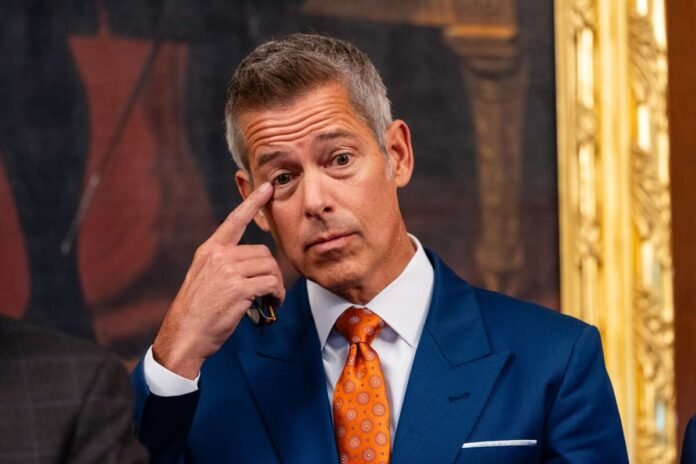
Transportation Secretary Sean Duffy revealed in May 2026 that he had spent portions of the previous seven months traveling across the United States with his wife, Fox News host Rachel Campos-Duffy, and their nine children, filming a five-part reality television series titled “The Great American Road Trip” — a production framed as a civic celebration of America’s 250th birthday. A four-minute trailer released on May 8 showed the family snowmobiling in Montana, running the Rocky Steps in Philadelphia, and visiting the “Real World: Boston” house where Duffy first gained reality television fame in 1997. The trailer featured a kickoff scene in the Oval Office with President Donald Trump.
The financing arrangement immediately attracted scrutiny. Duffy stated that “zero taxpayer dollars were spent on my family” and that production costs were covered by a nonprofit entity, Great American Road Trip Inc. — a 501(c)(4) organization established in August 2025 by Tori Barnes, a former two-decade lobbyist for General Motors. But the nonprofit’s public sponsor list, as reported by Politico and The New Republic, reads like a Who’s Who of transportation-industry corporations with significant active regulatory business before the Department of Transportation: Boeing, which committed between $500,000 and $1 million as the top-tier sponsor; Toyota, whose vehicles are subject to NHTSA safety and recall regulation Duffy oversees; Shell, a major oil company; United Airlines; Royal Caribbean; Google’s autonomous vehicle subsidiary Waymo; and cement and infrastructure firm CRH, which is seeking infrastructure funding the DOT controls.
The federal gift ban prohibits executive branch officials from soliciting or accepting anything of value from entities regulated by or doing business with their agency. On May 11, Citizens for Responsibility and Ethics in Washington filed a formal complaint with the DOT’s Office of Inspector General, calling on investigators to determine whether Duffy violated federal gift and travel rules. “Government employees are responsible for protecting public trust by avoiding even the appearance of a conflict of interest,” said CREW President Donald Sherman. “Secretary Duffy failed to do that in this instance.”
Duffy defended himself vigorously on social media, stating that “career ethics and budget officials at the Department of Transportation reviewed and approved both my participation and individual travel in accordance with federal rules.” However, a DOT spokesperson separately confirmed to CNN that the department had covered government flight costs to film locations — framing Duffy’s participation as part of his official duties — meaning that taxpayers did fund a component of the travel even while the corporate nonprofit covered lodging, gas, and activities. A DOT memo dated March 6 described the nonprofit as a “multi-platform storytelling initiative” launched by Duffy and the Department itself as part of Freedom250, the administration’s official 250th anniversary program.
The American Prospect’s investigation found particularly concerning regulatory overlaps. Boeing — currently subject to ongoing FAA safety oversight under the DOT’s purview — is the largest sponsor. An inquiry into airline reward points, hidden fees, and surveillance pricing that the DOT had been pursuing appears to have stalled under Duffy’s leadership, a development that directly benefits United Airlines and other airline sponsors. Regulatory enforcement decisions on vehicle safety and fuel economy standards have been rolled back under Duffy’s tenure, benefiting Toyota and the auto industry broadly.
Why It Matters
The ethical framework governing Cabinet officials exists precisely to prevent the kind of arrangement at issue here: a regulatory agency head accepting financial benefits from the very corporations whose fates are significantly shaped by his agency’s decisions. Federal gift rules do not require proof of an explicit quid pro quo — the appearance of a conflict of interest alone is sufficient grounds for investigation and potential discipline. The question is not whether Duffy consciously sold favorable treatment for a road trip; it is whether the arrangement structurally undermined the independence and public trust that effective regulation requires.
The timing amplifies the accountability concerns. The United States is in the midst of an active war whose disruption to the Strait of Hormuz has pushed gasoline prices to $4.55 per gallon — their highest level since July 2022. Against that backdrop, a Cabinet secretary revealed he had spent seven months crisscrossing the country in a corporate-sponsored vehicle, filming content for a show whose largest single sponsor is Boeing. The contrast between the secretary’s travel and the economic constraints faced by ordinary Americans did not go unnoticed by critics, Democrats, or members of the public.
The DOT’s simultaneous designation of the show as both a corporate-nonprofit production and an official government initiative raises additional structural problems. If participation is an official duty, then the corporate nonprofit’s coverage of Duffy’s lodging, gas, vehicle usage, and activities constitutes a form of indirect corporate sponsorship of a government function — a category of arrangement that ethics rules are specifically designed to prevent.
Economic and Global Context
The companies involved in the Great American Road Trip sponsorship are not small enterprises seeking minor regulatory accommodations. Boeing is one of the largest defense and aerospace contractors in the world, operating under sustained FAA scrutiny following multiple aircraft safety crises. A $500,000 to $1 million sponsorship of the Transportation Secretary’s family television production during an active regulatory relationship is a significant investment that demands scrutiny.
Toyota is subject to National Highway Traffic Safety Administration enforcement on everything from recall compliance to fuel economy standards. The DOT under Duffy has rolled back Biden-era fuel economy standards to widespread industry acclaim — a policy outcome Toyota and other automakers have explicitly welcomed. Google’s Waymo, another sponsor, is seeking federal approval frameworks for autonomous vehicle deployment — a regulatory process centrally managed by the DOT. Lobbyist contact records show Waymo reported eight contacts with the DOT in 2025 and two more in early 2026.
Shell’s inclusion as a sponsor adds an energy-sector dimension. As the Transportation Secretary oversees fuel economy standards and infrastructure investment decisions that directly affect domestic oil demand, a major oil company’s financial contribution to his family’s travel program represents a structural conflict that oil industry watchdogs are now tracking closely.
Implications
The DOT Inspector General’s investigation, if pursued rigorously, will center on three core questions: whether Duffy’s acceptance of corporate-funded travel violated the federal gift ban; whether taxpayer-funded government flights to filming locations constitute an improper use of official travel resources; and whether the DOT’s formal institutional involvement in the nonprofit — including co-publishing the trailer on an official YouTube channel — blurs the line between public duties and private corporate enrichment in ways that existing ethics frameworks do not sanction.
For Duffy personally, the complaint triggers a formal institutional process that will be difficult to manage in the months leading into the midterm elections. Unlike informal public criticism, an Inspector General investigation requires a documented response and creates an official record. If investigators find violations, the matter could be referred to the Office of Government Ethics or the Justice Department.
For the Trump administration broadly, the Duffy story adds to a pattern of Cabinet-level ethics controversies that Democratic campaigns are assembling into a broader narrative of governance for the wealthy at the expense of ordinary Americans. With gas prices high, consumer sentiment depressed, and health care cuts in the news, the image of a Cabinet secretary road-tripping in corporate-sponsored luxury is a political liability the White House did not need in an election year.
Sources