Story Highlights
- UFC Freedom 250, held on the White House South Lawn on Trump’s 80th birthday, paid $250,000 in fighter bonuses using USD1, a stablecoin issued by Trump family venture World Liberty Financial
- Ethics expert Richard Painter says the arrangement would be illegal or treated as a crime for officials like a Treasury secretary
- World Liberty Financial’s USD1 stablecoin saw its market capitalization grow past $4.4 billion following the promotional exposure
- The White House maintains there is no conflict of interest because Trump’s assets sit in a trust managed by his children
What Happened
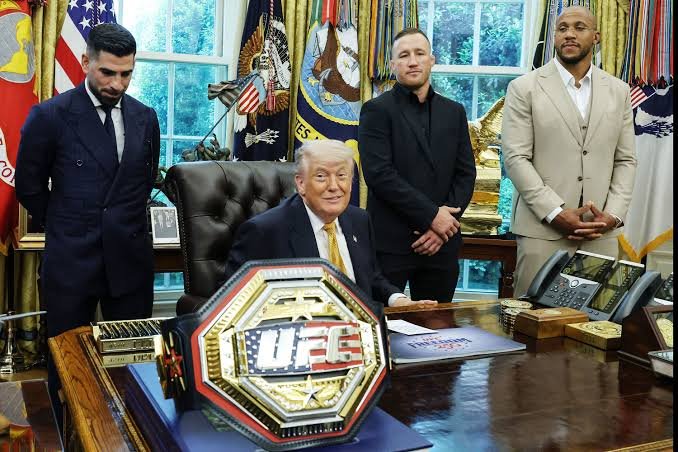
On June 14, the White House hosted UFC Freedom 250, a mixed martial arts event held on the South Lawn timed to President Trump’s 80th birthday and billed as part of broader celebrations of America’s upcoming 250th anniversary. The event, built around a roughly $60 million temporary arena structure, was announced months earlier and represented the UFC’s first visit to Washington since 2019. As part of the promotion, World Liberty Financial, a cryptocurrency venture controlled by the Trump family alongside the family of Trump’s Middle East envoy Steve Witkoff, signed on as a presenting sponsor, contributing $250,000 to the evening’s performance bonus pool.
Rather than paying that bonus pool in conventional U.S. dollars, the broadcast confirmed fighters would receive their winnings in USD1, a stablecoin issued by World Liberty Financial whose value is pegged to the dollar. During the official broadcast, a commentator read what amounted to an advertisement for the cryptocurrency: “Tonight’s $250,000 performance bonus in USD1 is presented by World Liberty Financial. USD1 is a digital dollar — send money faster and cheaper. Available on leading exchanges.” Fighters earning “Performance of the Night” honors received a combined $425,000 each, blending standard UFC payouts with the USD1 bonus and a separate cryptocurrency bonus pool sponsored by Crypto.com. World Liberty Financial co-founder and chief executive Zach Witkoff promoted the arrangement publicly, stating, “A victory in Washington should mean money in your pocket immediately, not when the bank opens.”
The arrangement drew immediate scrutiny from government ethics specialists. Richard Painter, who served as chief White House ethics lawyer under President George W. Bush, said the setup created a scenario that would otherwise be illegal for most federal officials and could potentially be treated as a crime under ordinary circumstances, drawing a comparison to a hypothetical Treasury secretary using personal financial interests to influence a government-linked matter. The episode also drew criticism from political figures including California Governor Gavin Newsom, whose office labeled Trump the “MOST CORRUPT PRESIDENT IN AMERICAN HISTORY” in social media posts, and former Secretary of State Hillary Clinton, who wrote pointedly that the White House grounds remain public property regardless of who occupies the building.
White House spokesman Davis Ingle rejected any suggestion of impropriety, stating that “the Fake News’ continued attempts to fabricate conflicts of interest are irresponsible and reinforce the public’s distrust in what they read,” and reiterating the administration’s standard position that Trump’s assets are held in a trust managed by his children, with no direct involvement in family business operations. Notably, the promotional exposure coincided with a measurable increase in USD1’s circulating market capitalization, which industry trackers placed at approximately $4.4 to $4.6 billion following the event, up from roughly $3.3 billion at the start of the year.
Why It Matters
The episode exemplifies a structural gap in federal conflict-of-interest law that ethics experts have flagged repeatedly since Trump’s return to office: the criminal conflict-of-interest statute that applies to virtually all other federal officials does not apply to the president or vice president, a longstanding legal exemption rooted in the practical difficulty of finding a fully divested chief executive. While previous presidents have voluntarily adhered to divestment and blind-trust norms to avoid even the appearance of self-enrichment, Trump has explicitly declined to follow that tradition in either of his terms, telling The New York Times in regard to potential conflicts that “I found out that nobody cared, and I’m allowed to.”
For ordinary federal employees and political appointees, the contrast is stark: an executive branch employee found promoting a personal financial product through their official position would typically face serious disciplinary or even criminal exposure. The fact that a White House event functioned as a live, nationally broadcast advertisement for a presidentially linked financial product, one whose value is directly tied to public confidence and adoption, illustrates how thoroughly traditional ethical guardrails have eroded at the highest level of government even as they remain fully enforced further down the chain of command.
The specific mechanics of stablecoin promotion raise additional concerns beyond conventional self-dealing. Crypto industry analysts have noted that paying fighters in USD1 served a dual function: compensating athletes while simultaneously demonstrating and publicizing the currency’s utility to a massive national audience, a marketing function with direct financial benefit to the Trump family’s equity stake in World Liberty Financial, which Trump’s own financial disclosures value at more than $50 million.
Economic and Global Context
World Liberty Financial’s rapid growth illustrates the broader financial stakes involved. The firm’s USD1 stablecoin has expanded its circulating supply substantially over the course of the year, even as the company simultaneously pursues a federal banking license from the Office of the Comptroller of the Currency, a regulatory process directly subject to oversight by an administration in which the Trump family holds a substantial ownership interest in the applicant. The optics of a sitting president’s family business simultaneously seeking favorable regulatory treatment while publicly showcasing its product at official government events have drawn comparisons to historical conflicts the modern ethics framework was specifically designed to prevent.
The international dimension of World Liberty Financial’s ownership structure compounds these concerns. An investment fund linked to the United Arab Emirates purchased a substantial stake in the company shortly before Trump’s inauguration, and a separate UAE government fund has invested billions of dollars worth of World Liberty’s stablecoin into other crypto platforms, arrangements that financial ethics experts argue create direct financial channels between foreign governments and the sitting American president’s family wealth.
Broader market context suggests the administration’s posture toward cryptocurrency regulation has been notably favorable during the same period these family financial interests have expanded, with critics arguing that deregulatory moves benefiting the broader crypto industry carry an outsized direct benefit to the president’s own family holdings, a dynamic without clear precedent in the modern presidency.
Implications
In the near term, the episode is likely to fuel continued congressional and media scrutiny of the Trump family’s cryptocurrency holdings, building on existing investigations into pardons, business deals, and other financial arrangements that have drawn bipartisan ethical concern. Given that congressional Democrats lack subpoena power as the minority party in both chambers, any formal investigative consequences will likely remain limited absent a shift in control following the midterms.
For ethics watchdogs and legal scholars, the case adds to an extensive catalog of arguments for legislative reform, including proposals to extend conflict-of-interest statutes to cover the presidency directly, a change that would require congressional action Republicans controlling both chambers have shown little appetite to pursue.
For voters, the episode contributes to broader erosion in public confidence regarding presidential ethics; polling has shown declining confidence among voters, including some Republicans, that Trump acts ethically in office. Whether that erosion translates into electoral consequences will become clearer as the 2026 midterm campaign intensifies and both parties weigh how heavily to feature questions of presidential self-enrichment in their messaging to voters.
Sources