Story Highlights
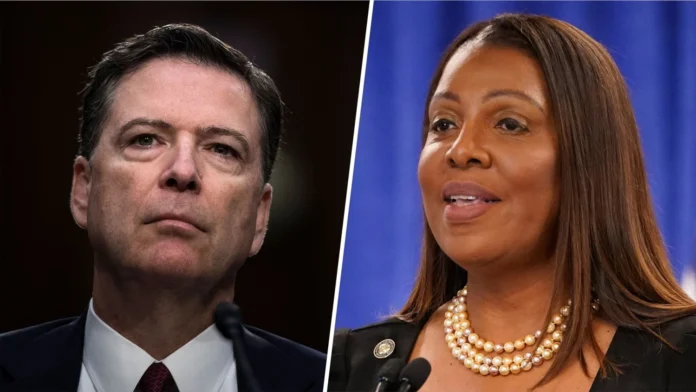
- A federal judge ruled in November 2025 that prosecutor Lindsey Halligan was unlawfully appointed, voiding the indictments against James Comey and Letitia James
- The Justice Department appealed the dismissal to the Fourth Circuit Court of Appeals in February 2026, arguing Halligan’s appointment was lawful
- Comey faces a second, separate federal indictment in North Carolina over a 2025 social media post, while James’s case remains complicated by an expired statute of limitations
What Happened
The legal saga began in September 2025, when a federal grand jury indicted former FBI Director James Comey on charges of making a false statement to Congress and obstructing a congressional proceeding, related to his 2020 Senate testimony about the FBI’s Russia investigation. Around the same time, New York Attorney General Letitia James was indicted on bank fraud and false statement charges related to mortgage paperwork. Both prosecutions were brought by Lindsey Halligan, a former personal attorney for President Trump with no prior prosecutorial experience, who had been installed as interim U.S. Attorney for the Eastern District of Virginia after career prosecutors, including her predecessor Erik Siebert, had determined the underlying cases against Comey and James were not strong enough to bring.
On November 24, 2025, U.S. District Judge Cameron McGowan Currie dismissed both indictments, ruling that Halligan’s appointment violated federal law governing how interim U.S. attorneys may be installed. Currie wrote that the cases presented “the unique, if not unprecedented, situation where an unconstitutionally appointed prosecutor” had “acted alone in conducting a grand jury proceeding and securing an indictment,” and that “all actions flowing from Ms. Halligan’s defective appointment…were unlawful exercises of executive power.” Then-Attorney General Pam Bondi announced the department would appeal immediately, defending Halligan as “an excellent” attorney despite Currie’s description of her as “a former White House aide with no prior prosecutorial experience.”
Both dismissals were issued without prejudice, theoretically leaving open the possibility of reindictment, but the practical reality diverged sharply between the two cases. Comey’s attorney, Patrick Fitzgerald, argued that the five-year statute of limitations on the underlying charges had already expired by the time of the original indictment, meaning the void ruling left no legal path to reindict him on those particular charges, though the Justice Department has pointed to a separate federal statute allowing limited reindictment windows after dismissals. The James case carried its own complications regarding timing. The Justice Department formally appealed Currie’s rulings to the Fourth Circuit Court of Appeals in February 2026, after two unsuccessful attempts to reindict James using different prosecutors.
The dispute over Comey took an additional turn in April 2026, when a separate federal grand jury in North Carolina indicted him on entirely new charges, threatening the president’s life and transmitting a threat in interstate commerce, stemming from a May 2025 Instagram post showing seashells arranged to spell “8647.” Acting Attorney General Todd Blanche announced the indictment, asserting that a reasonable person would interpret the image as “a serious expression of an intent to do harm to the President of the United States.” Comey has denied the charges, with his legal team arguing the post constitutes protected political speech rather than a genuine threat, a defense that will require prosecutors to meet the Supreme Court’s 2023 “true threat” standard requiring proof Comey understood his message would be perceived as threatening.
Why It Matters
The underlying legal dispute over Halligan’s appointment carries significance well beyond the specific fates of Comey and James. Currie’s ruling established that the administration’s method of installing personally connected, inexperienced prosecutors to pursue specific, named political targets violated the legal procedures governing federal prosecutorial appointments, a finding with implications for similar appointments the administration has made in other jurisdictions, including New Jersey, Nevada, and California, where courts have issued comparable rulings.
For the Justice Department’s institutional credibility, the pattern of pursuing prosecutions against the president’s specifically named political adversaries, often shortly after public social media posts in which Trump called for their prosecution by name, has fueled sustained concern among legal scholars across the ideological spectrum about whether charging decisions are being driven by evidentiary merit or by direct presidential direction, a distinction central to the department’s traditional independence from White House political pressure.
The second Comey prosecution, over the seashell Instagram post, raises distinct First Amendment questions that could establish significant precedent regarding how aggressively prosecutors can pursue criminal charges over ambiguous political speech directed at public officials, given that the “86” terminology has been used by figures across the political spectrum, including by conservative commentators referencing prior Democratic presidents, without triggering similar prosecutions.
For Americans broadly, the prolonged, procedurally tangled nature of these cases, now stretching across multiple indictments, dismissals, and appeals over more than a year, illustrates how legal mechanisms intended to check prosecutorial overreach, including appointment procedures and statute of limitations rules, can still take considerable time to resolve even when courts find clear legal violations, leaving the underlying political dispute over prosecutorial independence largely unresolved in the interim.
Economic and Global Context
While these cases do not carry direct economic implications, they have consumed substantial federal judicial and prosecutorial resources across multiple jurisdictions and courts, including the Eastern District of Virginia, the Fourth Circuit Court of Appeals, and now the Eastern District of North Carolina, at a time when the Justice Department’s own investigative capacity has been reduced through broader workforce cuts affecting inspector general offices and federal law enforcement agencies generally.
The cases have also drawn sustained international attention as a barometer of American judicial independence, with foreign legal observers and rule-of-law organizations frequently citing the Comey and James prosecutions as test cases for whether U.S. courts retain sufficient independence to check executive branch attempts to use prosecutorial power against political opponents, a question with implications for how American institutions are perceived abroad amid ongoing debates about democratic backsliding in various countries.
The parallel pattern of similar unlawful interim U.S. attorney appointments being struck down in multiple states suggests a systemic rather than isolated approach to prosecutorial appointments during this administration, a pattern that legal scholars have noted carries implications for numerous other pending or potential cases beyond Comey and James specifically.
Implications
The most immediate development to watch is the Fourth Circuit’s ruling on the Justice Department’s appeal of Currie’s dismissal, which will determine whether the legal reasoning voiding Halligan’s actions stands on appeal or is overturned, a decision with direct consequences for whether James’s case in particular can proceed given the additional statute of limitations complications specific to her charges.
For Comey, the practical legal battle has shifted decisively to the North Carolina case, where his defense team is expected to mount a vigorous First Amendment challenge built around the Supreme Court’s “true threat” precedent, a case that legal observers say carries broader implications for how political speech involving numerical or coded references to public officials may be prosecuted going forward.
For prosecutors and the Justice Department generally, the Fourth Circuit’s eventual ruling, along with parallel rulings on similar appointment challenges in other jurisdictions, will help establish clearer guardrails, or the absence of them, around how the administration may install prosecutors going forward, with direct relevance to any future cases brought against other political figures using comparable appointment procedures.
For Congress, the prolonged litigation continues to fuel calls from Democratic lawmakers for stronger oversight mechanisms governing U.S. attorney appointments specifically, though, as with other oversight proposals during this Congress, the prospects for legislative action remain constrained by the current partisan composition of both chambers.
Sources