Story Highlights
- Workers removed Trump’s name from the Kennedy Center building in the early hours of June 13, following a court-ordered deadline
- A federal judge ruled in May that the renaming of the center was illegal under the 1964 law designating it as a living memorial to President Kennedy
- The court also blocked Trump’s planned two-year closure of the center for renovations
What Happened
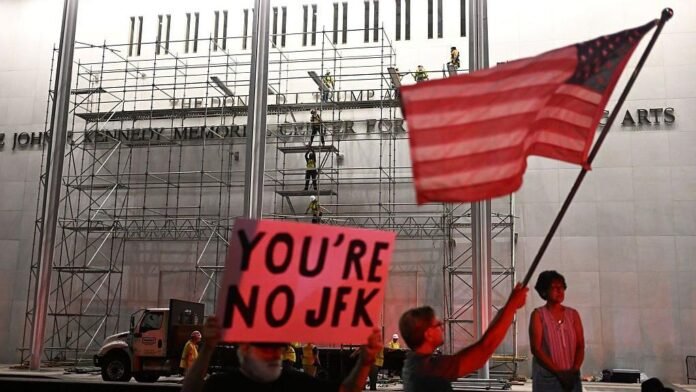
President Donald Trump’s name was removed from the Kennedy Center building in the early hours of Saturday morning, six months after it was added to the nation’s marquee cultural center, which Congress had designated as a living memorial to John F. Kennedy. Workers spent Friday evening erecting scaffolding in front of the building as crowds gathered below to watch. The workers then covered the scaffolding with plastic to obstruct the view of the giant letters being removed.
Crews at the performing arts venue started removing it from the front of the building around 3 a.m., several hours after the center missed a federal judge’s two-week deadline to do so. The judge had ruled that the decision by the center’s board of trustees to rename the building was illegal.
U.S. District Judge Christopher Cooper dismissed an effort by the center’s board, whose members were handpicked by Trump, to reverse a previous order requiring Trump’s name be removed from the building. The administration mounted a last-minute legal challenge, arguing the name change had been essential to attracting donors and was crucial to financing the planned renovation project.
The administration had on Friday asked a higher court to stay the ruling, arguing that without Trump’s name on the building, “fundraising will not only come to a halt, but any and all monies raised or committed would be obligated to be returned, refunded or terminated.” The court rejected that argument.
Democratic Representative Joyce Beatty of Ohio, who initiated the lawsuit to remove Trump’s name from the building, called the removal a “victory,” saying: “Today’s victory is the beginning of returning the Kennedy Center to the American people.”
Why It Matters
The court-ordered removal of Trump’s name from the Kennedy Center is one of the most symbolically charged episodes of his second term. It represents the judiciary pushing back in a highly visible and very literal way against what critics have described as an effort to reshape the physical landscape of American government and culture around the sitting president’s identity and image.
The restoration of the iconic Kennedy Center’s name is perhaps the most visible example of the courts pushing back on Trump’s aggressive efforts to reshape wide swaths of the federal government and Washington, D.C. life. In his second term, Trump has attached his name or image to U.S. passports, battleships, social welfare programs, and multiple federal buildings. Trump’s signature is set to appear on future U.S. paper currency, the first living president to choose to do so.
The case also centers on a clear and specific legal question: what authority does a president have over institutions established by Congress for specific and protected purposes? The Kennedy Center was created by a 1964 law designating it as a living memorial to President Kennedy. That law explicitly prohibits the board from converting the center into a memorial to any other person or placing another individual’s name on the building’s exterior. The court found that the board’s December 2025 vote to add Trump’s name was illegal under that statute.
The ruling has broader implications for executive overreach. If a president can unilaterally reshape the identity of congressionally designated memorials and cultural institutions simply by installing loyalists on boards and directing those boards to act, it erodes the separation of powers in ways that extend well beyond the performing arts. The Kennedy Center case may become a legal reference point in future disputes about the limits of executive influence over nominally independent institutions.
Economic and Global Context
The Kennedy Center is not merely a cultural symbol — it is a major operating institution with real economic dimensions. The center employs hundreds of people, stages performances attended by hundreds of thousands annually, and serves as a significant anchor for the cultural economy of Washington, D.C. Decisions about its operation, closure, and programming have direct effects on the arts community, tourism, and local employment.
The same May court decision that ordered Trump’s name to be removed from the building also blocked a planned two-year closure for renovations that was set to begin next month. The Kennedy Center’s calendar for the weeks ahead includes performances of “Moulin Rouge! The Musical” and “Bluey’s Big Play,” and comedian Bill Maher is to be awarded the Mark Twain Award for American Humor during a ceremony on June 28. But little is scheduled for the stages beyond that and, after substantially reducing staff, it is unclear how quickly the Kennedy Center could build out a robust performance list.
The dispute has also highlighted the intersection of philanthropy, political loyalty, and institutional governance. The administration’s argument that Trump’s name was necessary to attract donors reveals the degree to which the fundraising apparatus had become tied to presidential branding — a model that, stripped of legal cover, also stripped out the revenue it claimed to generate.
Implications
The legal battle over the Kennedy Center is almost certainly not over. The Trump administration has expressed anger at the court’s order, and the president has signaled his intention to respond. The center’s board — composed of Trump appointees — must now operate under judicial oversight while navigating a deeply uncertain institutional future.
There are concerns about whether the Kennedy Center can meaningfully continue to operate. A memo from the center’s Office of General Counsel indicated staff had been told the center need not do anything to ensure it remained meaningfully operational after July 5, 2026, and could instead implement a total closure via inertia. That would effectively allow the administration to shutter the center by non-action, even after the court blocked an explicit closure plan. Time
For the arts community and the broader public that values independent cultural institutions, the case raises urgent questions about institutional resilience. The Kennedy Center’s experience may embolden other institutions facing executive pressure to resist and litigate, knowing that at least in some cases, federal courts are willing to enforce statutory protections against presidential overreach.
The episode will also feature prominently in political debates about accountability and the rule of law. For critics of the administration, the image of workers removing Trump’s name under cover of darkness — before crowds of onlookers in the rain — encapsulates broader concerns about an executive branch that required judicial compulsion to comply with the law.