Story Highlights
- U.S. District Judge Christopher Cooper ruled last month that the Trump-handpicked board had no authority to rename the Kennedy Center without congressional approval
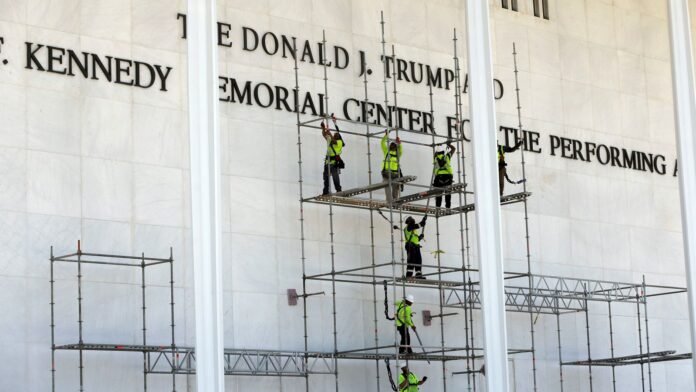
- Workers completed the name removal overnight Friday into Saturday after a brief extension was granted due to thunderstorms
- Both a lower court and an appeals court rejected last-minute requests to pause the order
What Happened
The saga began in December 2025, when Donald Trump’s newly installed board of trustees voted to add his name to the exterior of the Kennedy Center, renaming it the Donald J. Trump and John F. Kennedy Memorial Center for the Performing Arts. The change was made without any congressional authorization and was applied to the building’s facade, website, and official communications almost immediately after the board’s vote.
U.S. Representative Joyce Beatty of Ohio, a Democrat, subsequently filed suit challenging the renaming as illegal. The legal argument was straightforward: Congress established the Kennedy Center by law in 1964 as a living memorial to the recently assassinated President John F. Kennedy, and that same statute makes clear that only Congress may alter the institution’s formal name.
U.S. District Judge Christopher Cooper agreed. In a sweeping 94-page decision issued on Kennedy’s birthday last month, Cooper wrote that the Kennedy Center’s organic statute “makes crystal clear that the Center is to be named for President Kennedy, and it cannot bear any other formal name or public memorial based on the Board’s unilateral say-so.” He gave the board 14 days to remove Trump’s name from the building, grounds, and website.
The board — all members of which were handpicked by Trump after he gutted the previous leadership in the early days of his second term — filed a last-minute appeal and also sought an emergency stay. Both were denied. An appeals court panel that included a Trump appointee, Judge Gregory Katsas, rejected the stay request late Friday without explanation. Trump blasted the ruling on Truth Social, suggesting he had little interest in continuing what he called a “hopeless journey” to transform the institution. Workers nonetheless began the physical removal in the early hours of Saturday morning, completing the task before a noon deadline granted to account for thunderstorms that had delayed earlier work.
By Saturday, Matt Floca, the Kennedy Center’s executive director and chief operating officer, filed a notice with the federal court confirming full compliance. A tarp obscured the scaffolding from public view, but onlookers who gathered outside reported a marked symbolism to the moment.
Why It Matters
The Kennedy Center ruling is significant far beyond the realm of arts policy. It represents a direct judicial rebuke of the Trump administration’s practice of using board appointments and executive control to reshape major federal institutions without congressional involvement. The administration has pursued similar strategies across a range of agencies and bodies, and courts have increasingly been asked to adjudicate the boundaries of that authority.
The case also touches on fundamental questions about memorialization and the separation of powers. Congress created the Kennedy Center by statute and named it for a slain president. The court’s ruling affirms that this kind of legislative naming decision cannot be undone through an administrative board vote, no matter who appoints that board. That principle has implications well beyond this specific building.
For Trump’s political brand, the removal is an image problem. The spectacle of workers stripping his name from a building under court order — with small crowds gathering to watch — is precisely the kind of visual that opposition Democrats will use in the 2026 midterm campaign. The episode reinforces a broader narrative about the limits of executive power during Trump’s second term.
Kennedy family members reacted publicly with approval. Kerry Kennedy, daughter of the late Senator Robert F. Kennedy, praised the ruling, writing on social media that she may not need the pickaxe she had earlier suggested might be necessary to remove Trump’s name.
Economic and Global Context
The Kennedy Center itself faces a broader set of institutional challenges beyond the naming dispute. Trump’s administration moved to close the center for a multi-year renovation, a decision that prompted separate legal challenges from a coalition of cultural and historic preservation organizations. That closure threatens significant economic disruption to the performing arts ecosystem in Washington, which relies on the Kennedy Center as a primary venue and employer.
The legal costs associated with this litigation have not been publicly disclosed, but the management turmoil created by Trump’s board takeover has already disrupted the institution’s programming, fundraising, and staff operations. Cultural organizations across the country have watched the Kennedy Center saga closely as an indicator of how far executive power can reach into federally chartered institutions.
Internationally, the episode has attracted attention as an example of the friction between American democratic norms and the current administration’s governing style. Foreign cultural ministries and arts organizations that partner with the Kennedy Center have expressed concern about institutional stability.
Implications
The appellate process is not over. The Kennedy Center’s board filed a notice of appeal, and the question of whether Trump’s name can be permanently kept off the building will continue to be litigated. If an appellate court ultimately sides with the board, the name could theoretically return. However, legal observers note that the statutory case against the renaming appears strong, and an appellate reversal would require the court to find that Congress’s naming statute was somehow ambiguous.
For the Trump administration, the ruling creates a strategic decision: continue fighting in court for a symbolic victory or accept the loss and move on. Trump’s social media post suggesting he may wash his hands of the renovation project could indicate the latter, but his history of protracted legal battles suggests the former is equally likely.
For congressional Democrats, the case provides a template for challenging executive overreach into federally established institutions. Rep. Beatty’s legal strategy — using the institution’s own founding statute against the administration’s actions — proved effective and will likely be replicated in other contexts.
For Americans watching Washington, the Kennedy Center drama serves as a reminder that the judiciary remains a functional check on presidential power. Despite significant pressure from the administration, federal judges appointed by presidents of both parties have shown consistent willingness to enforce statutory limits.
Sources
“Trump’s name is fully removed from Kennedy Center, official tells judge”