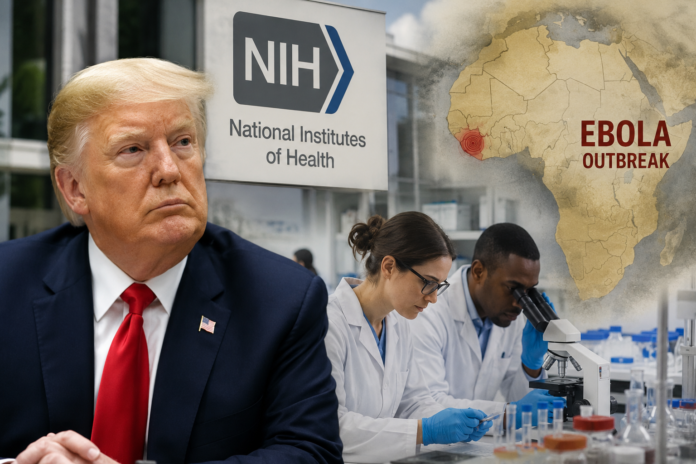
The Trump administration’s arrest and prosecution of two National Institutes of Health virologists on smuggling charges has triggered growing concern among scientists who see the case as part of a broader pattern of federal retaliation against researchers, even as the world confronts one of its most severe Ebola epidemics in recent memory. The prosecutions began after conservative commentators and a Republican senator pushed for action against the researchers, raising questions about whether political pressure influenced a criminal case with significant implications for public health infrastructure. Colleagues warn the arrests could deter urgently needed field research into dangerous emerging pathogens.
Story Highlights
- NIH researchers Vincent Munster and Claude Kwe were charged in June with smuggling mpox specimens into the U.S. and lying to border agents
- The arrests followed public pressure from commentator Laura Loomer and a letter from Montana Senator Tim Sheehy calling for investigation
- FBI testing confirmed the viral specimens were inactivated, though prosecutors say the scientists still endangered public safety
- The arrests come as the World Health Organization has declared an Ebola outbreak in the Democratic Republic of Congo and Uganda a Public Health Emergency of International Concern
What Happened
Federal authorities arrested Vincent Munster, chief of the Virus Ecology Section at the National Institutes of Health’s Rocky Mountain Laboratory in Hamilton, Montana, and Claude Kwe, a research fellow in Munster’s section, on June 2 on charges of conspiracy to smuggle mpox specimens into the United States and making false statements to federal border agents. The two researchers, whose work focuses on tracking how emerging viral pathogens cross species barriers, were stopped January 25 at Detroit Metropolitan Airport upon returning from field research in the Republic of Congo, where they had spent nine days investigating a viral outbreak.
According to the criminal complaint filed by the U.S. Attorney’s Office for the Eastern District of Michigan, Customs and Border Protection officers observed the two men traveling with a large black case that Munster told officers contained diagnostic equipment. Subsequent investigation revealed the case actually held 113 vials in Styrofoam coolers. Of the vials the FBI has tested, seventeen contained inactivated monkeypox virus, one contained chickenpox virus, and two contained only human DNA. U.S. Attorney Jerome Gorgon Jr. stated at the announcement of charges, “These NIH experts apparently broke our laws by smuggling viral pathogens on a packed commercial airplane from an outbreak in the Republic of Congo. Let that sink in.”
Notably, FBI testing confirmed that Munster, who helped develop the very inactivation technique used to render the specimens harmless, had ensured the samples posed no live biological threat. Daniel Jernigan, a virologist who worked at the CDC for 26 years and formerly led its National Center for Emerging and Zoonotic Infectious Diseases, said that if the samples were genuinely inactive, “the risk is zero,” though he noted proper documentation for such transport remains legally required. Jernigan said he recalled reprimands issued for similar documentation lapses in the past but knew of no prior arrests over comparable conduct.
The path to prosecution began with public pressure campaigns rather than a standard law enforcement referral. Conservative commentator Laura Loomer posted publicly on May 17 questioning why Munster, a Dutch citizen, and Kwe, a Cameroonian citizen, “weren’t imprisoned or deported,” suggesting the pair were about to “unleash Ebola in America.” Within a week and a half, Montana Republican Senator Tim Sheehy sent a letter to the Department of Health and Human Services calling for an investigation, characterizing the researchers’ alleged conduct as a potential national security threat. Munster and Kwe were formally charged days after Sheehy’s letter. Arizona Republican Representative Paul Gosar subsequently cited the charges as justification for closing the Hamilton research facility entirely, part of his broader push to defund what he termed “Fauci-era programs.”
Why It Matters
The prosecution of Munster and Kwe arrives at a moment of acute global public health urgency, as the World Health Organization has declared the ongoing Ebola-Bundibugyo outbreak in the Democratic Republic of Congo and Uganda a Public Health Emergency of International Concern, with approximately 300 suspected cases and at least 88 confirmed deaths concentrated primarily in eastern DRC’s Ituri province, alongside travel-linked spread into Uganda. Scientists specializing in exactly this kind of field research argue that researchers like Munster play an indispensable role in identifying the animal sources of dangerous pathogens before they spread more widely among human populations.
For the broader scientific community, the case has become a flashpoint symbolizing what many researchers view as an emerging pattern of federal retaliation against scientists associated with pandemic-era virus research. Stanley Perlman, a virologist at the University of Iowa and longtime member of the FDA’s vaccine advisory panel, defended Munster’s work directly, stating “he’s done lots of things that needed to be done, and he does them well.” The chilling effect extends beyond the two individuals charged, as colleagues describe a climate of fear now permeating biosecurity research institutions nationwide.
For public health infrastructure specifically, the timing of these prosecutions, occurring precisely as international health authorities scramble to respond to a severe Ebola outbreak, raises questions about whether domestic political pressures are undermining the nation’s capacity to maintain robust international disease surveillance and response capabilities at precisely the moment such capabilities are most needed.
For questions of prosecutorial independence, the sequence of events, beginning with a social media campaign from a political commentator, followed swiftly by a senator’s letter and then formal charges, has raised concerns among some observers about whether political pressure rather than standard investigative processes drove the decision to pursue criminal charges rather than the administrative reprimands that similar documentation lapses have historically received.
Economic and Global Context
The Rocky Mountain Laboratories facility itself has become a target of broader political pressure beyond the individual prosecutions. The White Coat Waste Project, a self-described government watchdog group focused on ending taxpayer-funded animal testing, paid for billboards in April across seven cities hosting NIH-funded laboratories calling to “End Fauci’s Labs,” reflecting a coordinated campaign against biomedical research infrastructure associated with pandemic-era virology work more broadly.
Globally, the case has drawn attention within international scientific circles, given Munster’s standing as a leading virologist who has spent decades tracking pathogens including Ebola and, more recently, emerging strains of monkeypox virus. In 2020, Munster and his research partner and spouse Emmie de Wit won a Golden Goose Award, an honor recognizing obscure federally funded research that later proves broadly beneficial, for their earlier work on coronaviruses in camels that eventually informed antiviral treatments developed during the COVID-19 pandemic.
The broader financial and institutional stakes extend to NIH’s capacity to continue conducting the kind of international field research that has historically allowed American scientists to identify emerging pathogen threats at their source, before those pathogens spread more widely, a capability global health officials consider essential to pandemic preparedness.
Implications
In the coming months, the criminal case against Munster and Kwe will proceed through the federal court system, with both researchers currently suspended from Rocky Mountain Laboratories and barred from campus access pending an internal NIH investigation, according to statements from associate director Marshall Bloom to local health officials.
For the broader scientific community, the outcome of this case is likely to influence how other American researchers approach international field research involving pathogen sampling going forward, potentially affecting recruitment and retention of top virology talent at a moment when such expertise is urgently needed to respond to the ongoing Ebola crisis abroad.
For congressional Republicans pushing further scrutiny of pandemic-era research programs, the case may serve as a template for additional legislative or funding actions targeting similar federal biomedical research facilities, building on Representative Gosar’s calls to close the Hamilton facility entirely.
For the Department of Health and Human Services, spokesperson Emily Hilliard maintained that the federal government “remains fully equipped to protect Americans and respond to emerging public health threats,” pointing to CDC deployment of experts both domestically and internationally in response to the current Ebola outbreak, even as questions persist about whether the prosecution of key researchers undermines that stated readiness.
Sources
American Scientists See Prosecutions as Part of Federal Campaign Against Them