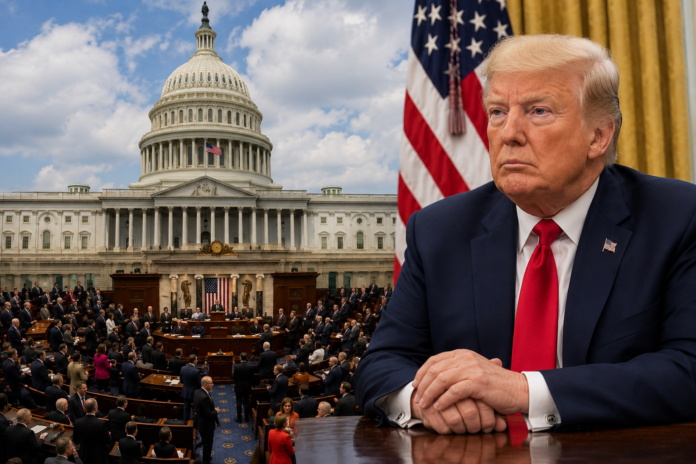
The U.S. House of Representatives voted Thursday to formally direct President Trump to end American military hostilities against Iran, marking the second such rebuke since fighting began and underscoring deepening congressional frustration with a war now stretching past 145 days. The measure passed narrowly, 214 to 208, with only four Republicans crossing party lines, while a companion Senate effort failed hours later. The vote highlights a widening rift between the White House and lawmakers over who holds the constitutional authority to wage war.
Story Highlights
The House passed a war powers resolution 214-208 directing the removal of U.S. forces from hostilities against Iran, the second such vote to succeed since the conflict began.
Republican Reps. Thomas Massie, Brian Fitzpatrick, Tom Barrett, and Warren Davidson again crossed party lines to support the measure, as they did in June.
A parallel Senate effort failed 47-49 later Thursday, and the resolution is not legally binding since it was not presented to the president for signature.
What Happened
The House approved a war powers resolution Thursday introduced by Democratic Rep. Pramila Jayapal, directing President Trump to remove U.S. Armed Forces from hostilities against Iran. The measure passed 214 to 208, with the same four Republicans who supported a similar resolution in June again breaking with their party: Massie of Kentucky, Fitzpatrick of Pennsylvania, Barrett of Michigan, and Davidson of Ohio. All argued that continued fighting, now well past the 60-day window set by the War Powers Resolution of 1973, requires explicit congressional authorization Trump has not sought.
The vote came just days after four U.S. service members were killed in the Middle East, an event Democrats said galvanized renewed momentum after previous attempts had failed. This marked the House’s fifth vote on legislation to curb Trump’s military actions in Iran, but only the second time such a measure has successfully passed either chamber. A similar resolution cleared the House in June, though it likewise carried no binding legal force.
Hours after the House vote, Senate Democrats attempted to advance their own version, but the effort failed 47 to 49, falling short of the support needed to proceed. The Senate had approved a similar resolution the previous month, only to reverse course on a follow-up measure after Trump publicly criticized the initial vote, illustrating the fragile coalition behind congressional efforts to restrain the war.
Speaker Mike Johnson defended the administration’s approach, saying it remains essential for the war’s objective, preventing Iran from acquiring a nuclear weapon, to be completed, and he called on U.S. allies to assist given the global stakes. Democratic Rep. Gregory Meeks, ranking member of the House Foreign Affairs Committee, announced he would file a separate resolution allowing him to pursue legal action against the administration for not complying with the June resolution, signaling the fight over war authority is far from over.
Why It Matters
The repeated passage of war powers resolutions, even without binding legal force, represents a significant rebuke of presidential war-making authority from a Congress that has rarely challenged a sitting president on military matters. Because these are concurrent resolutions rather than joint resolutions, they are not sent to the president for signature and carry no enforcement mechanism, but their political weight has grown as casualties mount and public support for the war weakens.
For American voters, the standoff raises fundamental constitutional questions about which branch controls decisions to send troops into sustained combat. The Constitution grants Congress the power to declare war, yet presidents of both parties have historically stretched executive authority to conduct extended military operations without a formal declaration, a tension now playing out publicly in back-to-back House votes.
For lawmakers, the votes carry political risk and reward in roughly equal measure. The four House Republicans who crossed party lines face potential primary challenges for breaking with Trump, while Democrats see the resolutions as rare leverage to force public accountability on a war that has already claimed American lives without a formal declaration of hostilities.
Economic and Global Context
The war’s toll continues to grow more than 145 days after fighting began, with American service members among the casualties and no clear resolution in sight. Meeks’s plan to pursue legal enforcement of the earlier resolution reflects a broader effort by congressional Democrats to use the courts as a check on executive war powers when legislative measures alone prove insufficient.
Internationally, the war has strained relationships with allies asked to assist in ensuring Iran does not acquire nuclear weapons, even as the conflict’s economic costs, including disruptions to global oil markets and shipping routes, continue to mount. The lack of a clear endgame has fueled skepticism on Capitol Hill among members of both parties.
The Senate’s inconsistent voting pattern, approving a resolution one month and rejecting a follow-up after presidential pressure, illustrates how political dynamics rather than fixed principle are driving congressional response, complicating any sustained bipartisan effort to formally check the administration’s military decisions.
Implications
In the near term, expect continued symbolic votes in the House as Democrats seek to keep pressure on the administration ahead of the August recess, even though such measures lack the force of law absent Senate concurrence and presidential signature. Meeks’s threatened legal action could set up a novel court test of how far Congress can go to enforce its own war powers resolutions against a resistant executive branch.
For the four Republican defectors, continued votes against the administration’s war posture will likely intensify scrutiny from Trump-aligned primary challengers, testing whether principled objections to executive war-making can survive the political pressures of a midterm election year.
For the broader public, the unresolved standoff leaves the fundamental question of congressional war authority unanswered heading into what could be a prolonged conflict, with American troops continuing to face risk in a war Congress has now twice voted to end without practical effect.
Sources
“For a 2nd time, House approves resolution to end the war in Iran in a rebuke to Trump”