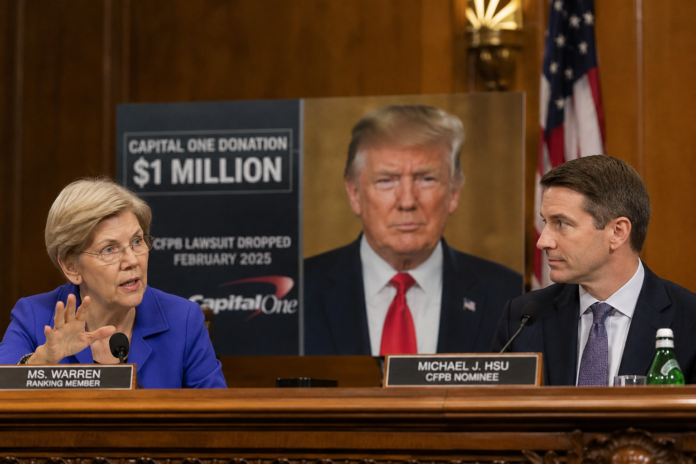
Senate Banking Committee ranking member Elizabeth Warren pressed President Trump’s nominee to lead the Consumer Financial Protection Bureau on Thursday over his continued financial ties to Capital One, just months after the agency dropped a $2 billion enforcement action against the bank following a large donation to Trump’s inaugural committee. The confirmation hearing exposed sharp partisan divides over the nominee’s independence and the bureau’s future under an administration that has moved to significantly shrink its power.
Story Highlights
Nominee Brian Johnson remains employed and paid by Capital One while seeking confirmation to lead the CFPB, the agency that regulates the bank.
The CFPB dropped a $2 billion lawsuit against Capital One in 2025, about a month after the company donated $1 million to Trump’s inaugural committee.
Johnson signed an ethics agreement to recuse himself from Capital One matters for two years and divest his stock within 90 days if confirmed.
What Happened
Brian Johnson, President Trump’s nominee to direct the Consumer Financial Protection Bureau, appeared before the Senate Banking Committee Thursday for a confirmation hearing that grew contentious over his ongoing financial relationship with Capital One. Johnson has served as a vice president and compliance officer at the bank since November 2024 and previously worked as deputy director of the CFPB during Trump’s first term. Committee Democrats, led by ranking member Elizabeth Warren of Massachusetts, focused on a January 2025 lawsuit the CFPB filed against Capital One, alleging the bank misled customers out of more than $2 billion in interest on savings accounts, a lawsuit the agency dropped roughly a month after Capital One donated $1 million to Trump’s inaugural committee.
Warren asked Johnson directly whether he would commit to notifying Congress and the CFPB’s inspector general if the White House ever pressured him regarding an enforcement action involving a Trump family business or major political donor. Johnson declined to make that commitment, telling Warren he disputed the premise of the question and was not aware of any such interference occurring during his earlier tenure at the bureau. When Warren pointed out that Capital One continues paying Johnson’s salary even as he testified, Johnson responded he was appearing in his “personal” capacity, a characterization Warren met with visible skepticism.
Ahead of the hearing, Johnson signed an ethics agreement pledging to recuse himself from any CFPB matters involving Capital One for two years if confirmed, and to divest any Capital One stock within 90 days, while agreeing to forfeit unvested restricted stock units from the company. Warren had separately written to Capital One CEO Richard Fairbank requesting copies of any correspondence between Johnson and the CFPB regarding the decision to drop the lawsuit, seeking to determine whether Johnson played any role in the bank avoiding accountability for the alleged misconduct.
Warren also noted during the hearing that the CFPB under acting Director Russell Vought has dropped 42 enforcement cases since Trump returned to office, including actions against several other major companies that had also donated to Trump’s inauguration, among them Apple, Bank of America, JPMorgan Chase, Toyota, Walmart, and Meta. Democrats separately pressed Johnson on whether he intended to continue Vought’s efforts to shrink or dismantle the agency, questions Johnson largely avoided answering directly.
Why It Matters
The hearing raises fundamental questions about regulatory independence and the potential for financial industry influence over an agency created to protect consumers from predatory banking practices. The CFPB was established after the 2008 financial crisis with the explicit purpose of policing exactly the kind of conduct Capital One was accused of, making Johnson’s continued financial ties to a regulated entity a significant concern for consumer advocates.
For American consumers, the pattern of dropped enforcement actions against companies that donated to Trump’s inauguration, now totaling 42 cases, suggests a broader shift in how aggressively the bureau pursues accountability against politically connected corporations, with direct implications for the roughly $2 billion in disputed interest payments Capital One customers may never recover.
For policymakers, the episode highlights the so-called revolving door between financial regulators and the industries they oversee, a dynamic Warren specifically flagged as Johnson’s “second pass through the revolving door” between the CFPB and private financial firms, raising questions about whether recusal agreements alone are sufficient to prevent conflicts of interest.
Economic and Global Context
The CFPB’s enforcement retreat fits within a broader deregulatory push affecting financial services, with acting Director Vought having previously called for shrinking or eliminating the agency altogether. The bureau’s reduced enforcement posture could have material effects on consumer costs across banking, lending, and credit markets if predatory practices go unchecked.
Capital One’s $1 million donation to Trump’s inaugural committee, followed by the dismissal of a lawsuit alleging over $2 billion in consumer harm, has drawn comparisons to similar patterns involving other major donors whose CFPB cases were also dropped, raising questions among watchdogs about whether campaign contributions are effectively purchasing regulatory relief.
Financially, the potential weakening of the CFPB carries implications beyond individual cases, since the bureau has historically returned billions of dollars to consumers through settlements across banking, mortgage, and credit card industries, funds that would otherwise remain unrecovered under a diminished enforcement regime.
Implications
In the coming weeks, the Senate Banking Committee will need to schedule a vote on Johnson’s nomination, and Democrats are likely to keep pressing for documentation from Capital One regarding Johnson’s role in the dropped lawsuit before any vote proceeds. Warren’s requests to CEO Richard Fairbank remain outstanding and could shape the timeline for further Senate action.
For consumer advocacy groups, the hearing reinforces concerns that the CFPB’s independence is eroding under the current administration, a dynamic likely to fuel continued oversight requests and public pressure campaigns regardless of whether Johnson is ultimately confirmed.
For the broader financial industry, the case illustrates the potential benefits of political donations in securing favorable regulatory treatment, a dynamic likely to draw continued scrutiny from ethics watchdogs and could shape how other regulated industries approach political giving heading into the 2026 midterms.
Sources
“Warren clashes with Trump CFPB nominee over potential conflicts of interest”