Story Highlights
- General Randy George, the Army’s 41st Chief of Staff, was ordered to retire immediately with no public explanation
- Gen. David Hodne, commander of Army Transformation and Training Command, and Maj. Gen. William Green Jr., Army Chief of Chaplains, were also dismissed
- The firings followed a day after Trump’s national address signaling intensified strikes on Iran
What Happened
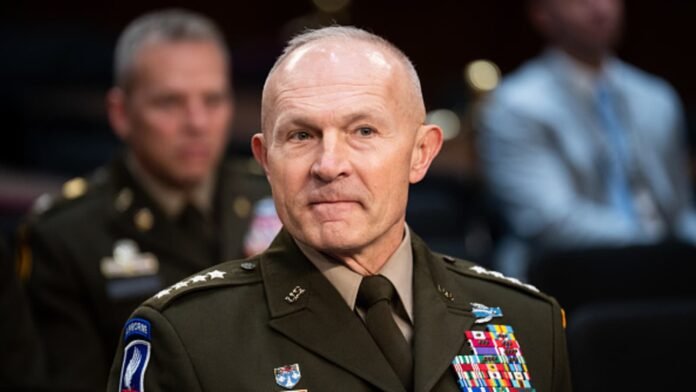
Defense Secretary Pete Hegseth on April 2 ordered Gen. Randy George, the Army’s 41st Chief of Staff and a 38-year Army veteran, to retire immediately from his position. Pentagon spokesman Sean Parnell confirmed the departure in a statement on social media, writing that George “will be retiring from his position as the 41st Chief of Staff of the Army effective immediately” and that the department was “grateful for General George’s decades of service.” No reason for the dismissal was provided.
Simultaneously, Hegseth removed Gen. David Hodne, the commander of Army Transformation and Training Command, and Maj. Gen. William Green Jr., the Army’s Chief of Chaplains. Green had been only recently promoted to his current rank and had served as an Army chaplain since the 1990s. Gen. Christopher LaNeve, the Army’s vice chief of staff, was named as acting chief of staff to ensure continuity of operations.
George’s dismissal came one day after President Donald Trump addressed the nation on the Iran war, signaling that the United States would intensify its strikes against Iranian targets. George had served as Army chief since September 2023, having been nominated by then-President Biden. His proximity to the Biden administration was widely cited within Pentagon circles as a factor in Hegseth’s decision, though no official explanation was given.
The removals represent the most extensive wartime shakeup of Army leadership since the Vietnam era. George previously served as the senior military assistant to Defense Secretary Lloyd Austin during the Biden administration, a role considered among the most demanding and apolitical in the military establishment. His career included combat deployments in the Gulf War, Iraq, and Afghanistan.
Why It Matters
The firing of a sitting Army chief of staff during active combat operations is extraordinary. It raises immediate questions about the chain of command during ongoing missions, the continuity of planning and doctrine during a live conflict, and the criteria by which the administration evaluates senior military leadership. Congress received no advance briefing. Multiple members of the Armed Services committees from both parties expressed alarm.
Rep. Don Bacon of Nebraska, a retired Air Force brigadier general and Republican, told Hegseth at the April 29 hearing: “We had a huge bipartisan majority here that had confidence in the Army chief of staff and the secretary of the navy. And I would just point out it may be constitutionally right … but it doesn’t make it right or wise.” The comment was unusual in its directness, coming from a member of the president’s own party.
For military personnel and veteran communities, the firings carry a different kind of weight. General George was viewed within the Army as a deeply respected, apolitical officer focused on modernization and readiness. His removal — with no stated reason, during wartime, via a press statement on X — sends a message to the officer corps that proximity to the previous administration or insufficient political loyalty to the current one may be disqualifying even for the most decorated and experienced commanders.
The firings continue a pattern that began early in Trump’s second term with the dismissal of Gen. Charles “CQ” Brown Jr. as chairman of the Joint Chiefs of Staff and the removal of Adm. Lisa Franchetti, the Navy’s top uniformed officer. Navy Secretary John Phelan also stepped down. In aggregate, the administration has removed more than two dozen senior military and civilian leaders from the Pentagon.
Economic and Global Context
The leadership shakeup occurs at a moment of acute military strain. The Iran war has depleted significant quantities of precision munitions, including long-range stealth missiles and Patriot interceptors, which must be replenished through domestic production that typically operates on multi-year timelines. The Army’s Transformation Initiative, which George had been leading, was designed to restructure the service for large-scale combat operations — exactly the kind of operations now underway.
George’s initiative had created new commands and modernized weapons systems and doctrine ahead of anticipated near-peer conflict scenarios with China or Russia. Disrupting that institutional process mid-war, critics argue, creates unnecessary turbulence in a service already under significant operational pressure. The Army has approximately 13,000 service members assigned to the Middle East theater.
Military analysts note that adversaries closely track U.S. leadership stability. The removal of the Army chief of staff with no explanation during an active conflict provides intelligence services in Iran, China, and Russia with a signal about internal military-civilian relations at the Pentagon. Whether that signal is read as strength or dysfunction is debated, but the lack of transparency around the firings is itself a strategic message.
The Trump administration is simultaneously seeking $1.5 trillion in defense spending for fiscal year 2027 — arguing that the military needs transformational investment. Critics note the irony of seeking record defense spending while simultaneously dismissing the general officers responsible for managing and modernizing the force.
Implications
Congress is expected to press for clearer explanations of the firing criteria being applied to senior military officers. The bipartisan discomfort expressed at the April 29 hearing suggests that the issue will not go away. Some members have indicated they want a classified briefing on what specific concerns prompted the dismissals.
For the Army itself, the selection of Gen. LaNeve as acting chief is notable. LaNeve gained President Trump’s attention on Inauguration Day when he called into the Commander in Chief’s Ball from South Korea, earning praise from Trump as “central casting.” That episode illustrates the implicit loyalty standard that appears to influence Pentagon personnel decisions under the current administration.
For the broader military institution, the cumulative weight of more than two dozen leadership removals since Trump took office is affecting recruiting, retention, and officer culture in ways that will take years to assess. Former defense officials have warned that the purges are hollowing out the institutional memory and doctrinal continuity that make the military effective over sustained campaigns.
Sources
“Hegseth ousts US Army chief of staff and two other generals amid Iran war”