Story Highlights
- The roughly $70 billion bill would fund ICE and the Border Patrol for three years, through the end of Trump’s current term
- Democrats launched amendments Thursday morning, including one to eliminate Trump’s controversial $1.776 billion anti-weaponization settlement fund
- Republicans are using budget reconciliation to bypass the Senate’s 60-vote filibuster threshold, allowing passage with a simple majority
What Happened
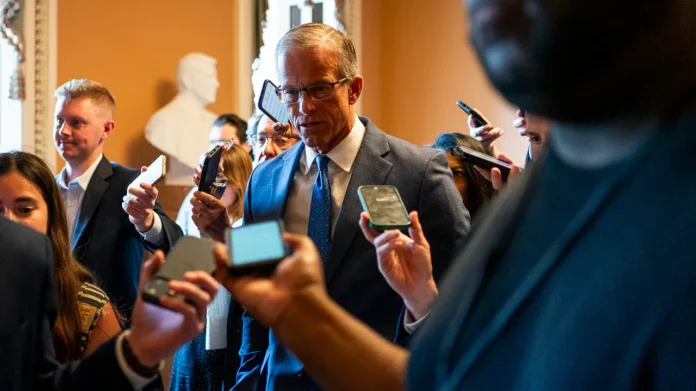
The Senate moved Thursday into a lengthy amendment process on legislation to fund President Donald Trump‘s immigration enforcement agencies, with both parties digging in for what is expected to be a prolonged floor fight. The roughly $70 billion measure would finance ICE and the Border Patrol through the end of Trump’s second term — a three-year funding commitment that Republicans framed as essential to continuing the administration’s immigration crackdown.
Senate Majority Leader John Thune of South Dakota told reporters Wednesday evening that the bill was designed to be “narrow and targeted” and that Republicans were focused on keeping it that way. Democrats, however, had other plans. Their opening amendment Thursday morning was a motion to eliminate Trump’s $1.776 billion anti-weaponization settlement fund and return the immigration spending bill to committee — a procedural maneuver designed to either kill the bill or force Republicans to publicly defend the fund.
The political backdrop to the vote is significant. Funding for ICE and the Border Patrol lapsed in mid-February after Democrats refused to approve it without new constraints on immigration enforcement tactics. Their demands came in the aftermath of two deadly incidents: the January 7 fatal shooting of Renee Good and the January 24 fatal shooting of Alex Pretti, both American citizens killed by federal immigration agents in Minneapolis. Democrats insisted that ICE and Border Patrol be subject to the same operational rules as local law enforcement.
Negotiations between the parties collapsed. Congress eventually funded the rest of the Department of Homeland Security in late April with bipartisan support, but ICE and Border Patrol remained without regular appropriations. Republicans then pursued a separate reconciliation path — a budget procedure that requires only a simple majority rather than the 60 votes needed to overcome a filibuster — to fund the two agencies without any Democratic input.
Acting Attorney General Blanche told senators this week that the anti-weaponization fund would not move forward, easing some Republican anxieties about the bill. But Trump complicated matters Wednesday by telling reporters the fund was “very important” and that he was uncertain whether it was dead. That equivocation prompted Senate Minority Leader Chuck Schumer to announce Democrats would press ahead with their amendment to ban the fund by law.
Why It Matters
The fight over ICE and Border Patrol funding goes well beyond a line-item budget dispute. It represents a fundamental clash over the scope and accountability of federal immigration enforcement. Democrats have argued for months that ICE and the Border Patrol operate with inadequate oversight, and the Minneapolis shootings — which prompted protests and a lawsuit by the state of Minnesota — gave those arguments a visceral, human dimension that traditional budget fights rarely carry.
For the Trump administration, the bill is central to its core policy identity. The president made immigration enforcement the defining issue of both his 2024 campaign and his second term. Sustaining ICE and the Border Patrol at full funding through 2029 would insulate those agencies from the kind of political disruption that has characterized the past several months of government funding battles.
The reconciliation strategy reflects a broader governing reality of Trump’s second term: bipartisan cooperation on contentious issues is essentially unavailable. Republicans have increasingly turned to procedural shortcuts to advance their agenda, accepting the tradeoff of legislative fragility and limited democratic input in exchange for speed and partisan clarity. Democrats, for their part, have used every available procedural tool to slow or stop legislation they oppose.
The vote also has midterm implications. Republicans face a competitive political environment heading into November 2026, and their ability to demonstrate control over the immigration agenda is central to their electoral strategy. Democrats, meanwhile, have made the ICE shootings and enforcement accountability a key part of their message to voters — particularly in suburban districts where concerns about both immigration and government overreach tend to overlap.
Economic and Global Context
The prolonged funding gap for ICE and the Border Patrol had tangible economic consequences. The partial shutdown of DHS created significant disruptions at major U.S. airports, where TSA staffing shortages led to hours-long security lines. Trump addressed the TSA problem through an executive order authorizing emergency pay, but officials warned repeatedly that a long-term funding resolution was necessary to stabilize agency operations.
The broader DHS shutdown — the longest agency shutdown in American history — affected roughly 260,000 federal employees across the Transportation Security Administration, the Coast Guard, FEMA, and other operations. Many workers endured weeks of pay uncertainty. Some quit. The economic cost of the staffing instability extended beyond individual employees to the airlines, hospitality industry, and cargo sectors that depend on reliable federal security operations.
From a border enforcement perspective, the funding uncertainty also disrupted planning and hiring at both ICE and the Border Patrol. Immigration attorneys and advocacy groups reported confusion and inconsistency in detention practices during the gap period. Foreign governments watching U.S. border policy closely — particularly Mexico and the countries of Central America whose nationals make up the majority of immigration enforcement encounters — adjusted their own diplomatic postures based on signals from Washington.
A fully funded, three-year ICE and Border Patrol operation would give the administration a stable financial and operational base for continued enforcement. That stability, however, comes without the accountability guardrails Democrats demanded, leaving unresolved questions about oversight that are unlikely to disappear from the political conversation.
Implications
If the bill clears the Senate through reconciliation and is signed into law, the Trump administration will have secured uninterrupted funding for its two primary immigration enforcement agencies through the remainder of his term. That outcome would represent a significant legislative victory and likely accelerate enforcement operations, including deportations and detention programs, into 2027 and 2028.
For Democrats, a defeat on the amendment strategy would not end the political debate. The Minneapolis shootings remain an open wound — Minnesota’s lawsuit against the administration is ongoing, and the prospect of additional incidents will continue to fuel demands for accountability. Democrats are unlikely to abandon the issue before the midterms, even if they fail to legislate restrictions.
For the families of Renee Good and Alex Pretti, and for the communities most affected by aggressive immigration enforcement, the passage of this bill without any new oversight provisions would signal that Congress is unwilling to constrain the agencies responsible for those deaths. That signal carries political weight in communities where distrust of federal law enforcement is already high.
Senate Republicans who privately favor some form of guardrails on ICE and the Border Patrol — several voted for Democratic amendments in prior rounds — will now face fresh pressure to stay in line. With two Republicans already opposed to the bill itself, the margin for defection remains narrow, and any additional Republican votes against final passage could sink the measure.
Sources
“Senate begins voting on bill to fund ICE, Border Patrol as Democrats try to derail it”