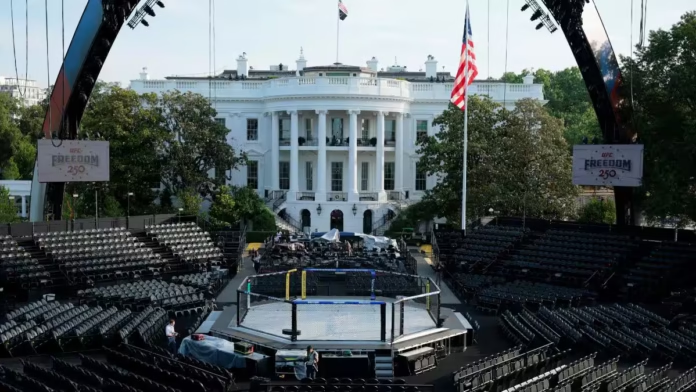
Story Highlights
- Federal court filings confirm the UFC Freedom 250 event will cost more than $60 million, involve over 900 contractors, and require support from at least seven federal agencies
- The Public Integrity Project filed a lawsuit calling the event “deeply corrupt,” alleging improper permitting and failure to undergo an environmental review
- More than 125,000 guests are expected across the White House grounds and the nearby Ellipse, with 4,000 spectators attending on the South Lawn itself
What Happened
The extraordinary scale of the UFC Freedom 250 event at the White House came into full public view this week when the federal government filed detailed court documents defending the spectacle against a legal challenge. The filings, submitted by the National Park Service and other federal entities, described the event as “a highly complex, multi-faceted Event that has been carefully planned by a multitude of public and private entities over a significant period.” Among the disclosures: more than $60 million expended, tens of thousands of hours of labor, participation from at least seven federal agencies, and a crowd projection exceeding 125,000 people across the event’s footprint.
President Donald Trump announced the fight at an Iowa state fairgrounds appearance in June 2025, billing it as a celebration of America’s 250th anniversary of independence. The event was subsequently branded as part of the broader America 250 initiative and tied to Flag Day — which also happens to be Trump’s 80th birthday. UFC president Dana White, a long-standing Trump ally and major donor, confirmed the event alongside other details, including that fighters would walk to the octagon from the Oval Office and that replacement of the White House South Lawn grass alone would cost approximately $700,000.
The legal challenge was filed by the Public Integrity Project, representing a Vietnam veteran and political activist. The lawsuit argues the Trump administration improperly used a temporary permitting rule created for America 250 celebrations to bypass the standard National Park Service permitting process, which would normally apply to an event of this scale on federal land. The plaintiffs further allege the event fails to qualify under the America 250 exemption because it is organized by a private entity — the UFC — rather than the federal government, and is not explicitly dedicated to commemorating American independence.
The Justice Department dismissed the case as “a desperate last-ditch attempt to attack the celebration of America’s 250th Birthday by people who hate fun.” A Trump administration official called the lawsuit “obstructionist, baseless, and dilatory” and said the event would become “one of the most historic sporting events in our Nation’s history.” U.S. District Judge Amit P. Mehta had not set a hearing as of Thursday, leaving the legal status in flux with fight night days away.
TKO Group Holdings, the UFC’s parent company, separately confirmed it expects to spend roughly $60 million on the event, with corporate partner investments expected to offset approximately half of that figure. TKO’s president and chief operating officer Mark Shapiro said the promotion would not profit from the event, framing it as a long-term brand investment.
Why It Matters
The White House UFC event sits at the intersection of several accountability questions that have defined scrutiny of the Trump administration. The central issue is whether public resources and public land are being appropriated to benefit a private company with deep financial ties to the president and his allies, without the legal and environmental safeguards that would normally govern such use. The National Park Service’s South Lawn is federal property maintained by taxpayers, and the exemptions invoked to authorize the event were created to facilitate national anniversary events — not commercial sporting promotions.
The $60 million price tag — even if not drawn entirely from public funds — raises additional questions about how federal agencies have coordinated and contributed to an event that primarily serves the promotional interests of a private entity and the political brand of a sitting president. The involvement of at least seven federal agencies in staging the fights suggests a level of government resource commitment that goes well beyond what any previous administration has devoted to a single commercial sporting event.
For government accountability advocates, the case also tests whether courts will apply meaningful scrutiny to presidential actions taken under loosely defined emergency or anniversary authorities that may be stretched beyond their intended purpose.
Economic and Global Context
The UFC has experienced significant financial growth in recent years, and the White House event represents an unprecedented marketing opportunity for the sport on both a national and global stage. TKO Group Holdings’ assessment that the $60 million outlay constitutes an “investment” in earned media reflects the estimated broadcast and promotional value of staging a major fight card on the White House grounds — exposure that commercial advertising expenditures could never replicate.
For the surrounding Washington, D.C. economy, an event drawing more than 125,000 visitors over the weekend represents a windfall for local hospitality, food service, and retail businesses. Hotels in the capital region were reportedly sold out for the weekend well in advance, and the economic activity generated is expected to be substantial. Local governments and businesses in the District have generally supported the event on economic grounds even while some cultural and civic organizations have raised objections.
The 494 portable toilets, hundreds of trucks, and extensive security infrastructure required for the event also represent significant contracts flowing to private vendors — economic activity that, depending on procurement practices, may or may not have followed normal competitive bidding processes.
Implications
If the lawsuit fails and the event proceeds Sunday as planned, the administration will have successfully used the America 250 framework as a permitting bypass mechanism for a major commercial event, establishing a precedent that future administrations could invoke or challenge. The legal theory underlying the challenge — that private entities cannot use national anniversary exemptions to sidestep standard federal land-use requirements — is narrow but potentially significant for future event planning around federal landmarks.
For Trump personally, the event arrives on his 80th birthday and is designed to project vitality, cultural dominance, and a fusing of American patriotism with the commercial entertainment brands he favors. Its optics are deliberate: a president celebrating a personal milestone through a spectacle that doubles as a national anniversary celebration, using the literal grounds of the executive mansion as the venue.
The fight card itself features 14 athletes who have been training for months. Regardless of the legal outcome, the images of a live UFC octagon on the White House South Lawn will constitute one of the most visually striking moments of Trump’s presidency — which, by design, is precisely the point.
Sources