Story Highlights
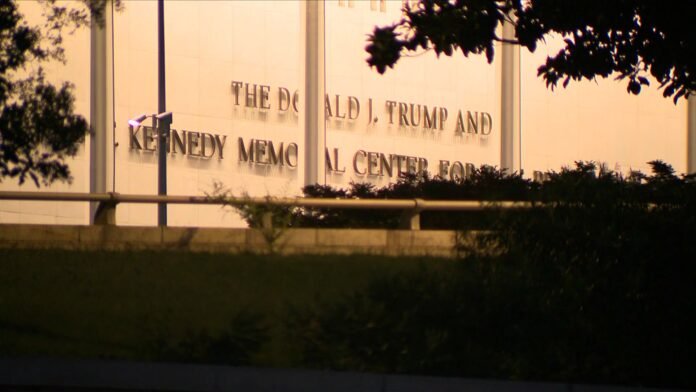
- The Kennedy Center board appealed a federal judge’s May 29 ruling ordering removal of Trump’s name from the building’s façade by June 12
- The appeal also challenges the judge’s separate order blocking a planned two-year closure of the center for renovations
- Trump’s name had already been removed from the center’s Facebook page and website before the appeal was filed
What Happened
The legal confrontation over the John F. Kennedy Center for the Performing Arts escalated sharply Thursday as the Trump-aligned board voted to appeal a ruling by U.S. District Judge Christopher Cooper that had given the institution 14 days to strip all references to President Trump from its signage, branding, and digital presence. Lawyers for the Kennedy Center filed the appeal notice with the U.S. Court of Appeals for the D.C. Circuit, simultaneously requesting a stay of Cooper’s order while the appeal plays out.
The case originated with a lawsuit brought by Democratic Representative Joyce Beatty of Ohio, who serves as an ex officio member of the Kennedy Center’s board of trustees through her congressional role. Beatty challenged the Trump administration’s December 2025 decision to rename the institution the Donald J. Trump and the John F. Kennedy Memorial Center for the Performing Arts, as well as the administration’s plans to shut down the venue for two years to carry out a major renovation project.
Cooper ruled in late May that the board had violated federal law by adding Trump’s name to the building without congressional authorization. His ruling stated plainly that Congress gave the Kennedy Center its name through statute, and that only Congress has the legal authority to change it. The board’s action, he concluded, exceeded its legal power and could not stand.
Kennedy Center lawyers argued in filings accompanying the appeal that forcing a name change “now, only to potentially revert back to the current name after appeal would be incredibly confusing for the public,” and cited the time and money that would be wasted if Trump’s name were removed and then restored following a successful appeal. Partial compliance was already underway before the appeal was filed — Trump’s name had been removed from the center’s Facebook page, YouTube channel, and website.
Trump responded to the original ruling from the Oval Office, joining a board meeting remotely and criticizing Cooper while board members passed a resolution honoring the president. He separately posted on Truth Social that without the freedom to “bring this Institution back, physically, financially, and artistically,” he had “no interest in continuing what could only be a hopeless journey into ‘NEVER NEVER LAND.'”
Why It Matters
The Kennedy Center dispute is not merely a fight over words carved in marble — it represents a broader constitutional confrontation over the limits of executive power over federally chartered institutions. The question of whether a sitting president can unilaterally rename a landmark created by Congress goes to the heart of the separation of powers, and the outcome of the appeal could set precedent applicable to other federally chartered entities far beyond the performing arts.
For the cultural community, the case carries particular weight. Dozens of artists canceled scheduled performances at the Kennedy Center following the renaming in December, citing their unwillingness to perform at a venue bearing Trump’s name. The center’s ability to book top-tier talent has been compromised during the legal standoff, creating financial and reputational damage that persists regardless of how the courts ultimately rule.
The two-year closure also blocked by Cooper’s ruling raises separate but equally significant concerns. Critics, including Beatty and outside legal challengers, argue that the administration fabricated or exaggerated the need for renovation to justify shutting down the cultural institution. Court-ordered disclosures earlier this year showed that the Kennedy Center had not consulted a single outside expert or adviser during the alleged one-year review that Trump claimed justified the closure plan.
Economic and Global Context
The Kennedy Center, as a federally chartered nonprofit, receives an annual appropriation from Congress. It also depends heavily on earned revenue from ticket sales, private donations, and event bookings. The prolonged uncertainty has disrupted the center’s financial planning. Contracts with artists, touring companies, and resident orchestras operate on lead times of months to years, and the threat of a two-year closure has forced the institution into a state of operational limbo.
Internationally, the Kennedy Center functions as a showcase for American arts diplomacy. Foreign dignitaries and cultural delegations regularly attend performances there as part of official state and diplomatic visits to Washington. Prolonged controversy over the center’s identity and governance — broadcast globally — has added an unexpected dimension to perceptions of the Trump administration’s relationship with American cultural institutions and democratic norms.
Implications
The D.C. Circuit Court of Appeals now faces a high-profile, politically charged case with few clear precedents. Courts have historically been reluctant to intervene in disputes between coordinate branches over symbolic matters, but the statutory clarity of the Kennedy Center’s enabling legislation gives the judiciary a firm textual hook. If the appeals court upholds Cooper’s order and denies a stay, physical removal of Trump’s name from the building’s marble façade could begin as early as this weekend.
If a stay is granted, the legal fight could extend for months or years, keeping the institution in an uncertain state. Either outcome has implications for how courts handle future presidential attempts to reshape federally chartered institutions through unilateral board action. Congress, notably, has remained largely passive in the dispute — declining to pass legislation that would either authorize the renaming or formally block it.
For Trump, the Kennedy Center battle fits a pattern of aggressive assertion of presidential authority over institutions traditionally insulated from direct political control. The appeal ensures this story continues into the summer, giving both sides an ongoing political flashpoint at a moment when cultural issues remain deeply polarizing among voters.
Sources