Story Highlights
- The House rejected a three-week FISA Section 702 extension in a 198-218 vote Thursday, falling well short of the required two-thirds majority
- Democrats refused to support renewal citing Trump’s installation of Bill Pulte as acting director of national intelligence, calling him unqualified and a national security risk
- Section 702 expired at midnight Friday — the first lapse in the program’s history since it was enacted in 2008
What Happened
The House voted 198-218 Thursday on a measure that would have extended Section 702 of the Foreign Intelligence Surveillance Act through July 2, buying lawmakers three additional weeks to negotiate a longer-term reauthorization. The bill failed by a substantial margin, requiring a two-thirds supermajority under the fast-track suspension of the rules procedure. Only seven House Democrats voted in favor of the extension, while 19 Republicans voted against it.
In the Senate, three separate unanimous consent requests to extend FISA authorities also failed Thursday, as individual senators objected on both sides of the aisle. With the House departing for a scheduled weeklong recess following the vote, the authority was left with no realistic path to renewal before the Friday midnight deadline. The House is not expected to vote again until at least June 23.
The proximate cause of the Democratic blockade was Trump’s appointment of Bill Pulte, director of the Federal Housing Finance Agency, as acting director of national intelligence. Democrats argued that Pulte, who has no intelligence or national security experience, was an inappropriate and potentially dangerous choice to oversee the country’s most sensitive surveillance authorities. Representative Jamie Raskin called Pulte famous for creating “personal mortgage dossiers” on Trump’s political opponents and said his appointment made it “even more obvious that he intends to use FISA to investigate, harass and persecute his political opponents.”
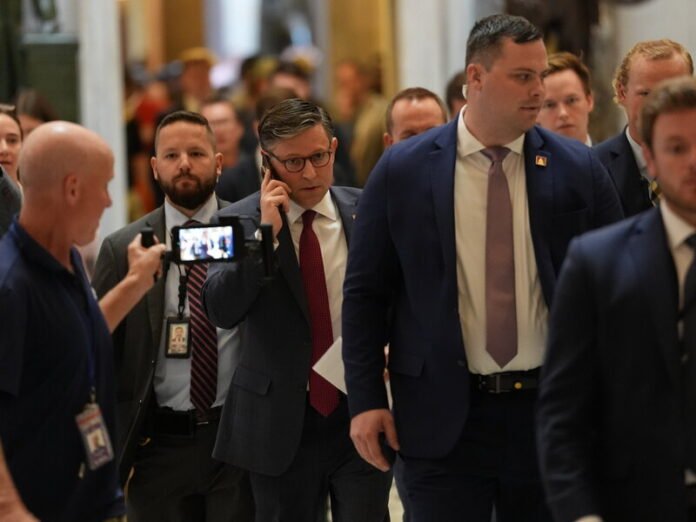
House Minority Leader Hakeem Jeffries characterized the floor vote as a “show vote” that Republicans brought forward knowing it would fail, placing blame for the expiration squarely on President Trump and Speaker Mike Johnson. Johnson, speaking to reporters after the vote, said Republicans had done “everything within our power” to prevent the lapse and accused Democrats of using the surveillance authority “as a political hostage.” Johnson declined to commit to bringing the House back from recess to vote again.
Section 702 was originally enacted in 2008 and has never been made permanent, requiring periodic reauthorization by Congress. Lawmakers last reauthorized it in April 2024, setting a sunset date of April 20, 2026. A 45-day stopgap passed April 30 pushed the final deadline to June 12, but the Senate failed a procedural vote on June 5, and the House vote Thursday sealed the program’s expiration.
Why It Matters
Section 702 permits U.S. intelligence agencies to surveil foreign targets located outside the United States without obtaining a warrant from a U.S. court. In practice, because those foreign targets often communicate with people inside the United States, the program generates substantial volumes of communications involving American citizens — a feature critics have long argued makes it a backdoor into warrantless domestic surveillance. The authority’s lapse does not immediately shut down all existing collection, but it introduces serious legal uncertainty about the government’s ability to initiate new targeting and sustain ongoing operations.
National security hawks in both parties warned in the days leading up to expiration that allowing Section 702 to lapse would create real gaps in intelligence collection. Senator Todd Young invoked a specific example: “FISA 702 enabled the Intelligence Community to disrupt a terrorist attack against a Taylor Swift concert.” With the FIFA World Cup now underway in the United States, Young and others argued the stakes of losing the authority could not be overstated.
The Pulte appointment added a dimension to this debate that went beyond standard partisan posturing. Democrats’ specific objection was that placing a figure perceived as a political operative — rather than a career intelligence professional — atop the DNI created unacceptable risks that surveillance authorities would be weaponized against domestic political opponents. That argument resonated widely enough among Democrats to hold 199 members in unified opposition, a remarkable display of caucus discipline on a vote that historically has been politically difficult to explain to constituents.
Economic and Global Context
The operational consequences of the lapse are likely to unfold quietly rather than dramatically. Intelligence agencies will not immediately lose access to data already lawfully collected under Section 702, but legal guidance from the Justice Department will govern what new collection can proceed under the program’s expired authorization. Historical precedent from previous near-lapses in surveillance authorities suggests agencies will operate cautiously, likely curtailing some new targeting while the legal situation remains unclear.
For the technology sector, the lapse introduces added uncertainty about the legal environment governing data requests from major internet platforms and telecommunications companies. Companies subject to Section 702 directives have in the past sought clarity from courts and the government before complying with new orders during legal gray periods. That uncertainty can slow intelligence timelines in ways not easily visible to the public but consequential in practice.
Implications
The expiration shifts political leverage dramatically. Democrats have now demonstrated they can block a national security priority that Republicans consider essential, using it as a lever to extract concessions on executive personnel choices. Whether that leverage succeeds depends on whether Trump retreats on Pulte’s appointment, which he had shown no sign of doing as of Friday morning.
If Trump nominates a permanent, Senate-confirmed director of national intelligence and withdraws Pulte, a rapid reauthorization when Congress returns from recess becomes plausible. If he refuses, Democrats may be content to let the lapse continue — betting that the political cost of being seen as blocking intelligence authorities is lower than the cost of handing Trump an unchecked surveillance apparatus under a politically motivated DNI.
For voters, the episode crystallizes a now-familiar dynamic of the second Trump term: major governance decisions being disrupted not by policy disagreements alone but by personnel choices that opponents argue represent corruptions of institutional integrity rather than ordinary executive prerogative.
Sources