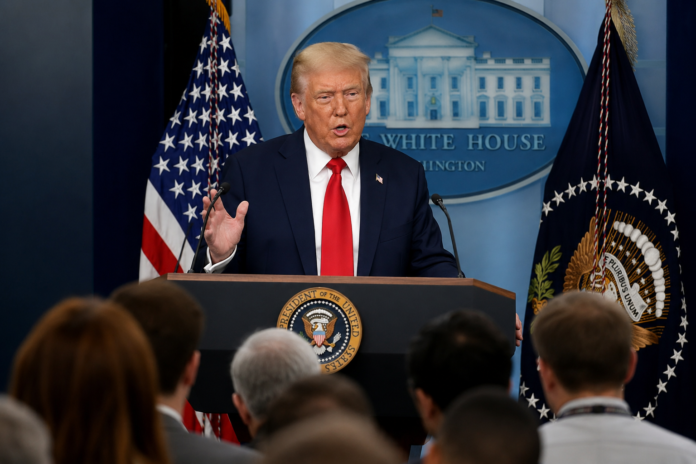
President Trump on Friday defended his Justice Department’s use of subpoenas against journalists to identify government leakers, a day after prosecutors withdrew subpoenas seeking phone records and grand jury testimony from three New York Times reporters. The episode has reignited long-running tensions between the administration and the press over the appropriate limits of government power when pursuing unauthorized disclosures. A federal judge’s sharp criticism of the government’s handling of the case forced the reversal, but Trump signaled the broader practice would continue.
Story Highlights
- The DOJ withdrew subpoenas for phone records and grand jury testimony from three New York Times reporters after a federal judge threatened to quash them
- The subpoenas came two days after the Times reported security concerns prompted Trump not to use a Qatari-donated jet on a July 8 trip
- A court filing revealed Google also received a subpoena in the same leak investigation
- Trump did not directly answer whether subpoenaing journalists’ family members is appropriate, saying “I don’t know what’s appropriate, what’s not”
What Happened
President Trump spoke to reporters in the Oval Office on Friday, defending his administration’s pursuit of government officials suspected of leaking sensitive information to journalists, one day after the Department of Justice withdrew a set of controversial subpoenas targeting three New York Times reporters. “We’re after leakers. We’re after people that are cowards, people that are unpatriotic, people that are treasonous in many cases. And the way you find them is through the journalists,” Trump told reporters.
The subpoenas at the center of the controversy sought grand jury testimony and phone records from Times journalists as part of a criminal investigation into the leak of information regarding security concerns surrounding the president’s use of a jet gifted by Qatar. According to court filings, FBI agents visited several reporters’ homes on the night of Friday, July 10, just two days after the Times published its initial story, delivering subpoenas that compelled testimony before a grand jury. The FBI additionally sought phone records for all five reporters involved in the story along with several of their family members, according to the newspaper’s own reporting.
U.S. District Judge Arun Subramanian sharply criticized the government’s handling of the case this week, questioning whether prosecutors had followed established legal standards governing the subpoena of journalists, standards that customarily treat compelling testimony from reporters as a last resort rather than an initial investigative step. Facing the judge’s indication that he would quash the subpoenas if the government did not act first, the Justice Department voluntarily withdrew them on Thursday. A separate court filing revealed that Google had also received a subpoena in connection with the same investigation, expanding the scope of the government’s effort to identify the source of the leak.
Jay Clayton, the chief federal prosecutor for the Southern District of New York and Trump’s nominee to become the next director of national intelligence, defended the department’s process, stating he had followed all appropriate policies and that the Justice Department sought “to limit to the greatest extent possible any intrusion into the operation of the free press.” However, in newly unsealed documents, the Times’ legal team argued the Justice Department had violated its own internal policies by pursuing subpoenas from reporters as an initial measure rather than a last resort, as those policies require.
When asked directly whether he believed it was appropriate to subpoena family members of journalists during leak investigations, Trump did not provide a direct answer, instead defending the broader practice. “I don’t know what’s appropriate, what’s not. We do it legally,” Trump said, drawing a comparison to the Obama administration’s own historical pursuit of leak sources. “Barack Hussein Obama did it all the time. He went after journalists and nobody said anything about it,” Trump added.
Why It Matters
The episode raises significant questions about the boundaries between legitimate national security investigations and the constitutional protections afforded to journalists under the First Amendment. While government leak investigations targeting journalists are not unprecedented across administrations, the specific tactics employed in this case, including the pursuit of family members’ phone records and the initial rather than last-resort use of subpoenas, drew unusually pointed criticism from a sitting federal judge, suggesting the government’s conduct exceeded what courts have historically tolerated.
For press freedom advocates, the willingness of federal prosecutors to seek phone records not just from reporters but from their spouses and family members represents an escalation that Katherine Marsh, wife of Times reporter Julian Barnes, described in stark terms: “You almost feel like you’re being treated as an enemy of the state and we’re just reporters and reporters’ families.” This kind of intrusion into personal communications, even when framed as necessary for national security purposes, carries a chilling effect that extends well beyond the specific journalists targeted.
For the broader relationship between the press and the executive branch, Trump’s explicit acknowledgment that “the way you find them is through the journalists” signals an approach to leak investigations that treats reporters themselves as investigative tools for identifying government sources, rather than as independent actors deserving of heightened legal protection for their newsgathering activities, a framing that press freedom organizations have long argued undermines the practical ability of journalists to maintain confidential sources.
For government accountability more broadly, leak investigations targeting national security disclosures inherently involve a tension between the government’s legitimate interest in protecting classified or sensitive information and the public’s interest in learning about matters of genuine public concern, including, in this case, security arrangements surrounding presidential travel.
Economic and Global Context
The involvement of Google in the same investigation, revealed through court filings, underscores how leak investigations in the modern era increasingly implicate major technology companies that maintain vast troves of user communications data, raising additional questions about the scope of government data requests directed at technology platforms in connection with journalism-related investigations.
The controversy also arrives amid a broader pattern of Justice Department leak investigations throughout the Trump administration’s second term, reflecting an intensified focus on identifying and prosecuting the sources of unauthorized disclosures across multiple agencies and national security matters, a priority that officials have consistently framed as essential to protecting sensitive government operations from compromise.
Historically, leak investigations targeting journalists have occurred under administrations of both parties, though the frequency and intensity of such efforts have varied considerably. The Obama administration faced its own significant criticism for aggressive leak investigations, including the secret seizure of Associated Press phone records in 2013, a comparison Trump explicitly invoked in defending his administration’s current approach.
Implications
In the near term, the withdrawal of the specific subpoenas at issue in this case does not preclude the Justice Department from pursuing alternative investigative avenues to identify the source of the leak, meaning the underlying investigation into the Qatari jet security story is likely to continue through other means, even as the immediate legal confrontation over these particular subpoenas has been resolved.
For news organizations more broadly, the case serves as a cautionary example of the legal exposure journalists and their sources face when reporting on sensitive national security matters, potentially affecting how reporters and their editors approach future stories involving classified or sensitive government information, particularly regarding presidential security arrangements.
For Congress, the episode may prompt renewed legislative attention to establishing clearer statutory protections for journalists facing government subpoenas, an area where federal shield law protections remain notably weaker than those existing in many state jurisdictions, leaving reporters vulnerable to exactly the kind of aggressive subpoena practices seen in this case.
For the Justice Department under its next confirmed leadership, the handling of this case, including the judicial rebuke that forced the subpoenas’ withdrawal, may factor into broader institutional practices regarding when and how prosecutors pursue journalists in future leak investigations, particularly as questions about appropriate departmental policy continue to surface in ongoing Senate confirmation proceedings.
Sources
To track down government leakers, Trump supports pursuing journalists