Story Highlights
- The White House announced that China agreed to an “initial purchase” of 200 Boeing aircraft and at least $17 billion per year in American agricultural products, but Boeing had not publicly confirmed the aircraft deal as of the summit’s conclusion, and China’s Commerce Ministry described arrangements more cautiously
- The two presidents agreed to a vague “strategic stability” framework, and Xi said he would visit the United States in September 2026, but analysts described the summit as producing more optics than binding deliverables on trade, Taiwan, technology, or Iran
- Trump told reporters China had offered to help open the Strait of Hormuz — a claim not confirmed by Beijing and contradicted by Chinese officials who have publicly stayed neutral on the Iran conflict
What Happened
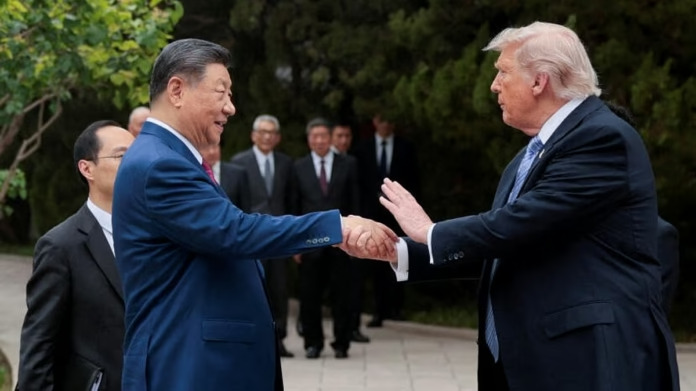
President Donald Trump arrived in Beijing on May 13, 2026, for a two-day state visit with Chinese President Xi Jinping — his second official visit to China as president and the first by a sitting U.S. president in nearly a decade. The visit was arranged against a complex backdrop: the ongoing Iran conflict, unresolved trade tensions despite a series of framework agreements dating to October 2025, and persistent friction over Taiwan, technology exports, and China’s support for Russia’s defense industrial base.
Trump and Xi met for a closed-door session lasting roughly two hours and fifteen minutes on May 15, after which Trump described the conversation as “great” and announced what he called “fantastic trade deals.” The White House issued a fact sheet claiming China had agreed to an initial purchase of 200 American-made Boeing aircraft, a commitment to buy at least $17 billion per year in U.S. agricultural products, and agreements to reduce barriers to additional American exports including beef, biotech products, and energy. Ambassador Jamieson Greer of the U.S. Trade Representative’s office went on television to describe the deals as a major win for American workers and farmers.
However, the Chinese readout of the summit was noticeably more measured. China’s Commerce Ministry confirmed only “arrangements on procuring aircraft” and language about mutual tariff reductions on farm goods, declining to confirm the specific numbers cited by the White House. Boeing itself had not publicly confirmed the 200-aircraft purchase as of the day the summit concluded — an unusual gap for a deal of that claimed magnitude. CNN, the BBC, Reuters, and The New York Times all described the summit as heavy on ceremony and light on binding commitments, with CNBC reporting that critics viewed Trump as leaving Beijing “empty-handed” on his major asks regarding technology transfer, Taiwan, and Chinese support for Iran via Russia.
Trump also told reporters that China had offered to help reopen the Strait of Hormuz as part of the discussions — a statement that aligned with his diplomatic ambitions but was not corroborated by Chinese officials. Beijing has maintained public neutrality on the Iran conflict, and Chinese state media made no reference to any Hormuz-related commitment in its coverage of the summit. NPR‘s post-summit analysis found that, a week after the visit, the U.S. and Chinese governments had largely stuck to their own divergent interpretations of what was agreed.
A week after the summit, Xi’s expected September White House visit was confirmed as planned, setting up a future opportunity for both sides to claim credit for further progress.
Why It Matters
The divergence between the American and Chinese accounts of the Beijing summit is not a minor communications gap — it is a substantive accountability question. When a president claims to have secured historic trade deals and the counterpart government does not confirm the core numbers, either the deals are not as concrete as described or the two sides have agreed in principle to vague commitments that may never materialize. Both scenarios are governance failures of different kinds, and both matter enormously for the businesses, farmers, and workers the administration claims to be serving.
For American agricultural producers — farmers, ranchers, and processors who have been navigating years of market disruption from the trade war with China — the promise of $17 billion in annual Chinese purchases is significant. But commitments of this type have a mixed track record. The 2020 Phase One trade deal between Trump’s first administration and China included similarly large purchase commitments that China did not fully meet. The absence of enforcement mechanisms in summit announcements is a recurring accountability concern.
For Boeing, which has been navigating financial difficulties and a period of intense scrutiny over its manufacturing quality, a 200-aircraft Chinese order would be genuinely transformative. The company’s silence on the deal at the time of the summit — normally, a purchaser and seller would jointly announce a transaction of this scale — raises questions about whether a binding commercial agreement has actually been reached or whether a political statement of intent was dressed up as a confirmed deal.
Economic and Global Context
U.S.-China trade relations have been in a state of managed tension since the first Trump administration. China’s economy grew by a better-than-expected 5 percent in 2025 as its exporters pivoted away from the U.S. market and its push for technological self-sufficiency accelerated in semiconductors and advanced manufacturing. The summit did not change the fundamental structural dynamics of that competition.
The Strait of Hormuz dimension of the Beijing visit is particularly consequential if Trump’s account is accurate. China is the world’s largest importer of oil and a major customer for Iranian crude. If Beijing has privately committed to using its leverage with Tehran to help reopen the strait, that would represent a significant geopolitical development — one that has not been confirmed, acknowledged, or explained in detail by either government. The gap between Trump’s public characterization and Beijing’s silence is itself a story of governance accountability.
The Boeing deal, if it eventually materializes, would have significant industrial policy consequences. Resuming large-scale Chinese aircraft purchases from U.S. manufacturers would benefit the American aerospace supply chain, create or sustain tens of thousands of jobs, and generate pressure within Boeing to accelerate its manufacturing recovery. The stakes make the lack of confirmation more troubling, not less.
Implications
The September Xi visit to the United States will be the next major test of whether the Beijing summit produced durable agreements or political theater. If the aircraft purchases, agricultural commitments, and bilateral frameworks are not further specified and operationalized by then, the summit’s legacy will be a continuation of the pattern where high-profile Trump-Xi meetings produce announcements that fade under scrutiny.
For Congress, the trade accountability question is one that both parties have an interest in pursuing. The USTR’s characterization of the Beijing deals as “historic” and “delivering for American farmers” is a specific, testable claim. If Chinese purchases of American agricultural products do not approach $17 billion by the end of the year, that gap will become a political liability — and a legitimate oversight question for congressional committees.
For American allies watching the U.S.-China relationship, the summit’s ambiguous outcome reinforces concerns about the reliability of U.S. diplomatic commitments. Partners who have reorganized their own trade and security policies around assumptions about American behavior need clarity about whether Washington is moving toward stable coexistence with Beijing or continuing managed competition — and the mixed signals from the summit do not provide it.
Sources
“What did Xi and Trump agree to in China? From a ‘board of trade’ to Boeing planes”