Story Highlights
- The Trump-Xi summit on May 14–15 is Trump’s first presidential visit to China since 2017, and his first visit to Beijing as sitting president since November 2017
- Iran war diplomacy is expected to dominate the agenda, potentially crowding out progress on tariffs, rare earth supply chains, and Taiwan
- Analysts warn that beneath the summit’s cooperative surface, major trade conflict is building as China quietly amasses new economic countermeasures
What Happened
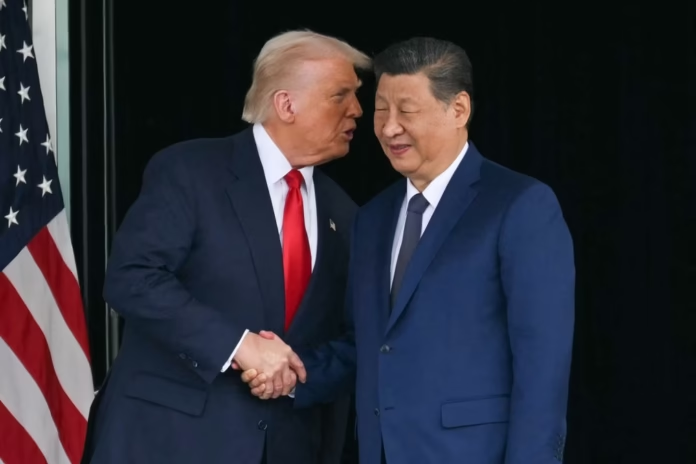
The Iran war is likely to take center stage in the summit between President Donald Trump and China’s Xi Jinping, leaving less scope to resolve issues like tariffs and rare earth supplies. U.S. Treasury Secretary Scott Bessent has already confirmed that Iran will be a topic in the meetings. The scheduled May 14–15 summit will be Trump’s first visit to China since November 2017, when he was received with a “state plus” treatment at the Forbidden City during his first term.
Trump is expected to notch deals on Chinese purchases of U.S. soybeans and Boeing airplanes, according to Scott Kennedy, senior advisor at the Center for Strategic and International Studies. Trump is also expected to discuss establishing trade and investment organizations — called “boards” — to handle specific bilateral issues. But analysts caution that these headline deliverables will mask deeper unresolved tensions.
Trade experts warn that beneath the summit’s surface, major trade conflict is building. In the past, a weaker China was forced to accept U.S. tariffs and export restrictions, but Beijing has quietly and methodically amassed increasingly effective tools it believes will counter Washington’s heavy-handed behavior. China’s toolkit now includes rare earth export controls, anti-sanctions legislation, and expanded domestic semiconductor capability.
Outside observers should have low expectations for the upcoming summit. While the relationship has stabilized since the two leaders met last November in Busan, it remains fragile — defined more by an absence of friction than any affirmative agenda or deep dialogue on the substantial differences that continue to divide the two nations. Chinese analysts largely expect any U.S. snap back to a more competitive posture following the midterm elections or the end of Trump’s presidency in 2029.
The summit’s meager bureaucratic preparations limit the prospects for progress. Counterintuitively, by signaling early and loudly a desire for multiple presidential encounters this year, the Trump administration may have reduced Beijing’s incentive to offer major concessions. Chinese officials calculate that Trump will want to tout any agreement as a major breakthrough ahead of the midterm elections and that they will extract more value by delaying concessions.
Why It Matters
The U.S.-China relationship is the most consequential bilateral relationship in the world, shaping everything from semiconductor supply chains to global energy pricing to military deterrence in the Pacific. A summit that produces genuine progress on tariffs, technology controls, and rare earth supply chains would have immediate and lasting benefits for American businesses, consumers, and national security. A summit that produces only optics would delay — and possibly deepen — the structural competition between the two countries.
For American businesses, the key deliverables they are watching include progress on rare earth export controls, which China tightened sharply in 2025, and any clarity on the long-term tariff trajectory. Changes to China’s increasingly tight rare earths export controls affect all countries, not just the United States, but they hit American defense and technology industries with particular force. Without secure rare earth supplies, American manufacturers of electric vehicles, advanced weapons systems, and semiconductors face structural vulnerabilities that no amount of domestic production can quickly address.
The Taiwan question adds another layer of complexity. Beijing is signaling that Taiwan cannot be avoided in the summit discussions. Xi may seek changes in U.S. declaratory policy — including on Taiwan’s legal status — and may ask Trump to impose constraints on American arms sales to Taiwan. Whether senior U.S. officials will adequately brief Trump in advance on how to handle those discussions is an open question. Any informal concessions on Taiwan policy could have profound security consequences for the island’s 23 million residents and for America’s credibility with regional allies.
For American voters, the summit’s outcome matters most through its effect on prices. Tariff reductions on Chinese goods would ease consumer cost pressures that are already being compounded by the Iran war’s impact on energy prices. Continued trade friction adds to inflation at a moment when households are already strained.
Economic and Global Context
Throughout 2025, the U.S.-China trade conflict escalated sharply after Trump introduced sweeping “Liberation Day” tariffs. Beijing retaliated with countermeasures and restrictions on rare earth exports, causing tariffs on both sides to surpass 100 percent. Temporary truces later eased some pressure, with agreements involving soybean purchases, fentanyl enforcement cooperation, and limited technology export approvals.
A breakthrough came when Trump and Xi met in Busan, South Korea, at the Asia-Pacific Economic Cooperation summit last October, agreeing to a new trade truce. Under the deal, the U.S. agreed to scale back tariffs while China committed to targeting illicit fentanyl trafficking, resuming American soybean purchases, and pausing rare earth export curbs. That truce remains fragile, with both sides making new accusations of non-compliance in the months since.
The Trump administration is also trying to reconstruct its tariff regime after the Supreme Court ruled in February that many of the previous tariffs were unlawful. Beijing could argue that restoring tariff levels back to where they were violates the tenuous trade war ceasefire, opening up the possibility of a renewed cycle of escalation. That legal uncertainty weakens Washington’s negotiating hand at exactly the moment Trump needs leverage.
China absorbed more than 80 percent of Iran’s shipped oil in 2025 and has refused to comply with U.S. sanctions targeting Chinese refineries that continue to purchase Iranian crude. In May 2026, China’s Ministry of Commerce invoked its anti-sanctions law for the first time, ordering domestic companies to defy U.S. sanctions — a significant escalation that signals Beijing is willing to directly confront Washington’s extraterritorial use of sanctions authority.
Implications
The most immediate implication of the summit is whether Trump can secure China’s active assistance in pressuring Iran to accept a peace deal. U.S. officials have openly pressed China to lean on Tehran to open up the Strait of Hormuz. But Beijing’s willingness to act as a pressure mechanism on Iran is constrained by its own confrontation with Washington, and by China’s economic dependence on Iranian oil. Any Chinese pressure on Iran will almost certainly come at a price — likely meaningful tariff concessions or technology access concessions from Washington.
For the global economy, the summit’s outcome will determine whether the world’s two largest economies move toward greater stability or renewed confrontation. Markets have been pricing in a relative détente; a summit that reveals deeper fractures could trigger significant volatility in equities, currency markets, and commodities.
For American policymakers, the deeper accountability question is whether the Trump administration has done sufficient preparation for a summit of this magnitude. The reported meager bureaucratic preparations for this meeting limit the prospects for progress, suggesting the summit may generate announcements that mask rather than resolve the structural tensions between the two nations.
For the longer-term relationship, the May summit is only “the first half of the game,” according to Brookings analysts. Xi’s planned return visit to the United States later this year will be the second act, and the full impact of this diplomatic exchange will not be known until both meetings have concluded and both governments have had to act on any commitments made.
Sources
“Iran focus at Trump-Xi summit may delay progress on tariffs, rare earths”