Story Highlights
- Ed Gallrein, a former Navy SEAL backed by President Donald Trump, defeated incumbent Rep. Thomas Massie in the Republican primary in Kentucky’s 4th congressional district.
- The contest shattered the record for the most expensive House primary in history, with roughly $35 million spent by candidates and outside groups combined according to FEC data.
- Secretary of Defense Pete Hegseth made a rare campaign appearance in the district on Monday, though federal law restricts government employees from engaging in partisan political activity while on duty. His office stated he attended in a personal capacity.
What Happened
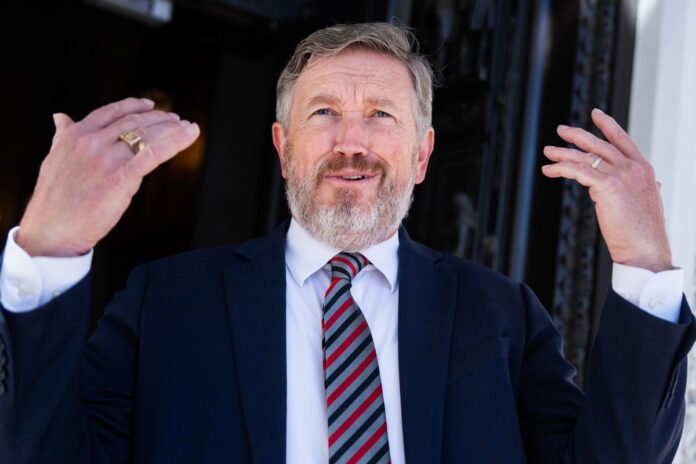
Ed Gallrein, a retired Navy SEAL and farmer, was projected to win the GOP primary in Kentucky’s 4th Congressional District, ending Thomas Massie‘s 14-year tenure in the deep-red seat. The Associated Press called the race just under two hours after polls closed, with Gallrein leading by nearly nine percentage points.
Trump came to northern Kentucky in March and rallied support for Gallrein, whom he personally asked to enter the race. At the time, Trump said, “I asked for a warm body, give me a warm body that could beat Massie.” That request turned into a campaign juggernaut, with super PACs, pro-Israel groups, and administration officials flooding the district with money and attention.
Pete Hegseth flew to the state on Monday to campaign for Gallrein. Acting Attorney General Todd Blanche signed a separate document the same week that drew significant controversy. The administration invested enormously in the outcome, treating the race as a referendum on presidential loyalty.
Massie had angered Trump by opposing U.S. military action in Iran and Venezuela, criticizing aid to Israel, resisting parts of the president’s legislative agenda, and backing efforts to release files related to the late Jeffrey Epstein. In his concession speech, Massie called for a “unity party” and offered a pointed parting shot, joking that it had taken a while to call his opponent because he had to find Gallrein “in Tel Aviv.”
Gallrein, in his victory speech, made clear he would support the president’s agenda without reservation, saying, “Now my focus is on advancing the president’s and the party’s agenda to put America first and Kentucky always.”
Why It Matters
The northern Kentucky race continues the trend of this midterm primary season in which Trump has been able to exert his control over the party to defeat incumbents he dislikes. In Louisiana, GOP Sen. Bill Cassidy, who voted to convict Trump in his 2021 impeachment trial, came in third in his primary. In Indiana, all but one of the Republican senators who blocked the president’s mid-term redistricting effort lost their primaries to Trump-endorsed candidates.
The pattern reveals a Republican Party that is rapidly being reshaped in Trump’s image ahead of November’s general elections. Lawmakers who once felt secure in their districts based on conservative voting records and constituent relationships are now discovering that loyalty to the president personally supersedes other considerations.
A senior Trump official told NBC News after the results came in: “It means the president keeps his commitments.” That framing was deliberate. Trump had publicly called Massie names for months, labeling him a “nut job,” a “moron,” and “the worst congressman in the long and storied history of the Republican Party.” The personal nature of his campaign against Massie underscored how Trump’s approach to party discipline is rooted as much in personal grievance as in ideological alignment.
For voters and constitutional observers, questions linger about the role cabinet officials play in primary races. Hegseth’s visit to Kentucky came, according to later reporting, just hours before the administration had considered restarting military strikes on Iran. Using a sitting secretary of defense as a campaign surrogate against a fellow Republican raises accountability concerns that have gone largely unaddressed.
Economic and Global Context
The Massie defeat is not an isolated political event. It reflects the consolidation of executive power in a period when major foreign policy commitments — the ongoing Iran conflict, a recent summit with China, and continued operations in Latin America — have dominated the national conversation. Trump’s ability to discipline the legislative branch through primary threats has direct implications for how Congress will or will not check executive action on these fronts.
One pro-Gallrein super PAC released an ad falsely accusing Massie of being “in a throuple” with Democratic lawmakers, while a pro-Massie group aired an AI-generated ad depicting Gallrein abandoning Trump on a battlefield. The record spending in a single House primary highlights how political money is increasingly deployed not to win general elections, but to control who the Republican nominee will be — and therefore who will serve in Congress.
Massie was also one of the few Republican voices opposing the deficit implications of Trump’s domestic tax and spending legislation. With his removal, fiscal hawks in the House Republican caucus lose a prominent voice at precisely the moment when the national debt trajectory and trade policy are shaping market expectations.
Implications
With Massie gone and Cassidy defeated in Louisiana, the roster of Republicans willing to publicly defy Trump on matters of war, spending, and oversight shrinks further. That has direct implications for November. Democrats are hoping to capitalize on falling presidential approval ratings — a New York Times/Siena College poll published Monday found Trump’s overall approval at 37%, a new second-term low, with nearly two-thirds of voters disapproving of his handling of the economy.
A more compliant Republican caucus may accelerate Trump’s legislative agenda but could also reduce the party’s ability to self-correct before midterms. Voters in competitive districts are watching whether their representatives are willing to stand independently or simply follow White House direction, and the answer may affect turnout in November.
Gallrein, a political newcomer, now advances to what is expected to be a comfortable general election in the deep-red 4th District. But his pledge of unequivocal support for the president’s agenda will be tested by the difficult legislative environment ahead, including budget negotiations, Iran war funding, and healthcare debates.
Sources