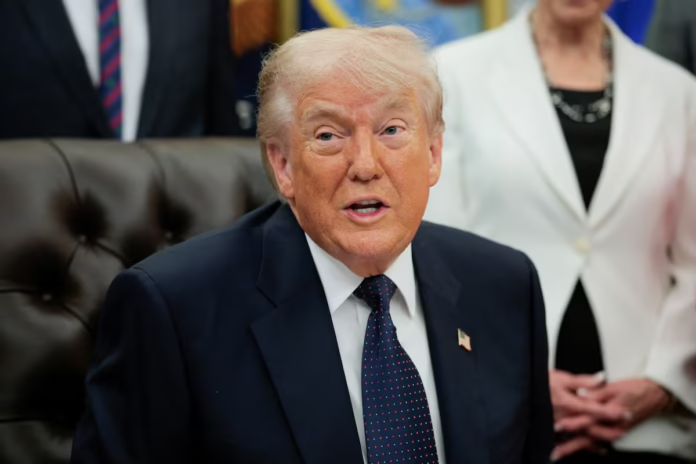
President Trump followed through on his vow of political retribution against Indiana Republican state senators who blocked his redistricting push last December, with at least five of the seven incumbents he targeted losing their primary elections on May 5. Trump-backed challengers flooded the typically quiet state legislative races with millions of dollars in advertising and national attention, turning local contests into a referendum on loyalty to the president. The outcome sent a clear message to Republicans across the country: defying Trump, even on state-level votes, carries serious political consequences.
Story Highlights
- Five of seven targeted Indiana GOP incumbents were defeated by Trump-endorsed challengers in the May 5 primary
- Advertising spending in Indiana state Senate primaries surged from $280,000 in 2024 to $13.4 million in 2026 — nearly a 48-fold increase
- The redistricting plan, which failed last December, would have redrawn Indiana’s congressional maps to eliminate the state’s two remaining Democratic congressional seats
What Happened
President Donald Trump vowed revenge when the Republican supermajority in the Indiana state Senate embarrassed him in December by voting down his demands to redraw the state’s congressional maps — maps designed to help the party win two additional House seats. At least five of the seven Trump-endorsed challengers defeated GOP incumbent state senators in Tuesday’s primary, serving as a stark reminder that all politics, no matter how local, can be nationalized. CNN
The White House had strongly encouraged Indiana Republicans to support the redistricting proposal, which would have given the GOP an advantage across all nine of the state’s congressional districts by eliminating the only two Democratic seats. While the measure passed the state House of Representatives, it failed in the state Senate despite Republicans holding a 40-to-10 supermajority, with 21 Republicans joining all 10 Democrats to defeat it. Time
Among the incumbents who lost was state Sen. Greg Walker, a 20-year veteran of the chamber who had reversed his planned retirement to take a stand against redistricting and broke down in tears on the chamber floor speaking about his fears for the future of the party. He was defeated by state Rep. Michelle Davis, who had launched her primary campaign before Walker decided to run again but remained in the race and ultimately secured Trump’s endorsement. State Sen. Linda Rogers also lost her primary to Dr. Brian Schmutzler, an anesthesiologist backed by Trump’s political allies. NBC News
The political advertising tracking firm AdImpact calculated that $13.4 million was spent on advertising in the Indiana state Senate primaries this year, compared to approximately $280,000 spent on all state Senate primary ads combined in the entire 2024 election cycle. The bulk of spending came from a group linked to U.S. Sen. Jim Banks, a close Trump ally. Club for Growth led the direct mail effort, and Turning Point USA supplied ground troops for door-to-door voter outreach. CNN
Why It Matters
The Indiana primary results carry implications that extend far beyond the Hoosier State. They demonstrate that Trump retains enough political capital to end the careers of Republican officeholders who defy him, even in state-level races that would ordinarily draw little national attention. For any Republican lawmaker — at the state or federal level — the message is unmistakable: crossing Trump on priorities he cares about will result in a well-funded primary challenge.
A top Trump political adviser, James Blair, put it plainly after the results came in: “Sometimes you can vote your feelings, but sometimes you need to vote with the party.” The comment reflects the administration’s view that party loyalty on strategic priorities, like redistricting, is non-negotiable when House control hangs in the balance. CNN
The redistricting effort itself was part of a broader national push by Trump-aligned Republicans to redraw congressional maps in GOP-controlled states ahead of the 2026 midterms, where Democrats are widely viewed as having an enthusiasm advantage. Before Tuesday’s primary, Republican states across the South had been emboldened by a Supreme Court ruling further limiting the Voting Rights Act, accelerating their own redistricting efforts. Indiana was meant to join that wave, and its state Senate’s refusal was treated by the White House as a breach of party discipline. CNN
For voters and civil libertarians, however, the episode raises fundamental questions about the integrity of representative government. The senators who voted against redistricting said they were following the will of their constituents and the principles of fair representation. Their defeat suggests that voters in Republican primaries, at least those energized enough to turn out, prioritize loyalty to Trump over the independent judgment of their own elected officials.
Economic and Global Context
While Indiana’s primaries are primarily a story of intraparty politics, they connect to a broader national fiscal and governance debate. Redistricting battles have real economic consequences — the composition of Congress directly shapes tax policy, infrastructure spending, and regulatory frameworks that affect businesses and workers nationwide.
The nearly 48-fold increase in state Senate primary advertising spending in Indiana illustrates how national political money is reshaping even the most local democratic contests. Outside groups spent over $12 million opposing the incumbents, a sum that dwarfs the budgets of many congressional campaigns. This nationalization of state politics raises concerns about the growing influence of Washington-based donors in shaping legislative bodies at every level of government. CNN
The Indiana redistricting battle is also playing out against a backdrop of nationwide mid-decade map redrawing. Several Republican-controlled states, including North Carolina and Texas, have already moved forward with new maps at Trump’s urging, potentially adding multiple Republican seats to the House before the November elections. Whether those gains materialize — or whether they provoke a Democratic backlash large enough to offset them — remains the central question for House control in 2026.
Implications
The defeat of the five Indiana state senators will almost certainly accelerate compliance with Trump’s redistricting agenda in other states where Republican legislators have been hesitant. The cost of resistance has now been quantified in political careers, and few elected officials will be eager to face a multimillion-dollar primary campaign funded by Washington allies of the president.
Analysts note, however, that the Indiana results may not benefit Republicans in the general election. Trump’s approval rating has been sinking into the mid-30s, and Democrats motivated by opposition to his presidency are more energized than at any point since 2018. Aggressively partisan redistricting maps can backfire by creating unpredictable swing districts, and the gains from new maps could fall well short of what Republicans need to hold the House against an energized opposition. CNN
For the constitutional principles that govern representative democracy, the broader concern is the erosion of the independence of state legislatures. The Founders designed federalism to create a buffer between national political currents and local governance. The Indiana precedent suggests that buffer is thinning rapidly in the Trump era, with consequences that will outlast any single election cycle.