Story Highlights
- Ratcliffe met in Havana with Raúl Guillermo Rodríguez Castro — a grandson of former Cuban leader Raúl Castro — as well as the Cuban minister of the interior and the head of Cuban intelligence services.
- The Trump administration offered $100 million in humanitarian aid, which Cuban President Miguel Díaz-Canel said his government may be willing to accept, though he insisted it must come without political conditions.
- Cuba’s minister of energy announced the island currently has zero petroleum and zero fuel oil reserves, underscoring the severity of the crisis against which these negotiations are taking place.
What Happened
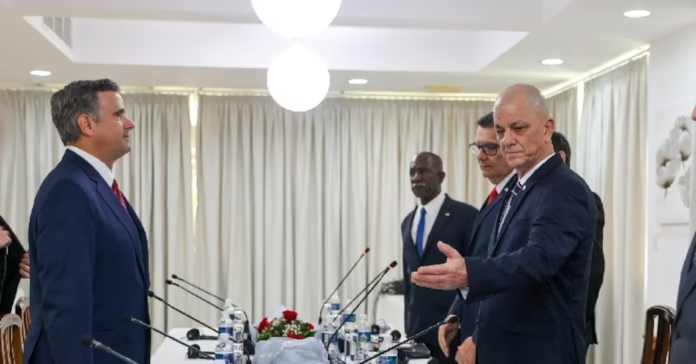
CIA Director John Ratcliffe arrived in Havana on Thursday, May 14, leading a U.S. government delegation that met with senior Cuban officials in a meeting confirmed by both governments and documented in photographs released by the CIA on its official social media account. The visit, notable for its directness and for involving the head of an intelligence agency rather than a State Department diplomat, was framed by U.S. officials as a delivery of Trump’s personal message to the Cuban leadership.
A CIA official confirmed to Fox News that Ratcliffe met with Raúl Guillermo Rodríguez Castro, who has been acting as a spokesperson for his grandfather, the 94-year-old former Cuban leader Raúl Castro, in negotiations with the United States. Also present in the Havana meeting were Interior Minister Lázaro Álvarez Casas and the director of Cuban intelligence services. The meeting covered intelligence cooperation, economic stability, and security issues, with the specific emphasis that Cuba can no longer function as a safe haven for adversaries of the United States in the Western Hemisphere.
The message Ratcliffe carried from Trump was direct: the United States is “prepared to seriously engage on economic and security issues, but only if Cuba makes fundamental changes.” U.S. officials speaking to Fox News indicated that the window for engagement would not remain open indefinitely and that Trump should be taken seriously, particularly given the precedent established by recent U.S. diplomatic pressure on Venezuela. The Venezuelan reference appeared intended to signal Cuba’s leadership about the potential consequences of failing to engage.
Cuban President Miguel Díaz-Canel responded publicly on Thursday, writing on social media that Cuba would be willing to consider the $100 million in humanitarian aid offered by the United States, provided the assistance is delivered in accordance with internationally recognized humanitarian practices and without political strings attached. He acknowledged Cuba’s extensive experience receiving international assistance and described the humanitarian situation as grave, attributing it largely to the long-standing U.S. economic embargo. Cuban Foreign Minister Bruno Rodríguez echoed a similar position, expressing openness while insisting that no political conditions be attached.
The talks represent a continuation of engagement that began in April, when a first American government plane landed on Cuban soil — a visit that Havana did not publicly acknowledge for 10 days. That earlier flight preceded Ratcliffe’s Havana visit, which came after he had also met with a Cuban representative in a prior U.S. meeting in Washington. The public statement from Cuba announcing Thursday’s arrival came hours after the delegation landed, reflecting Havana’s careful management of the optics of direct talks with Washington.
Why It Matters
The Ratcliffe visit is significant on multiple levels. It represents the most direct high-level U.S. government engagement with Cuban authorities in years, and the use of the CIA director rather than a State Department envoy carries distinct meaning. Intelligence channels are traditionally used when governments want to communicate credibly and directly without the formal diplomatic visibility that a State Department visit would generate, suggesting both sides see value in a channel that can be acknowledged or denied as circumstances require.
For Americans, the engagement raises important questions about the direction of U.S. Cuba policy and the conditions Trump is actually demanding. The administration has been formally committed to maintaining the designation of Cuba as a state sponsor of terrorism — a classification Cuba rejects — and to continuing the economic embargo. If a genuine opening is underway, it would represent a significant shift in posture by an administration that has otherwise maintained and extended restrictions on Cuba inherited from prior administrations.
The humanitarian dimension of the engagement also matters for American governance accountability. The United States offering $100 million in aid while simultaneously maintaining an economic embargo that Cuba blames for its energy crisis creates a policy contradiction that policymakers and the public deserve to understand. The administration appears to be using both the pressure of the embargo and the prospect of aid as simultaneous instruments of leverage.
Cuba’s energy crisis, with the island’s energy minister publicly stating that the country has zero petroleum and zero fuel oil, represents a genuine humanitarian emergency. Public protests have erupted in Havana over unbearable living conditions — an unusual development in a country with tightly controlled political expression. The severity of that crisis gives the Trump administration real leverage while also creating genuine urgency around any humanitarian response.
Economic and Global Context
Cuba’s economic situation is severe by almost any measure. Years of pandemic-related collapse in tourism revenue, the withdrawal of Venezuelan subsidized oil, tightened U.S. sanctions, and the structural inefficiencies of a state-controlled economy have combined to produce what observers describe as the worst economic crisis the island has experienced since the fall of the Soviet Union. Fuel shortages have produced rolling blackouts that can last 20 hours or more, affecting hospitals, businesses, and daily life for 11 million Cubans.
The $100 million in humanitarian aid offered by the Trump administration, while substantial, represents only a fraction of what independent economists estimate Cuba requires to stabilize its energy supply. The aid’s humanitarian framing — focused on fuel, food, and medicine — is consistent with international assistance norms but would need to be followed by structural economic changes to produce lasting improvement in Cuban living standards.
From a geopolitical standpoint, the Trump administration’s engagement with Cuba occurs as Russia and China have both maintained relationships with Havana. The Kremlin confirmed this week that President Vladimir Putin plans to visit China shortly, and Russia has had ongoing engagement with Cuba. U.S. officials have consistently cited the need to limit adversary influence in the Western Hemisphere as a core strategic rationale for pressuring and potentially engaging Cuba.
Implications
For the Trump administration, the Havana visit represents a distinctive gambit: using intelligence-channel diplomacy rather than traditional State Department engagement to apply direct pressure on a government Washington has officially classified as a state sponsor of terrorism. Whether this approach produces a genuine opening or serves primarily as leverage for other policy objectives — such as pressuring Cuba to expel Russians or Iranians with a presence on the island — remains to be seen.
For Cuba’s leadership, the choices are stark. Accepting U.S. aid with conditions attached risks internal political backlash and accusations of capitulating to the country they have framed as the source of their problems for six decades. Refusing aid during an active energy crisis and public protests risks domestic instability and a potential erosion of regime legitimacy.
For Congress, the Cuba engagement raises constitutional questions about the executive branch’s authority to unilaterally offer or withhold humanitarian aid as a coercive diplomatic instrument, particularly given legislatively mandated sanctions that the executive cannot simply waive without congressional action.
For the Cuban people, the most immediate implication is whether the diplomatic contact produces any tangible relief — fuel, food, or medicine — in a timeframe relevant to a crisis that is unfolding in real time, regardless of how broader political negotiations between Washington and Havana ultimately resolve.
Sources
“Cuba says CIA chief Ratcliffe met with officials in Havana amid US tensions”