Story Highlights
- The Senate parliamentarian rejected a $1 billion funding request for White House security and the Trump ballroom project, ruling the provision violated budget reconciliation rules and cannot be included in the spending bill.
- Multiple Senate Republicans have privately expressed concern that the ballroom project is politically toxic, especially given Trump’s repeated promises the facility would be privately funded by donors.
- The ongoing ballroom dispute has become intertwined with the controversial anti-weaponization fund controversy, further straining Trump’s relationship with GOP senators ahead of the 2026 midterm elections.
What Happened
Senate Republicans proposed $1 billion in funding ostensibly for White House security improvements, but the proposal sparked immediate dispute about whether the money would fund President Trump’s ongoing ballroom construction project. The White House insisted the funds would support the ballroom, while Republican leadership claimed the money addressed only security matters, creating confusion about the legislation’s true purpose.
The ambiguity proved fatal. Senate Parliamentarian Elizabeth MacDonough, considered nonpartisan since her appointment in 2012, evaluated the provision under budget reconciliation rules. These procedural rules require that spending provisions have direct budgetary effects related to legislation’s primary purpose. MacDonough ruled that the $1 billion security and ballroom provision could not be included as written because it violated these reconciliation rules.
The ruling represented a significant setback for Trump’s ballroom ambitions. The administration had promoted the project as a national security matter and claimed it would be privately funded. Yet by seeking $1 billion in federal funding, Trump effectively admitted that private funding was insufficient. The contradiction undermined the administration’s argument that the project required federal support.
Trump has been promoting the ballroom for months, justifying it as a necessary addition to White House facilities. He has alternately characterized it as privately funded, then sought federal funding for security components. The administration claims the roughly 90,000-square-foot ballroom would accommodate larger state events than current White House facilities permit. The president has also suggested a massive underground complex beneath the ballroom serves national security purposes.
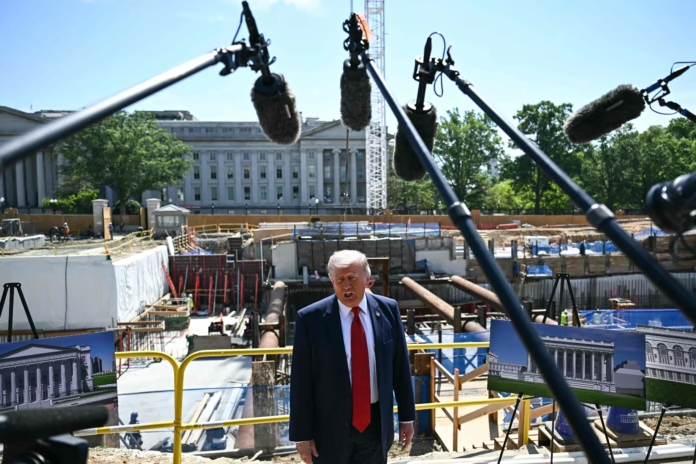
The ballroom project replaced the White House East Wing, which was demolished in October 2025. The demolition itself was controversial, with preservation advocates arguing Trump lacked authority to destroy a historic structure. Legal challenges ensued, with critics arguing Trump had overstepped constitutional bounds by undertaking major construction without congressional approval.
Senate Republican skepticism about the project reflects broader concerns about fiscal priorities. Gas prices remain above $4 per gallon, inflation persists, and Trump’s approval ratings sit in the 30s. Republican senators recognize that defending $1 billion for a presidential ballroom project is politically difficult when constituents struggle with energy and food costs. The project symbolizes to many Americans that Trump prioritizes personal vanity projects over addressing their economic hardship.
Why It Matters
The ballroom dispute symbolizes broader questions about Trump’s governance priorities and whether his administration will prioritize solving national problems or pursuing personal projects. The ballroom serves no function beyond hosting events; it creates no jobs beyond construction, generates no economic productivity, and addresses no constituent need. Spending $1 billion on the project while American families struggle financially creates politically toxic optics.
For constitutional governance, the ballroom question raises issues about presidential authority over federal property and buildings. Presidents traditionally consult Congress before undertaking major White House renovations because the building belongs to the nation, not the president personally. Trump’s approach of proceeding with construction and then seeking federal funding afterward reverses normal constitutional processes where appropriations precede spending.
The project also illustrates how Trump’s personal priorities can override party concerns and fiscal responsibility. Republican senators nominally committed to fiscal conservatism have watched Trump demand spending for the ballroom while criticizing other federal spending. The inconsistency has strained relationships and revealed that some GOP senators will not rubber-stamp presidential requests.
The dispute reveals that Trump’s political capital with Senate Republicans is limited. Earlier in his presidency, Trump enjoyed near-unconditional support from GOP senators. The ballroom and anti-weaponization fund controversies together suggest Trump’s grip on Senate Republicans is weakening, and senators increasingly willing to resist presidential pressure feel empowered to voice concerns.
For voters evaluating Trump’s stewardship, the ballroom controversy raises questions about judgment and priority-setting. The project was not part of Trump’s campaign agenda. It was not a legislative priority identified in his platform. It appears to be a personal priority Trump decided to pursue while serving as president.
Economic and Global Context
The $1 billion cost remains contested. Trump has claimed the project costs $400 million, while construction tracking documents and architectural costs suggest expenses approaching or exceeding $1 billion including underground construction and security elements. The lack of transparent accounting for spending creates questions about whether true costs are being disclosed.
The project also involves private funding commitments that remain mysterious. Trump has insisted donors are financing the project, but despite months of construction, little clarity exists about which donors are involved, what commitments they’ve made, and whether donations constitute improper quid pro quo arrangements. The opacity creates appearance-of-impropriety concerns that typically surround presidential private funding arrangements.
The economic opportunity cost warrants consideration. $1 billion could address infrastructure needs, fund research, or support displaced workers. Instead, the administration seeks to spend the money on a luxury facility serving the president’s personal interests. The allocation reflects priorities that some Americans will view as misaligned with real economic needs.
Global context includes how other democracies handle executive residences. Most other nations maintain executive residences without the president personally controlling large-scale construction projects using federal funds. The Trump administration’s approach is unusual internationally and reflects assertions of executive authority other democratic leaders would not claim.
Implications
The parliamentarian’s ruling means the ballroom funding cannot proceed through the reconciliation process and will need separate legislative authorization. This creates a higher political bar because any funding bill would face Democratic opposition and require broader Republican support than reconciliation allows.
For Trump’s relationship with Senate Republicans, the dispute has created lasting tension. Senators who resisted the ballroom funding will have that resistance on record, and Trump may retaliate by endorsing primary challengers, as he has done with Senators Cassidy and Cornyn. This dynamic creates a cycle where Trump punishes doubters, further eroding his standing with some senators.
For the broader Trump agenda, losing ballroom funding is relatively minor compared to other priorities. Yet the loss symbolizes that Trump does not automatically prevail when Senate Republicans resist. This has implications for other disputed spending and policy initiatives Trump may seek.
For 2026 midterms, the ballroom issue will be background noise compared to larger issues like inflation and foreign policy. Yet the dispute contributes to a narrative of Trump prioritizing personal interests over national needs—a narrative Democrats will emphasize in campaign messaging.
The ultimate implication is that the ballroom project will likely proceed with private funding, private donor arrangements, or Trump personal funding. The refusal to provide federal support represents a rare instance of Republicans declining to follow Trump’s lead on spending.
Sources