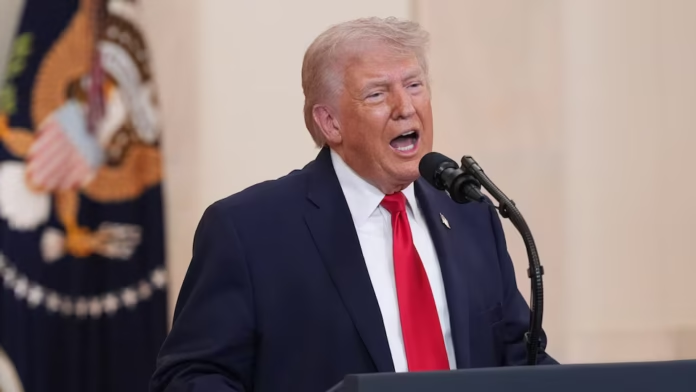
President Donald Trump gathered his full Cabinet at Camp David on Wednesday as intense negotiations with Iran over ending a three-month war entered a critical and uncertain phase. The rare retreat to the historic Maryland compound came amid conflicting signals from both sides about whether a ceasefire agreement was truly within reach. With global energy markets rattled and public support for the conflict eroding, the White House faces growing pressure to deliver a diplomatic resolution before conditions deteriorate further.
Story Highlights
- Iranian state media reported a draft memorandum of understanding calling for U.S. military withdrawal and the lifting of a naval blockade in exchange for reopening the Strait of Hormuz.
- Trump claimed on Truth Social over the weekend that a deal had been “largely negotiated,” only to walk back the statement days later.
- The Pentagon acknowledged it is struggling financially to sustain the operation, urging Congress to authorize additional emergency funding.
What Happened
President Donald Trump will meet with his Cabinet on Wednesday at a precarious moment for talks aimed at ending the war with Iran, just days after insisting that his administration and Tehran had “largely negotiated” a settlement, but with negotiations still in a state of flux. The gathering, held at Camp David rather than the White House, signaled both the gravity of the moment and Trump’s desire to project decisive leadership as the conflict stretches into its third month.
Trump and his top officials made the rare trip to the woodsy Maryland retreat to discuss issues both foreign and domestic. Topics on the agenda included recent administration successes in the economy and small business, Task Force to Eliminate Fraud highlights, and foreign policy updates, according to a White House official.
Under the potential deal, Tehran would agree to give up its stockpile of highly enriched uranium — a key Trump demand — in return for sanctions relief. That is according to two regional officials and one senior Trump administration official, all of whom spoke on the condition of anonymity to discuss the sensitive negotiations. One regional official with direct knowledge of the talks said how Iran would relinquish the uranium would be subject to further negotiations during a 60-day period.
According to a report on Iranian state television, the memorandum of understanding being negotiated between Iran and the United States will call for U.S. military forces to withdraw from Iran’s vicinity and lift the blockade of Iranian ports in return for the reopening of the Strait of Hormuz to pre-war levels. The U.S. had not yet commented on the report.
Despite the apparent progress, the situation remained fragile. Trump later appeared to qualify his earlier optimism, writing on Monday that an eventual agreement with Iran “will either be a great and meaningful one, or there will be no deal.” He warned that if negotiations fail, it would be “Back to the Battlefront and shooting, but bigger and stronger than ever before — And nobody wants that.”
Why It Matters
The outcome of these negotiations will define one of the most consequential chapters of Trump’s second term. Multiple polls show Americans increasingly do not believe Trump can end the Iran war with a clear-cut victory for the United States. A majority of polled voters want to end military operations in Iran even without a formal peace deal, and only 20 percent of Americans report having a “great deal” of faith in Trump to make sound decisions about Iran.
Beyond public opinion, the war has exposed significant divisions within the administration itself. Vice President J.D. Vance and special envoy Steve Witkoff have reportedly favored a diplomatic path and shown willingness to accept compromises to secure a deal. Secretary of State Marco Rubio and National Security Adviser Mike Waltz, by contrast, have advocated a maximalist approach in negotiations, making internal consensus difficult.
The deal’s domestic political stakes are equally high. Trump built much of his 2024 campaign on an “America First” non-interventionist message, and the ongoing military engagement has fueled a very public feud with conservative commentator Tucker Carlson, who has accused Trump of betraying core supporters. With midterm elections approaching in November 2026, a clean diplomatic win would give the White House a much-needed boost.
Any agreement must also survive scrutiny from hawks within both parties who will question whether Iran has genuinely abandoned its nuclear ambitions or is simply buying time. The credibility of any verification mechanism will be central to whether a deal can win public trust.
Economic and Global Context
The war has placed enormous strain on the global energy supply chain. The Strait of Hormuz, through which roughly 20 percent of the world’s oil passes, has remained restricted since the conflict began in late February, contributing to elevated crude oil prices and increased shipping costs worldwide. Reopening the strait is a prerequisite of any deal and would offer immediate economic relief to markets that have been on edge for months.
The Pentagon is feeling a significant financial squeeze and is struggling in some cases to carry out routine training and maintenance amid its ongoing operations against Iran. The Navy’s top officer, Admiral Daryl Caudle, told House Armed Services Committee lawmakers that his 2026 budget “didn’t bake in Operation Epic Fury” and that the Navy faces impacts on “routine operations” as a result.
The broader global economy has registered the conflict’s disruption. European and Asian allies have pressed Washington to reach a swift resolution, particularly given the inflationary pressure that elevated oil prices are transmitting through their domestic economies. With U.S. PCE inflation already running at 4.5 percent as of early 2026, policymakers at the Federal Reserve have limited room to maneuver if energy costs remain elevated.
Iran’s regional partners, including Oman, have played active mediating roles. The Omani channel has been instrumental in transmitting draft terms between the two sides without requiring direct high-level contact, maintaining a structured diplomatic back channel even as battlefield operations continued intermittently.
Implications
If a deal is reached on terms close to the reported draft memorandum, it would allow Trump to claim a significant geopolitical accomplishment — the first major U.S.-Iran diplomatic agreement of his presidency. However, skeptics warn that the 60-day follow-on negotiation period described in the leaked terms leaves ample opportunity for the arrangement to collapse, repeating the pattern of the April talks in Pakistan that produced no durable outcome.
For Iranian leadership, accepting a deal requires making difficult concessions on nuclear enrichment that could face domestic opposition from hardliners who view the enriched uranium stockpile as a strategic deterrent. The question of how and where Iran would transfer the material remains a sticking point that no public statement from either government has resolved.
For the United States, the Pentagon’s financial strain underscores the urgency of resolution. Congress will be asked to authorize additional emergency defense spending if the operation continues, and that request will land in a legislative environment already characterized by intra-party conflict and a looming midterm calendar that makes war funding politically complex.
For ordinary Americans, the implications are felt most directly at the gas pump and in broader inflation data. A successful resolution that reopens the Strait of Hormuz could provide a genuine economic tailwind heading into the fall campaign season, one that the White House will be eager to claim credit for.