Story Highlights
- A Public Citizen analysis identified 446 hospitals at high risk of closing or cutting services due to Medicaid cuts embedded in Trump’s “One Big Beautiful Bill Act”
- The law is projected to reduce federal Medicaid spending by approximately $1 trillion over a decade, with the heaviest impacts falling on rural hospitals and facilities serving Black and Latino patients
- More than 800 healthcare facilities have already closed, cut services, or are at risk, according to a Protect Our Care report published in April 2026
What Happened
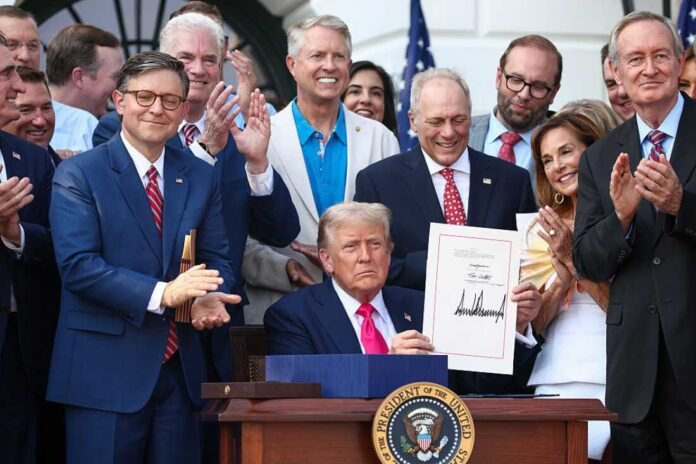
On July 4, 2025, President Donald Trump signed into law the “One Big Beautiful Bill Act,” a sweeping piece of domestic legislation that made significant changes to federal healthcare programs including Medicaid, Medicare, and the Health Insurance Marketplace. The law imposes new requirements on Medicaid enrollees, including a requirement starting in December 2026 that certain low-income adults log at least 80 hours per month of “community engagement” — defined as employment, volunteer work, or education — to maintain eligibility.
A new analysis from Public Citizen, published in April 2026, found that 446 hospitals are at high risk of closing or cutting services due to planned Medicaid cuts under the legislation. The report examined financial data from approximately 95 percent of U.S. hospitals between 2022 and 2024, identifying facilities at risk as those where Medicaid and other low-income government programs made up at least 20 percent of revenue and that had been operating at a financial loss.
A separate Protect Our Care report released in April found that since the passage of the One Big Beautiful Bill Act, more than 800 hospitals, nursing homes, maternity wards, psychiatric centers, and other healthcare facilities across the country have either closed entirely, cut services, or are at risk of doing so.
Rural hospitals and facilities serving Black and Latino communities are disproportionately affected by the cuts. More than a quarter of all hospitals are at risk in five states: Connecticut, California, New York, Massachusetts, and Washington. Public Citizen researcher Eileen O’Grady said hospitals already under severe financial strain are being forced to make difficult decisions about solvency, and called on Congress to restore Medicaid funding and extend enhanced Affordable Care Act premium tax credits.
The Trump administration has also proposed expanding Medicaid payment cuts beyond what the One Big Beautiful Bill Act already required. The administration proposed that the Centers for Medicare and Medicaid Services trim certain Medicaid reimbursement payments — which were set at higher commercial rates under a Biden-era change — far more aggressively than the law had specified, setting up a significant confrontation with healthcare providers.
Why It Matters
The nonpartisan Congressional Budget Office estimated that as a direct result of the legislation’s healthcare provisions, 10 million people will be forced off their health insurance. An additional 5 million people are projected to lose coverage because the law did not extend enhanced ACA premium tax credits, which expire at the end of 2026. These are not abstract projections — they represent real families, many in rural and suburban communities that voted for Trump, who are now confronting insurance loss for the first time.
The hospital closure crisis carries profound consequences for emergency care access. In rural areas, a hospital closure can mean that the nearest emergency room is an hour or more away. For stroke patients, heart attack victims, and trauma cases, that distance can be life or death. Maternity ward closures — already accelerating before the legislation — are compounding what health advocates describe as a growing maternal mortality crisis, particularly in underserved communities.
The political dimension is increasingly uncomfortable for Republicans. The law’s Medicaid cuts are producing visible, painful outcomes in red states as well as blue ones. State legislators in Missouri, Arizona, and Idaho are scrambling to fill budget gaps created when federal funding declines while new administrative mandates increase state costs. Republican governors and state lawmakers who supported the bill are now facing constituent pressure as clinics close and premiums rise.
The administration’s response has been to highlight the law’s $50 billion rural health fund, which distributes grants to states over five years through the Rural Health Transformation Program. However, health policy analysts point out that the fund is inadequate relative to the scale of cuts — one researcher estimated it offsets less than 40 percent of projected rural Medicaid losses over the same period.
Economic and Global Context
The healthcare sector is one of the largest components of the American economy, employing roughly 16 percent of the national workforce. Hospital closures and service cuts translate directly into job losses and reduced economic activity in the communities affected. Regions that lose a hospital often experience broader economic deterioration, as healthcare institutions are among the largest local employers in rural and small-town America.
Federal Medicaid cuts are costing some states as much as $450 million this year in added costs and lost tax revenue, further squeezing budgets that were already stretched thin. Legislatures in multiple states are now considering cuts and reallocations, including reductions to child care subsidies in Missouri, a 5 percent reduction across state agencies in Arizona, and a $22 million cut from disability services in Idaho.
Insurance markets are also under pressure. Several major insurers — including Aetna and Wellcare — have already announced they are exiting ACA marketplace coverage in certain states for 2026, citing higher costs and regulatory uncertainty. The consolidation of insurance options tends to drive up premiums for those who remain in the market, creating a self-reinforcing cycle of coverage loss and cost escalation.
Internationally, the United States continues to spend more per capita on healthcare than any other developed nation while delivering worse outcomes on key metrics including life expectancy and infant mortality. Analysts at the Commonwealth Fund and other health research institutions have warned that the Medicaid cuts will widen existing disparities and may accelerate a decline in U.S. healthcare performance relative to peer countries.
Implications
The political and policy consequences of the healthcare crisis will intensify heading into the 2026 midterm elections. Democrats are already running on healthcare access as a central campaign issue, and the growing volume of hospital closures, coverage losses, and premium increases gives them concrete examples to cite in competitive districts nationwide. Republicans in swing districts face a difficult balancing act between defending a law central to their legislative agenda and responding to constituent concerns about access and affordability.
For states, the coming years will require difficult fiscal choices as federal funding declines and new administrative mandates arrive in waves. States that expanded Medicaid under the Affordable Care Act and built public health infrastructure around federal funding streams will face the most acute pressure. Governors who resist federal requirements risk losing additional funding, while those who comply face the political fallout of cutting services.
For hospitals, the calculation is increasingly stark. Safety-net hospitals and rural critical access facilities that depend on Medicaid for a majority of their revenue have limited options: reduce services, seek private partnerships, or close. Communities that lose their local hospital rarely recover that infrastructure, meaning the consequences of the current policy trajectory are likely to be durable and geographically concentrated.
Sources
“Medicaid cuts threaten hundreds of hospitals, new report finds”