Story Highlights
- The Trump administration froze $185 million in annual federal childcare funds to Minnesota, affecting care for roughly 19,000 children from low-income families
- The freeze was triggered by a viral video from conservative influencer Nick Shirley alleging fraud at Somali American-owned daycare centers in Minneapolis, though state officials say the allegations remain unsubstantiated
- The Department of Health and Human Services expanded the pause to all states, requiring them to submit administrative data proving legitimate use of funds before payments resume
What Happened
The Department of Health and Human Services announced the freeze in funds in response to allegations by conservative YouTuber Nick Shirley, who claimed daycare centers operated by Somali Americans in Minneapolis had committed up to $100 million in fraud. Shirley’s video garnered 127 million views on X and received extensive coverage on Fox News.
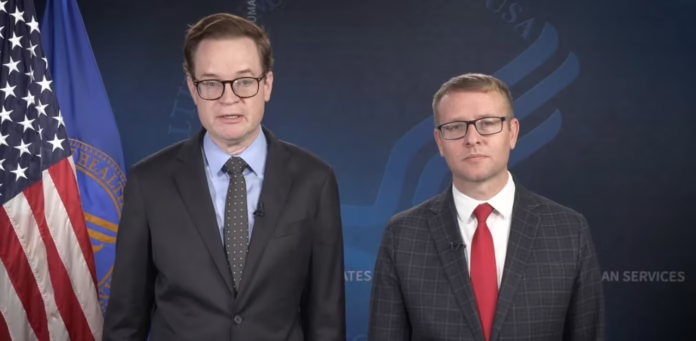
HHS Deputy Secretary Jim O’Neill said the action addressed serious allegations that Minnesota had funneled millions of taxpayer dollars to fraudulent daycare centers over the past decade. The HHS announced funds would be released only when states prove they are being spent legitimately, but the agency did not provide details about what proof would be required or how long the process would take.
Minnesota receives approximately $185 million annually in federal childcare funding, which supports care for 19,000 children, according to the U.S. Department of Health and Human Services. The state says the money helps cover routine childcare costs for thousands of low-income families each month, allowing parents to work or attend school.
Minnesota Attorney General Keith Ellison filed a lawsuit after the administration announced the freeze, arguing that the only nexus between Minnesota and the other affected states was that they all have Democratic governors and attorneys general. The lawsuit noted that the funds are drawn down periodically by state governments and contractors who administer childcare programs, and that family care providers and families themselves could face immediate harm.
A federal judge ordered the Trump administration to release the funds while the lawsuit was pending. Minnesota Governor Tim Walz, a Democrat, suspended his reelection campaign over the controversy. However, the freeze also highlighted a real fraud scandal involving the Feeding Our Future network, a COVID-era food program fraud scheme that resulted in charges brought in the Biden administration and prosecutions continuing into 2026.
Why It Matters
The Minnesota childcare freeze illustrates the tension between the administration’s stated goal of combating fraud in federal programs and its exercise of executive authority over funding streams that states depend on for essential social services. The decision to suspend payments based on unverified allegations from a viral social media video — rather than a completed law enforcement investigation — raises due process concerns about how the administration targets federal funding.
The expansion of the funding pause to all fifty states was even more consequential. By requiring every state to submit administrative data before receiving funds already allocated by Congress, the administration effectively conditioned federal appropriations on executive branch approval — a practice with significant constitutional implications. States that are administratively compliant risk funding gaps simply because of the time required to process data demands at scale.
The political dimension is unmistakable. Ellison’s lawsuit explicitly argued the states affected are those with Democratic leadership, and the timing of the freeze — triggered by a viral video, not a DOJ referral or OIG investigation — has reinforced perceptions that the administration is weaponizing federal funding authority for partisan purposes. The optics are further complicated by Minnesota’s own documented fraud history, which gives the administration a factual basis for concern even if critics argue the response was disproportionate.
For low-income families, the practical consequences are immediate and severe. Parents who rely on federally subsidized childcare to maintain employment cannot easily absorb sudden lapses in coverage. When daycare centers close or reduce capacity due to funding uncertainty, it creates a cascade of disruption affecting not only the families directly enrolled but the broader economy of caregiving that allows parents — disproportionately mothers — to participate in the workforce.
Economic and Global Context
Childcare funding has long-term economic significance that extends well beyond its immediate budget line. Research consistently shows that access to affordable, high-quality childcare increases maternal labor force participation, improves child developmental outcomes, and generates positive returns in tax revenue and reduced reliance on other social programs. Disrupting childcare access for 19,000 Minnesota children is not only a welfare issue — it is a workforce and economic productivity issue.
The broader federal childcare funding system involves billions of dollars annually distributed to states through the Child Care and Development Block Grant and related programs. The administration’s demand that all states validate their spending data creates a bureaucratic bottleneck that could delay payments to providers nationwide, with downstream effects on childcare availability, provider solvency, and family stability in every state.
Minnesota has the largest Somali American population in the United States, and the Shirley video specifically targeted daycare centers operated by Somali Americans. Critics and civil liberties organizations have raised concerns that the freeze functions as a form of economic discrimination against a specific immigrant community, even as the administration frames its actions as race-neutral fraud enforcement. The unsubstantiated nature of many of the specific claims in the viral video adds weight to those concerns.
At the international level, the Feeding Our Future fraud case — which is real and ongoing — has drawn attention to vulnerabilities in federal pandemic-era relief programs that were exploited through complex money laundering networks. The lessons from that case have informed bipartisan support for stronger anti-fraud controls in federal social programs, but critics argue the current administration is using those lessons as cover for a broader ideological campaign against social spending.
Implications
The legal outcome of Ellison’s lawsuit could set important precedents for the limits of executive authority over Congressional appropriations. If courts rule that the administration cannot condition the disbursement of already-appropriated funds on administrative data submissions — particularly when those conditions are applied selectively to politically unfavorable states — it would constrain a tool the administration has used in multiple policy areas.
For childcare providers, the uncertainty created by the freeze is itself harmful, independent of the ultimate legal outcome. Providers that closed or reduced capacity due to the funding pause will not automatically reopen when funding resumes. The economic damage to the childcare ecosystem in Minnesota and other affected states may persist for months or years after the legal dispute is resolved.
For the 2026 midterms, the childcare freeze gives Democrats a concrete, human-scale example of how federal policy decisions affect everyday family life. The imagery of daycare closures and working parents scrambling for alternatives is politically potent, particularly in suburban districts where childcare affordability and availability are consistently ranked among voters’ top concerns. Republicans will need a credible response to fraud concerns that does not come at the cost of children’s access to care.
Sources
“Trump administration freezes child care funds in Minnesota after claims of fraud”