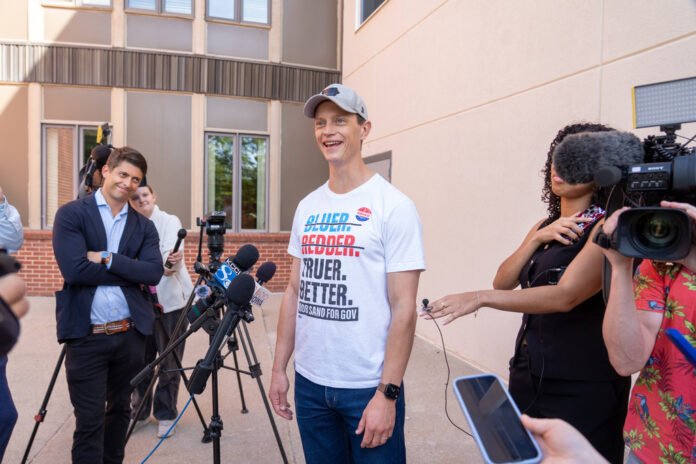
Story Highlights
- Businessman Zach Lahn defeated Trump-endorsed Rep. Randy Feenstra by less than one percentage point, 37.8% to 37%
- The loss marks the first time a Trump-endorsed candidate for a major office has lost a primary outright in the 2026 cycle
- Lahn was backed by the MAHA movement and ran on a platform challenging corporate agriculture and pharmaceutical companies
What Happened
President Donald Trump saw his first major primary loss of the 2026 midterm election cycle in Iowa’s Republican gubernatorial primary as businessman Zach Lahn defeated Rep. Randy Feenstra. Lahn narrowly defeated Feenstra by just less than one point. Feenstra’s primary loss came less than a week after Trump formally backed Feenstra, calling him “MAGA all the way!” in a post on Truth Social. The Hill
With 99% of the expected vote counted, Lahn had 37.8% of the vote to 37% for Feenstra. It is the first time in the midterm elections that a Trump-backed candidate for governor, the House, or the Senate has lost a primary. NBC News
The loss was particularly striking because Feenstra had long been viewed as the race’s front-runner. A four-term congressman with support from much of Iowa’s Republican establishment, he secured endorsements from prominent state Republicans including former Governor Terry Branstad, Senator Joni Ernst, and Representative Mariannette Miller-Meeks. Then, four days before the election, Trump weighed in personally, praising Feenstra as “MAGA all the way.” In most Republican primaries, that would have been enough. Time
Lahn aligned himself with Health and Human Services Secretary Robert F. Kennedy Jr.‘s “Make America Healthy Again” movement, and an outside group supporting him painted Feenstra as soft on immigration. He also appeared to benefit from an endorsement of his own — that of former Rep. Steve King, who lost to Feenstra in a bitter 2020 House primary. Lahn was leading Feenstra in 16 of the 19 counties King won in that contest when the race was called. NBC News
Lahn was able to gain traction as he overtook Feenstra in fundraising, adding to his own $2 million personal loan which kicked off the campaign. He also found support as a Republican candidate who affiliated himself with the MAHA movement. Iowa Capital Dispatch
Why It Matters
The Iowa result matters not simply as a single primary outcome but as a leading indicator of structural shifts within the Republican coalition. Trump’s endorsement has functioned since 2016 as arguably the most powerful tool in Republican politics, capable of clearing crowded fields, saving incumbents, and elevating unknowns to national prominence. An endorsement handed out just four days before the election — late, but deliberate — still failed to deliver. That outcome will be studied carefully by Republican strategists, candidates, and donors across the country.
The MAHA movement’s role in this race is particularly significant. Kennedy’s coalition, which has clashed with the Trump administration on issues ranging from pesticide regulation to pharmaceutical policy, demonstrated that it can mobilize enough grassroots energy to defeat an establishment Republican backed by the president himself. This opens a new political fault line within the GOP — not between Trump loyalists and moderates, as in previous cycles, but between competing visions of what conservative governance should prioritize.
For Iowa’s general election in November, the result creates unexpected competitive dynamics. Republicans have not lost a gubernatorial race in Iowa since George W. Bush was president. The loss encouraged Democrats who are hopeful they can flip control of the governor’s office. Democratic state Auditor Rob Sand, who faces Lahn in November, will enter the general election with a narrative advantage: Republican infighting and a primary process that rejected the president’s chosen candidate. MS NOW
The deeper significance of this result lies in what it says about voter motivations in a post-Trump political environment. Lahn’s campaign centered on fighting corporate agriculture and pharmaceutical companies — themes that resonated with rural Iowa voters experiencing the economic pressures of industrial farming consolidation. These are not traditional Republican talking points, and their success suggests that the economic anxieties driving some conservative voters are not fully captured by the MAGA framework Trump has defined.
Economic and Global Context
Iowa is one of the most agriculturally significant states in the nation, producing a disproportionate share of America’s corn, soybeans, pork, and ethanol. The political dynamics that shaped this primary have direct economic roots. Large-scale corporate consolidation in the agriculture sector — often referred to as “big ag” — has concentrated market power among a small number of multinational firms, squeezing independent farmers on both input costs and commodity prices.
Lahn’s explicit campaigning against agricultural monopolies resonated in a state where many farmers have watched their economic autonomy erode over decades. His victory signals that voters in key agricultural states are receptive to populist economic messaging that cuts across the traditional left-right divide — a dynamic that could have implications for federal agricultural policy, including pending Farm Bill negotiations and antitrust enforcement in the food and beverage sector.
Nationally, the MAHA movement’s electoral foothold has potential consequences for pharmaceutical regulation and food safety standards. Kennedy, as HHS Secretary, has already signaled interest in reviewing the approval processes for pesticides and food additives. A Lahn governorship in Iowa could amplify those policy preferences at the state level, creating a testing ground for MAHA-aligned regulatory approaches that could influence the national debate.
International agricultural markets will also be watching. Iowa’s policy environment affects export volumes for corn, soybeans, and pork — commodities central to U.S. trade relationships with China, Japan, and Mexico. Shifts in state agricultural policy or regulatory posture could ripple through global supply chains that depend on consistent American production.
Implications
For Trump, the Iowa loss presents a calibration challenge. His political brand depends heavily on the perception of endorsement invincibility, and that perception has now sustained a notable crack. If other primary candidates in competitive 2026 races begin calculating that a Trump endorsement is insufficient — or potentially a liability in certain constituencies — the dynamics of Republican primaries could shift meaningfully in the weeks and months ahead.
For Feenstra, the defeat is a career-altering setback. A four-term congressman with strong establishment credentials, he entered the race as the prohibitive favorite and exits without the nomination. His future in Republican politics is uncertain, particularly given the bitter loss to Lahn and the implied rebuke of a race decided by less than a single percentage point.
For the MAHA movement, the Iowa result represents a watershed moment. Having successfully backed a winning candidate against a Trump endorsee in a deep-red state, the coalition now has proof of concept for its electoral strategy. Expect Kennedy and MAHA-aligned organizations to invest more aggressively in future primary races, using Iowa as a template for identifying districts and states where their message on health, food, and pharmaceutical policy can outperform establishment Republican alternatives.
For Democrats, the lesson is strategic. Lahn enters the general election as a candidate who has already demonstrated the ability to defy expectations. Rob Sand will need a well-funded, disciplined campaign to capitalize on the opportunity the primary result has opened — and will need to avoid overreading a primary fracture as a guarantee of general election advantage.
Sources
Iowa hands Trump first major statewide primary loss of 2026 in governor’s race