Story Highlights
- Trump said Jan. 6 defendants who attacked officers should not necessarily receive payouts, but declined to close the door, saying “I have to see it”
- The DOJ’s proposed $1.8 billion anti-weaponization fund was formally halted by a DOJ attorney in a court filing on Friday
- A federal judge had already temporarily blocked the fund on May 29 pending litigation
What Happened
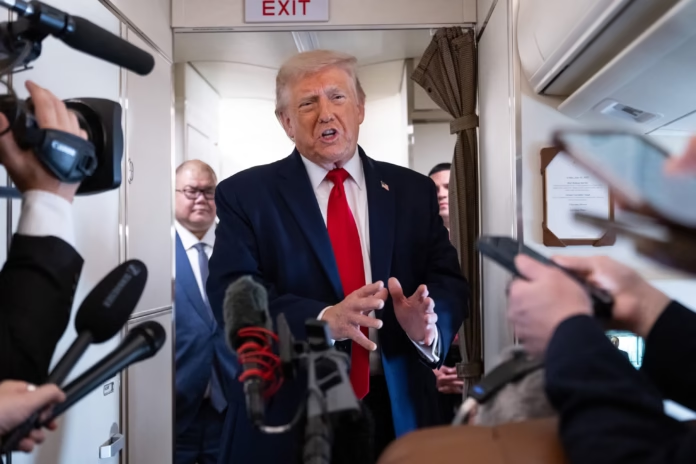
President Donald Trump sat for an interview with “Meet the Press” moderator Kristen Welker, taped Friday at a farmers’ roundtable in Chippewa Falls, Wisconsin, and broadcast Sunday. The interview covered a broad range of subjects, but the most explosive exchange came when Welker pressed the president on whether individuals convicted of attacking police officers during the January 6, 2021 Capitol riot deserved taxpayer compensation.
When asked directly whether those who pleaded guilty to assaulting officers should receive payouts, Trump said: “I wouldn’t be inclined to say so, but I have to see it.” He then pivoted to defending the broader class of January 6 defendants, arguing that many had been unfairly prosecuted and had suffered severe personal consequences including lost jobs, broken families, and in some cases suicide.
The exchange thrust the administration’s proposed “anti-weaponization” fund back into the spotlight at precisely the moment the DOJ was trying to quietly shelve it. Acting Attorney General Todd Blanche had told a House Appropriations subcommittee on June 2 that the administration was “not moving forward with the fund, period.” A DOJ attorney made that position official in a court filing on Friday.
Yet Trump on Sunday still called the fund “a great idea” and said he would be “disappointed” if Congress failed to approve it. The contradiction — the DOJ withdrawing the fund in court while the president endorsed it on national television — left lawmakers and legal observers scrambling to understand the administration’s actual policy position. More than 1,580 people were federally charged in connection with the January 6 riot, with over 1,000 pleading guilty.
Trump also appeared to question the validity of guilty pleas entered by some defendants, claiming many “pled guilty because they were frightened” and were “ushered into” the Capitol rather than having willfully breached it — a characterization that contradicts prosecutors’ and judges’ findings across hundreds of cases.
Why It Matters
The anti-weaponization fund, originally valued at nearly $1.8 billion, was conceived as a mechanism to compensate individuals whom the Trump administration characterizes as victims of politically motivated prosecutions under the Biden administration. While Trump allies have framed the fund as a corrective to institutional abuse, critics argue it represents an unprecedented use of federal dollars to reward criminal defendants and insulate the president’s political base from legal consequences.
The practical and constitutional questions surrounding the fund are significant. A federal judge issued a temporary restraining order against it on May 29, and the lawsuit behind that ruling remains active. The DOJ’s formal statement that the fund would not proceed was intended to signal institutional retreat — yet the president’s Sunday comments muddy that picture considerably, raising questions about whether the administration’s legal posture and its political posture are in alignment.
For Congress, the interview creates a difficult assignment. Republicans on Capitol Hill must now navigate a president who publicly endorses a fund that their own Justice Department has shelved. The episode also reignites debate over the appropriate use of executive authority, particularly in areas where the administration’s legal standing is actively contested in federal court.
For the American public, Trump’s refusal to unambiguously exclude police-assaulting rioters from potential payouts is a politically and morally charged statement. Approximately 221 individuals were found guilty at contested trials, and prosecutors documented incidents of extreme violence, including a defendant who was sentenced to 20 years for stomping on an officer’s head.
Economic and Global Context
The financial dimensions of the anti-weaponization fund are rooted in a separate legal matter. The nearly $1.8 billion figure reportedly originated from an IRS settlement related to the leak of Trump’s tax returns — a significant piece of context that has received limited public attention. The fund’s structure would have routed that settlement money into compensation for individuals deemed victims of government overreach, a novel and legally contested mechanism.
Internationally, the optics of a sitting U.S. president suggesting potential compensation for those who violently disrupted a constitutional certification process send a complicated signal to allies and democratic partners who already view America’s institutional stability with increasing concern. European governments and press corps have followed the January 6 accountability debate closely as a benchmark of American democratic health.
Domestically, the episode arrives against a backdrop of elevated inflation — consumer prices rose 3.3 percent year-over-year through March — and ongoing economic disruption tied to the Iran war. Public spending debates are particularly sensitive at a moment when federal fiscal resources are stretched and voters are feeling cost-of-living pressures acutely.
The DOJ’s legal costs defending the fund — against an active lawsuit — represent an additional, if modest, drain on federal resources. More broadly, the legal uncertainty around the fund’s status has created administrative limbo for the hundreds of individuals who may have anticipated eligibility for compensation.
Implications
The most immediate consequence of Trump’s Sunday interview is renewed congressional attention to the fund’s status. Republican lawmakers who had hoped the issue was resolved by the DOJ’s court filing now face pressure to either publicly contradict the president or endorse a proposal that puts them on record supporting potential payouts to individuals who attacked law enforcement officers.
For the legal system, Trump’s characterization of guilty pleas as coerced and his broad sympathy for January 6 defendants could influence pending clemency and pardon decisions. The administration has already issued pardons for a significant number of January 6 defendants since the start of Trump’s second term, and the Sunday interview suggests that process may not be complete.
The interview’s abrupt ending — Trump walked off set after becoming visibly frustrated during a back-and-forth about election interference and press criticism — adds another dimension to the story. The confrontational dynamic between the president and independent media organizations shows no sign of easing, and future high-profile interviews may face similar disruptions.
For voters and accountability advocates, the exchange is a defining moment in the ongoing national conversation about January 6. How the Republican Party manages this episode — and whether any members break with the president on the question of payouts for police assailants — will be a telling indicator of the institution’s independence heading into the next electoral cycle.
Sources