Story Highlights
- Trump told NBC’s Kristen Welker that new Fed Chair Kevin Warsh is “fantastic” and should act independently on rates
- Trump simultaneously criticized the prospect of rate hikes as “unfair,” arguing the strong jobs report doesn’t justify tighter policy
- Futures markets currently price in a 61 percent probability that the federal funds rate will be higher at year’s end than it is today
What Happened
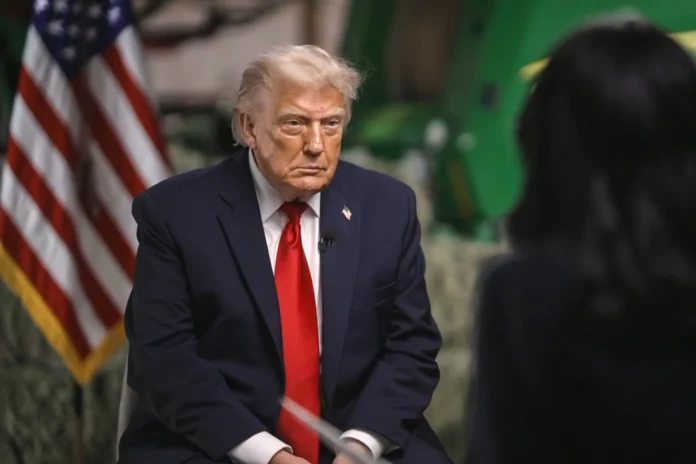
President Donald Trump, in his Friday interview with “Meet the Press” moderator Kristen Welker, addressed the Federal Reserve directly, offering praise for new Chair Kevin Warsh while making clear his own policy preferences. “Kevin is fantastic, and I want him to do whatever he wants,” Trump said. “I don’t want to have a big influence on him. But we had a great report. We’re doing great, and it’s unfair that whenever you do great, they want to raise interest rates.”
The statement reflects the inherent contradiction that has defined Trump’s relationship with the Fed throughout both of his terms. Publicly, the president has at various times insisted he respects the Fed’s independence; privately and in public forums, he has repeatedly pressed for lower borrowing costs and criticized Fed leadership when rates did not move in his preferred direction.
Warsh, 56, was confirmed by the Senate and sworn in at a White House ceremony in late May, becoming the 11th Fed chair of the modern era and succeeding Jerome Powell, who served eight years and will remain as a governor. At the swearing-in, Trump told Warsh: “I want Kevin to be totally independent. Don’t look at me, don’t look at anybody.” Hours later, at a rally, Trump told the crowd that interest rates would come down “very quickly.”
Warsh himself has declined to make Trump any promises on rates. In prior public statements, he suggested some openness to cuts but also has a track record from his earlier stint as a Fed governor of favoring tighter monetary policy. His first FOMC meeting as chair is scheduled for next month.
Why It Matters
The Federal Reserve’s interest rate decisions are among the most consequential economic levers in the American system, affecting mortgage costs, credit card rates, business investment, and the broader pace of economic growth. With inflation running above the Fed’s 2 percent target — driven by energy price shocks from the Iran war and the closure of the Strait of Hormuz — Warsh faces an environment where rate cuts are not only unlikely but where a hike may be necessary.
The May jobs report showed the economy added 172,000 positions while the unemployment rate held steady, providing a picture of labor market resilience that, under normal circumstances, would not argue for easing. But energy inflation is complicating that picture in ways that make the Fed’s standard analytical frameworks difficult to apply cleanly.
Trump’s public comments on the Fed matter beyond his personal preferences. Markets parse presidential remarks on monetary policy closely, and any signal that the executive branch is pressuring the independent Fed can trigger uncertainty in bond markets, currency markets, and equity valuations. That volatility is itself a form of economic cost, particularly for businesses trying to plan capital expenditures over multi-year horizons.
Warsh’s ability to lead an effective monetary policy operation will depend in part on his credibility with financial markets as an independent actor. If his decisions track Trump’s stated preferences too closely, that credibility erodes. If they do not, he may face the same public criticism that defined Powell’s tenure.
Economic and Global Context
The inflation picture facing the new Fed chair is sobering. A survey of professional economic forecasters published by the Philadelphia Fed showed projections for CPI to surge to 6 percent in the current quarter — more than double the prior projection of 2.7 percent. Core CPI, which strips out food and energy, was projected at 3.2 percent, up from 2.8 percent in the previous survey.
After cutting rates at three consecutive meetings to close out 2025, the Fed paused in January and again in late April, holding its benchmark rate in the 3.5-to-3.75-percent range. The April FOMC vote was 8-to-4 to hold steady, with Trump-appointed board members providing the dissents in favor of cuts — a pattern that has characterized recent Fed deliberations and set up a structurally divided committee for Warsh to manage.
Globally, elevated U.S. interest rates have ripple effects across emerging market economies that carry dollar-denominated debt, and can strengthen the dollar in ways that complicate trade balances. The Iran war and Hormuz disruption have already sent shock waves through global energy markets; a tighter-than-expected Fed policy response could add pressure to fragile sovereign debt situations in multiple countries.
Implications
The most immediate implication of Trump’s Sunday comments is that markets now have an on-the-record signal of the president’s preferences heading into Warsh’s first FOMC meeting in July. Warsh will face intense scrutiny: any rate cut will be seen as accommodation to Trump, while a rate hike — increasingly what market pricing suggests may be necessary — will test the new chair’s political fortitude and the administration’s stated commitment to Fed independence.
For American homeowners and prospective buyers, a rate hike scenario is directly painful. Mortgage rates, already elevated relative to the pre-pandemic period, would rise further, deepening the affordability crisis that has frozen housing market activity. Businesses with variable-rate credit facilities would face higher carrying costs, potentially constraining hiring and capital spending.
For Congressional Republicans, Trump’s comments place them in familiar uncomfortable territory — nominally supportive of Fed independence as a matter of institutional principle, but aligned with a president who clearly expects that independence to move in one direction. The political pressure Warsh will face from the White House is not theoretical; it is embedded in every presidential public statement.
Longer term, the question of whether Warsh can establish genuine independence from the executive branch — or whether his tenure becomes another chapter in the erosion of Federal Reserve autonomy — will have lasting consequences for U.S. monetary credibility and the dollar’s role as the world’s reserve currency.
Sources
“Trump says Fed chair should ‘do whatever he wants’ but criticizes possible interest rate hikes”