Story Highlights
- Trump claimed, without evidence, that California’s June 3 primary elections were “rigged” due to slow mail-in ballot counting
- California election officials say the drawn-out tally is by design and legally required, not the result of fraud
- Trump abruptly ended the NBC interview after becoming visibly frustrated, departing the set before the scheduled conclusion
What Happened
During his “Meet the Press” interview taped Friday in Chippewa Falls, Wisconsin, President Donald Trump made a series of unsubstantiated allegations about the California gubernatorial and Los Angeles mayoral primaries held June 3. Trump pointed to the fact that results were still being tabulated four days after polls closed as evidence of wrongdoing, claiming officials “aren’t even close” to finishing the count and characterizing the situation as proof that Democrats were “cheating.”
“They are dropping fast because it’s a rigged election,” Trump said, referring to Republican candidates losing ground as mail-in ballots were processed and added to totals — a well-documented and legally mandated process in California known as “ballot curing.”
California election officials swiftly pushed back. The state’s laws require counties to accept mail-in ballots postmarked by Election Day and received up to several days later. Election administrators had publicly warned before the June 3 vote that results would take time, and Governor Gavin Newsom had sent a letter to election officials the previous month specifically warning that delays could fuel disinformation campaigns. As of June 5, over 6 million gubernatorial primary ballots had been counted, with an estimated 3 million still in process.
California Democratic Party Chairperson Rusty Hicks rejected Trump’s claims outright, and Secretary of State Shirley Weber challenged the administration to produce evidence. The U.S. Attorney’s Office for the Los Angeles district, which Trump claimed was investigating the elections, declined to comment when contacted by news organizations.
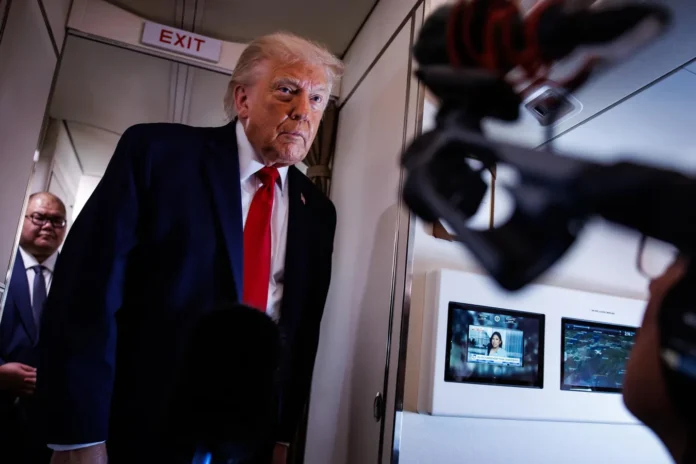
The interview concluded dramatically when Welker pressed Trump on his election interference claims and his criticisms of the press. Trump became visibly agitated, rose from his seat, and ended the interview early, departing the set and leaving NBC without the planned conclusion to the session.
Why It Matters
Trump’s California election claims are not new — he has alleged fraud in the state’s elections repeatedly, dating to the 2020 presidential race, the 2021 gubernatorial recall, and a 2025 congressional redistricting vote. In each instance, no court, independent body, or law enforcement agency has validated the allegations. The consistency of the pattern makes the current episode both predictable and significant: the president of the United States is systematically undermining public confidence in elections in the nation’s most populous state.
The mechanics of California’s vote-counting process make it a perennial target for such claims. The state’s mail-in voting system — available to all registered voters — produces a prolonged counting period that routinely results in results shifting over days and weeks, often in favor of Democrats as urban and suburban mail ballots come in. This shift is sometimes called the “blue shift,” and it is entirely a product of California’s legal election structure, not manipulation.
Election integrity experts have uniformly confirmed that slow counts in California reflect legal compliance, not fraud. Yet the president’s platform on Truth Social and his access to national broadcast media allow these claims to reach millions of Americans who may not be familiar with California’s election administration procedures, seeding doubt in ways that are difficult to counter after the fact.
The confrontational ending to the interview also matters institutionally. A sitting president walking off a nationally televised interview in frustration is not routine. It signals the administration’s continued hostility toward independent press scrutiny and raises questions about the conditions under which the president is willing to engage with journalists outside of controlled environments.
Economic and Global Context
California is not merely a political battleground — it is the world’s fifth-largest economy, with a GDP exceeding $4 trillion. The state’s political stability and governance directly affect business confidence, investment decisions, and the broader functioning of American economic institutions. When a sitting president repeatedly and baselessly alleges fraud in California elections, it creates a climate of uncertainty that has tangible downstream consequences.
The June 3 primaries were consequential on their own terms, determining who will compete in the fall general elections for governor and who will challenge Los Angeles Mayor Karen Bass in a runoff. The LA mayoral race had particular national visibility: City Council member Nithya Raman, a Democrat, took a narrow lead over former reality TV personality Spencer Pratt, a registered Republican, in the contest for the second runoff slot.
Internationally, repeated American presidential claims of election fraud — particularly when made without evidence and subsequently not validated — continue to complicate the U.S.’s role as an advocate for democratic governance in other nations. Authoritarian governments have cited Trump’s fraud claims, from 2020 through the present, as evidence that American democracy is dysfunctional.
The federal government’s relationship with California has been strained throughout Trump’s second term, touching areas ranging from immigration enforcement to education funding. Election integrity disputes add another layer of conflict to an already adversarial dynamic between the White House and the state’s Democratic leadership.
Implications
The immediate political implications of Trump’s California claims fall primarily on the state’s Republican Party, which must decide how closely to align itself with the president’s fraud narrative. California Republicans are already operating in a deeply challenging environment, and an association with election-denial politics that voters have consistently rejected could further complicate their path in the November general elections.
For federal-state relations, Trump’s suggestion that the U.S. Attorney’s Office is investigating California’s elections — a claim that office neither confirmed nor denied — raises the possibility of federal intervention in state-administered elections. That prospect, if it were to materialize without evidentiary basis, would represent a significant escalation with serious constitutional implications regarding states’ rights over election administration.
For the broader American media environment, Trump’s decision to walk off the “Meet the Press” set raises difficult questions about how major networks should approach presidential interviews when a subject refuses to engage with factual challenges. The incident will likely intensify internal discussions at news organizations about interview formats, fact-checking protocols, and the terms under which future presidential access is negotiated.
For voters — in California and nationally — the episode is another data point in an ongoing debate about the health of American democratic institutions. Whether the president’s fraud claims are understood as good-faith concerns or deliberate disinformation will depend substantially on whether credible evidence ever emerges — and if history is a guide, it will not.
Sources
“President Trump storms off NBC interview after claiming California election was ‘rigged'”