Story Highlights
- Representatives Jason Crow, Chrissy Houlahan, Chris Deluzio, and Maggie Goodlander introduced the House version of the bill on June 10
- All four sponsors were previously targeted by Trump administration indictment attempts that a federal grand jury rejected in February 2026
- The bill would bar taxpayer payments to Trump, his associates, Jan. 6 participants, and restrict DOJ settlement fund use by sitting presidents
What Happened
Representatives Jason Crow of Colorado, Chrissy Houlahan of Pennsylvania, Chris Deluzio of Pennsylvania, and Maggie Goodlander of New Hampshire introduced the House version of the Drain the Slush Fund Act on Wednesday, joining their Senate counterparts in a coordinated legislative push against the Trump administration’s controversial “anti-weaponization” fund.
The bill’s sponsors share an unusual distinction: all four were among the House members whom the Trump administration attempted to indict earlier this year. A federal grand jury in Washington rejected those indictment attempts in February 2026, along with parallel attempts against Senators Mark Kelly and Elissa Slotkin — two of the three Senate sponsors of the companion bill. The fifth senator in that group was Adam Schiff of California. Their prosecution had been sought in connection with a “Don’t Give Up the Ship” video that encouraged military and intelligence community members not to follow unlawful orders.
The Drain the Slush Fund Act targets the $1.776 billion “Anti-Weaponization Fund” that acting Attorney General Todd Blanche unveiled in May as a mechanism to compensate individuals who claimed to have been victimized by the “weaponization” of the federal government under the Biden administration. The fund generated swift bipartisan backlash when it became apparent it could benefit Jan. 6 participants, Trump associates, and others convicted of federal crimes. A federal court in Virginia temporarily blocked the fund, and the DOJ subsequently announced it would scrap the scheme entirely — though it maintained it had acted lawfully.
The legislation would formally prohibit taxpayer dollars from being directed to Trump, his associates, individuals convicted of crimes, or anyone involved in the January 6, 2021 attack on the Capitol. It would also place structural restrictions on the DOJ’s broader settlement fund, barring payments on claims or lawsuits filed by a sitting president or vice president, retroactive to January 20, 2025.
Senate Minority Leader Chuck Schumer has pledged to use floor amendments, oversight actions, and legislative vehicles to ensure the fund cannot be reconstituted under a different name or mechanism.
Why It Matters
The introduction of the House version of the Drain the Slush Fund Act is significant not just for its specific provisions but for what it reveals about the structural accountability crisis at the heart of the Trump administration’s second term. The $1.8 billion fund represented an attempt to use the DOJ’s legal settlement machinery — a mechanism originally designed to compensate ordinary Americans harmed by government wrongdoing — to instead direct federal money toward the president’s political beneficiaries. That the fund was ultimately abandoned reflects the limits of what the administration can accomplish when its actions are visible and politically costly.
However, the fund’s formal abandonment does not resolve the underlying legal architecture that made it possible. The DOJ settlement fund and the Judgment Fund, which were the vehicles through which the anti-weaponization scheme was constructed, remain available to future administrations. Without statutory guardrails of the kind the Drain the Slush Fund Act would impose, there is nothing to prevent a reconstituted version of the same mechanism from being deployed at a later date with greater political cover.
The bill’s sponsors include four members of Congress who have direct personal knowledge of what it means to be on the receiving end of a politically motivated prosecution attempt. Their credibility as witnesses to DOJ overreach is difficult to dismiss — they are not speaking theoretically about the risks of unchecked prosecutorial power, but from documented personal experience. That context gives the legislation a moral weight beyond its technical provisions.
The broader governance stakes are also significant. If the DOJ can create billion-dollar funds to compensate political allies, direct settlement terms to shield the president from tax enforcement, and pursue indictments against opposition members of Congress, the traditional separation between law enforcement and political governance has effectively collapsed.
Economic and Global Context
The $1.776 billion anti-weaponization fund was derived from a settlement between Trump and the Internal Revenue Service related to a $10 billion lawsuit the president filed over the leaking of his tax returns. The settlement, which critics noted also contained provisions shielding Trump, his family, and his companies from tax audits or enforcement on prior returns, effectively converted a personal legal grievance into a mechanism for distributing federal funds to political allies.
The settlement structure raised immediate questions among tax law experts about the appropriate use of the DOJ’s settlement authority, which was not designed for this purpose. The Congressional Budget Office does not score legal settlements the same way it scores direct appropriations, creating a potential avenue for significant fiscal commitments to be made outside the normal legislative appropriations process.
Internationally, allied governments and multilateral institutions have been watching the evolution of DOJ independence under Trump’s second term with increasing attention. The fund drew commentary from European legal scholars, several of whom noted that using prosecutorial settlement authority to reward political allies would be considered a rule-of-law violation in most democratic systems.
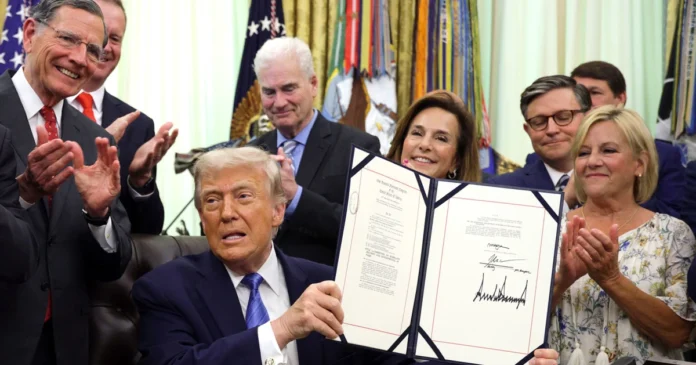
The fund’s collapse also created a secondary complication for the immigration enforcement funding package signed Wednesday, as Republican opposition to the anti-weaponization mechanism delayed that bill’s passage for weeks.
Implications
The immediate legislative prognosis for the Drain the Slush Fund Act is constrained by Republican majorities in both chambers. Without a significant number of Republican co-sponsors — who have expressed concern about the fund but have not yet committed to formal legislation — the bill is unlikely to advance through committee. Its primary value in the near term is as a public accountability tool, forcing members of both parties to go on record about whether taxpayer money should fund the president’s political allies.
For the four House Democrats who introduced the bill, the legislation serves an additional purpose: it documents the full cycle of their experience with the Trump DOJ, from indictment targeting to legislative response. That record will likely feature prominently in their midterm campaigns and will provide a template for how Democrats frame DOJ accountability as an electoral issue.
The lasting significance of this episode may be the precedent it sets for what future administrations — of either party — can attempt through the legal settlement mechanism. If no statutory reform results, the blueprint for routing political payments through DOJ settlement machinery will remain on the books, available to the next administration willing to use it.
Sources
“Live updates: Trump signs ICE funding bill; Maine and California midterms take shape”