Story Highlights
- Newsom said federal agents contacted more than a dozen friends, former employees, and associates of his and his wife as part of an apparent investigation
- A source told multiple outlets the inquiry includes scrutiny of Jennifer Siebel Newsom’s nonprofit, the California Partners Project, and its behested payments
- Newsom’s office filed a Freedom of Information Act request seeking DOJ records and communications related to the investigation’s origins
What Happened
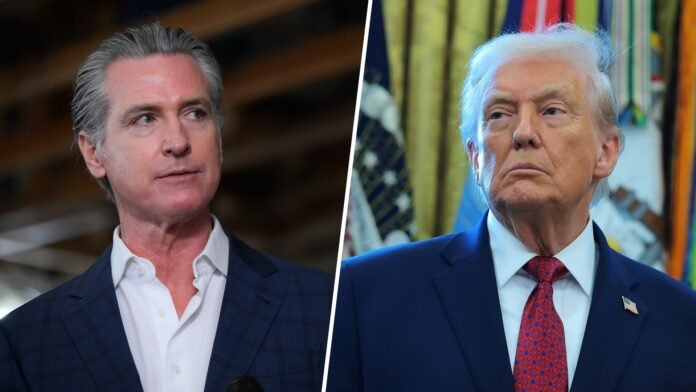
Governor Gavin Newsom announced on June 15 that he and his wife, Jennifer Siebel Newsom, had been placed on what he described as President Trump‘s “hit list” for Justice Department scrutiny. In a video posted to social media, Newsom said federal agents had “knocked on the doors of family friends and former employees,” adding that investigators were not pursuing a known crime but rather “trying to find one.” He said the Department of Justice was “abusing the grand jury process” by demanding what he characterized as years of unrelated personal records.
According to Newsom’s office, more than a dozen people connected to the governor and his wife, including friends, donors, business associates, and former staff, were contacted by FBI and IRS agents. A fact sheet released by Newsom’s office stated that the inquiry expanded into “increasingly personal matters involving the Governor’s family and professional network” after Todd Blanche, a former personal attorney for Trump, became acting head of the Justice Department. Sources familiar with the matter told several news organizations that the investigations had been underway for roughly a year, originating with whistleblower tips handled by federal prosecutors in California’s Eastern District, based in Sacramento, and that Washington was not directly involved in the decision to open the inquiry.
One thread of the investigation reportedly concerns Jennifer Siebel Newsom‘s nonprofit organization, the California Partners Project, which has received more than $5 million in so-called behested payments, donations solicited by public officials on behalf of charitable organizations, since 2020. California law requires disclosure of such payments above certain thresholds but does not generally cap their size. A second thread relates to Dana Williamson, Newsom’s former chief of staff, who pleaded guilty in May to conspiracy to commit bank and wire fraud, filing a false tax return, and making false statements to federal investigators in a case connected to a dormant campaign account belonging to former Health Secretary Xavier Becerra. Newsom’s office has said Williamson’s conduct was unrelated to the governor and that the broader investigation has since widened to include additional aides.
In response, Newsom’s office filed a Freedom of Information Act request seeking internal Justice Department communications, including emails, memoranda, and text messages referencing the governor or first partner, dating back to the start of Trump’s second term. The request specifically names former Attorney General Pam Bondi, former acting Deputy Attorney General Emil Bove, and Blanche. The Justice Department has not confirmed or denied the existence of a formal investigation into Newsom himself, and a spokesperson declined to comment when contacted by multiple news organizations.
Why It Matters
The episode lands amid a documented pattern of federal investigations and indictments touching prominent critics of the president, including former FBI Director James Comey, New York Attorney General Letitia James, Senator Adam Schiff, and Minnesota Governor Tim Walz. Taken individually, each case carries its own legal particulars, but taken together, they have fueled a broader debate about whether the Justice Department under the current administration is being used to pursue the president’s political adversaries rather than to enforce the law in a manner insulated from political direction, a principle that has guided the department’s internal norms for decades regardless of which party controls the White House.
For the broader system of checks on executive power, the central concern raised by legal observers is not whether any particular investigation will ultimately produce charges, but whether the mere existence of federal scrutiny, triggered by political criticism rather than evidence of wrongdoing, has a chilling effect on elected officials’ willingness to challenge the administration publicly. Newsom’s decision to publicize the investigation himself, rather than allow it to proceed quietly, reflects a calculated bet that transparency offers more protection than silence, a strategy that itself signals how unusual the political moment has become.
For voters, the dispute over the Newsom investigation underscores a recurring theme of accountability politics: when the agency responsible for enforcing the law is itself accused of selective or retaliatory enforcement, the normal checks, congressional oversight, inspector general review, and judicial scrutiny, become the only remaining mechanisms capable of testing those allegations, and each of those mechanisms has faced its own pressures over the past year.
For other elected officials, particularly those weighing future national campaigns or sustained public criticism of the administration, the episode offers a cautionary data point about the practical costs of high-profile opposition, regardless of whether the underlying investigations ultimately substantiate any wrongdoing.
Economic and Global Context
While the Newsom investigation itself is not primarily an economic story, it intersects with a broader federal enforcement initiative targeting California specifically. Federal prosecutors have separately pursued what has been described as a “Fraud Investigation of California,” examining alleged misuse of federal funds in state homelessness and healthcare programs. Prosecutors have claimed that Los Angeles County alone accounts for 18 percent of national home healthcare billing and have identified up to $3.5 billion in potential fraud connected to that billing activity, though officials have not directly tied those figures to Newsom or his administration.
The behested payments at the center of one thread of the inquiry, more than $5 million directed to Siebel Newsom’s nonprofit since 2020, illustrate a broader feature of California’s campaign finance and ethics framework, which permits substantial charitable solicitations by public officials with disclosure requirements but no overall cap, a structure that has drawn scrutiny from ethics watchdogs across the political spectrum independent of the current dispute.
Globally, the pattern of investigations into domestic political figures who criticize the administration has drawn attention from international rule-of-law observers, who have noted that the use of federal law enforcement against political opponents is more commonly associated with systems lacking robust independent judiciaries, a comparison that itself has become part of the domestic political argument surrounding these cases regardless of their ultimate legal outcome.
Implications
In the near term, the central procedural question is whether the Justice Department responds to Newsom’s FOIA request within the legally required 20-day window, and if so, what those records reveal about how and why the investigations were initiated. Newsom’s office has signaled it intends to use any released records as the basis for further public accountability efforts regardless of the investigation’s ultimate disposition.
For the Justice Department, continued public scrutiny of the Newsom matter adds to an already substantial list of cases in which its charging and investigative decisions involving the president’s political critics have drawn legal and public challenges, a pattern that could affect the department’s institutional credibility in future, unrelated prosecutions if courts or Congress conclude that political considerations played a determinative role.
For Newsom personally, the investigation, whatever its outcome, has become entangled with his political future, including persistent speculation about a 2028 presidential campaign. Recent polling has shown him trailing other potential Democratic contenders nationally, and how he navigates the investigation, whether it produces charges, fades quietly, or becomes a defining grievance in a future campaign, will likely shape his political trajectory regardless of the legal merits.
For Congress, the Newsom case adds to a growing list of episodes that congressional Democrats have cited in calling for stronger oversight of Justice Department charging decisions, though any legislative response would require a level of bipartisan agreement on executive branch oversight that has proven difficult to achieve in the current Congress.
Sources