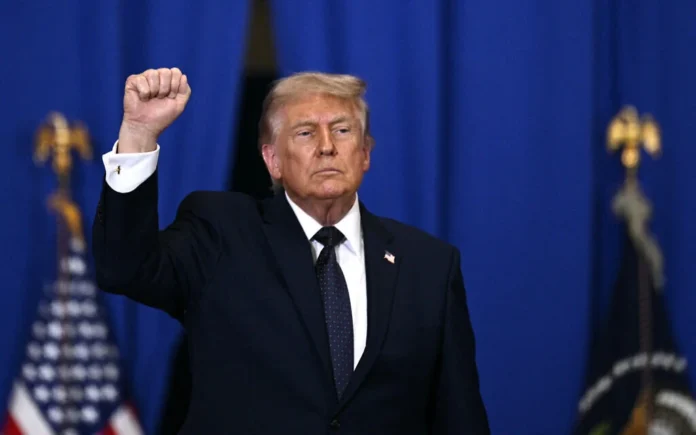
President Trump said Monday the United States will prevail in its conflict with Iran through either a negotiated deal or continued military pressure, as Tehran held major funeral processions for slain Supreme Leader Ayatollah Ali Khamenei. The remarks came amid a paused diplomatic track, a suspected attack on a tanker near the Strait of Hormuz, and continued uncertainty over the whereabouts of Khamenei’s son and successor, Mojtaba Khamenei. The combination of unresolved hostilities and an uncertain Iranian leadership transition has kept the region on edge even as mourning ceremonies dominate headlines out of Tehran.
Story Highlights
- Trump said the U.S. would either reach a deal with Iran or finish the job militarily
- Talks between Washington and Tehran remain paused during the multiday funeral for Ayatollah Khamenei
- A tanker near the Strait of Hormuz was reportedly struck by an unknown projectile, with no casualties reported
What Happened
Speaking to reporters in the Oval Office on Monday, President Trump said the United States would win its war with Iran one way or another, framing the outcome as either a negotiated settlement or a continuation of military operations. Trump’s comments came as Iran conducted a multiday state funeral for Ayatollah Ali Khamenei, who was killed alongside several family members in a U.S.-Israeli airstrike on February 28 at the outset of the war. Ceremonies have drawn crowds Iranian officials estimate at between 15 and 20 million people across several cities, with events culminating in burial at the Imam Reza shrine in Mashhad.
Diplomatic talks between the United States and Iran have been paused during the funeral period. Iran’s top negotiator has described implementation of the broader agreement between the two countries as difficult but achievable, while Parliament Speaker Mohammad Bagher Ghalibaf used the funeral to reaffirm Iranian support for regional armed groups, including meeting with the head of Hamas’s political bureau. Trump said the pause amounted to Iran receiving what he described as a week off from renewed pressure, while cautioning that the underlying dispute remains unresolved.
Adding to regional tensions, a tanker traveling off the coast of Oman near the Strait of Hormuz was reportedly struck by an unknown projectile, according to a British maritime tracking agency, though no casualties were reported. The incident is the latest in a series of attacks on vessels transiting the narrow waterway, through which a significant share of global oil and natural gas once flowed before the conflict disrupted shipping patterns.
Central to the uncertainty surrounding Iran’s post-war leadership is the continued absence of Mojtaba Khamenei, who was named supreme leader shortly after his father’s death but has not appeared publicly or issued any audio statement since the war began. Officials and people close to his inner circle have said he was seriously wounded in the same airstrike that killed his father, suffering facial disfigurement and significant leg injuries. Three of the late leader’s other sons have appeared at funeral events, but Mojtaba’s continued absence has fueled speculation about his health and about who is actually directing Iranian state affairs during the transition.
Why It Matters
Trump’s insistence on a binary outcome, either a deal or a resumption of military action, signals that the ceasefire reached earlier this year remains fragile and that Washington views the current lull as temporary rather than a durable resolution. That posture will shape how allies, particularly Gulf states and Israel, calibrate their own security postures in the coming weeks.
The uncertainty over Mojtaba Khamenei’s condition and public absence raises serious questions about the stability of Iran’s leadership structure at a moment when major decisions about the war’s future and the Strait of Hormuz’s security are pending. A leadership vacuum, or one perceived as such by hardline factions within the Islamic Revolutionary Guard Corps, could complicate any American effort to negotiate a lasting settlement.
The tanker attack near Hormuz, even absent casualties, underscores the fragility of the current maritime security environment. Continued disruption to that corridor carries direct consequences for global energy markets and reinforces why NATO allies meeting this week in Turkey have placed the strait’s security on their formal agenda.
Economic and Global Context
The Strait of Hormuz historically carried roughly one-fifth of global oil and natural gas shipments before the war disrupted normal transit patterns. Continued attacks on vessels in the waterway, even sporadic ones, have kept energy markets on alert, with traders closely tracking shipping data for signs of a broader closure or extended disruption.
The war has already produced substantial economic damage inside Iran, with military infrastructure and industrial projects destroyed and estimated damages reaching into the billions of dollars. More than 3,000 people were killed during the initial weeks of fighting, including senior political and military officials, according to figures cited by multiple outlets covering the conflict.
Globally, the conflict has reinforced energy-security concerns among allied nations, several of which are exploring alternative supply routes and strategic reserves in case Hormuz traffic becomes unreliable for an extended period. Gulf Arab states hosting American military installations have also faced direct retaliatory pressure from Iran during the fighting, complicating their diplomatic balancing act between Washington and Tehran.
Implications
For the Trump administration, the coming weeks will test whether the paused negotiations can resume once funeral proceedings conclude, or whether the leadership uncertainty in Tehran delays any further diplomatic progress. Much will depend on whether Mojtaba Khamenei ultimately appears publicly and asserts control over Iran’s negotiating position.
For global energy markets, continued instability in the Strait of Hormuz will likely keep oil prices volatile, with any further attacks on shipping raising the prospect of insurance costs rising for vessels transiting the region.
For regional allies, particularly Israel and Gulf states, the ambiguity surrounding Iran’s leadership and the durability of the ceasefire will shape defense planning and diplomatic engagement with Washington in the weeks ahead, especially as Trump prepares for a expected meeting with Israeli Prime Minister Benjamin Netanyahu.
Sources
Trump says U.S. will win Iran war “one way or the other” as Tehran holds funeral for supreme leader