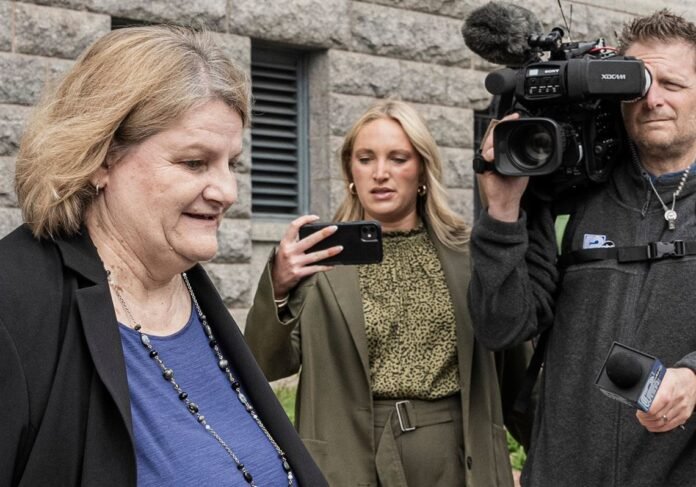
A federal judge on Wednesday sentenced former Milwaukee County Circuit Judge Hannah Dugan to a fine and probation rather than prison time, closing out a closely watched prosecution that became a flashpoint in the broader clash between the Trump administration’s immigration enforcement agenda and the judiciary. The case marked the first time a sitting state judge in Wisconsin stood trial for obstructing federal immigration agents.
Story Highlights
- Dugan, convicted in December of felony obstruction, was fined 5,000 dollars and received one year of probation rather than the up to five years in prison she faced
- U.S. District Judge Lynn Adelman cited Dugan’s otherwise law-abiding record and said prison was not necessary to satisfy sentencing goals
- Dugan helped a defendant facing state charges evade ICE agents who had come to arrest him at the Milwaukee County courthouse in April 2025
What Happened
Former Milwaukee County Circuit Judge Hannah Dugan, 67, was sentenced Wednesday to a 5,000 dollar fine and one year of probation, avoiding prison time despite facing a potential five-year sentence following her December conviction on a felony obstruction charge. U.S. District Judge Lynn Adelman, appointed by former President Bill Clinton, presided over the sentencing and cited Dugan’s decades of public service and otherwise clean record in explaining his decision not to impose incarceration. “I think this is a situation where an otherwise good person, upset by immigration policies in this country, made a bad decision in the moment,” Adelman said from the bench.
The case stemmed from an incident on April 18, 2025, when federal immigration officers arrived at the Milwaukee County courthouse seeking to arrest Eduardo Flores-Ruiz, a 31-year-old man who had reentered the United States illegally and was scheduled to appear in Dugan’s courtroom on a state battery charge. Dugan confronted the agents in a hallway outside her courtroom, telling them their administrative warrant was insufficient to justify an arrest and directing them to the office of the county’s chief judge. After the agents left the area, Dugan led Flores-Ruiz and his attorney out of the courtroom through a private jury door. Immigration officers subsequently spotted Flores-Ruiz in a corridor, followed him outside, and arrested him after a brief foot chase.
A week after the incident, FBI agents arrested Dugan inside the courthouse and led her out in handcuffs, a moment that quickly became a national flashpoint in the debate over the administration’s immigration enforcement tactics and their intersection with judicial independence. A jury convicted Dugan in December of felony obstruction but acquitted her of a separate misdemeanor charge of concealing an individual to prevent arrest. Under federal sentencing guidelines, a presentence report had recommended 15 to 21 months in prison, though prosecutors, who argued for a sentence reflecting the seriousness of what they called an “abuse of trust,” did not make a specific sentencing recommendation.
During Wednesday’s hearing, Dugan’s defense team called character witnesses, including a Marquette University Law School faculty member and a retired restorative justice center director, to testify on her behalf. Dugan herself addressed the court for the first time publicly since the case began, maintaining that her actions were consistent with her understanding of proper courthouse administrative procedure rather than an intentional effort to help Flores-Ruiz escape justice. Executive Assistant U.S. Attorney Richard Frohling, who prosecuted the case, argued that Dugan’s conduct as a sitting judge crossed a clear line that warranted serious consequences. Dugan resigned her judgeship in January amid threats of impeachment from Republican state lawmakers, and her attorneys have said they intend to appeal the underlying conviction regardless of the sentence imposed. Flores-Ruiz was ultimately deported in November.
Why It Matters
The Dugan case sits at the center of an unresolved and increasingly consequential conflict between the judiciary and the executive branch’s immigration enforcement priorities. The administration’s decision to prosecute a sitting state judge for actions taken from the bench, rather than pursuing alternative remedies such as judicial discipline through state channels, represents an aggressive assertion of federal authority that critics argue threatens the independence courts need to function without fear of federal prosecution for judicial rulings and courtroom management decisions they disagree with.
At the same time, supporters of the prosecution argue that no one, including judges, should be permitted to actively obstruct federal law enforcement officers carrying out lawful duties, regardless of their disagreement with the underlying immigration policy. The relatively lenient sentence has already drawn sharp criticism from Trump allies, including Wisconsin congressional Republicans, who argue it undercuts the deterrent effect the prosecution was meant to establish for other judges or officials who might consider similar conduct.
The case also has direct implications for how ICE conducts enforcement operations at courthouses going forward. The administration’s policy of allowing immigration arrests at state courthouses, a departure from more restrictive prior-administration guidance, has prompted pushback in multiple states, including a separate case in New York where a federal judge upheld a state law barring civil immigration arrests at courthouses. The Dugan prosecution will likely continue to shape how judges, court staff, and defense attorneys across the country navigate the tension between courtroom procedure and federal immigration enforcement.
For Wisconsin voters and the broader legal community, Dugan’s felony conviction permanently bars her from serving as a judge again, even though the lenient sentence leaves her still eligible to practice law, an outcome that satisfies neither side of the underlying political debate completely.
Economic and Global Context
While the Dugan case itself carries no direct economic dimension, it is emblematic of the resource-intensive legal battles the administration’s immigration enforcement strategy has generated across the country. Federal prosecutions of state officials for obstruction, combined with related litigation over courthouse arrest policies in multiple states, represent a growing category of federal litigation expense tied to the broader deportation push.
The case also reflects the human cost embedded within the administration’s enforcement statistics. ICE arrested roughly 10,000 people over a five-day period at the end of June alone, translating to approximately 2,000 arrests per day, a sharp increase over previous months, according to data obtained by the Deportation Data Project at UC Berkeley. Courthouse arrests, like the one at the center of the Dugan case, remain a contested subset of that broader enforcement effort.
Internationally, the case has drawn attention as an example of how U.S. domestic immigration enforcement intersects with judicial independence, an issue that resonates in ongoing global conversations about the rule of law and separation of powers amid rising nationalist immigration policies across multiple Western democracies.
Implications
Dugan’s legal team has confirmed plans to appeal her underlying felony conviction, meaning the case is likely to continue working through the federal court system for months or longer, potentially reaching the U.S. Court of Appeals for the Seventh Circuit. The outcome of that appeal could set important precedent regarding the scope of judicial immunity and the boundaries of permissible courtroom management when it intersects with federal law enforcement operations.
For other judges nationwide who may face similar situations involving ICE enforcement in their courtrooms, the case offers a cautionary example of the legal risk involved in taking direct action to delay or redirect federal agents, even when motivated by genuine procedural or humanitarian concerns rather than an intent to permanently shield a defendant from law enforcement.
For the Trump administration, continued aggressive prosecution of state officials who resist federal immigration enforcement is likely to remain a hallmark of its broader strategy, even as the relatively lenient sentence in this high-profile case may prompt internal debate over whether such prosecutions are achieving their intended deterrent effect.
Sources
“Former Wisconsin judge Hannah Dugan spared prison for obstructing ICE arrest of Mexican immigrant”