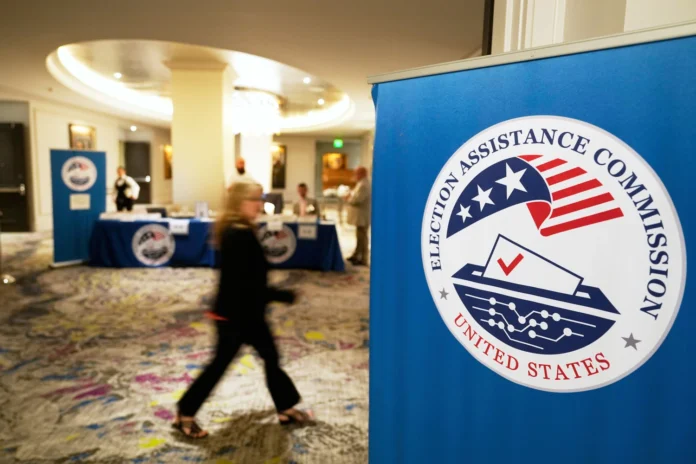
The White House fired the final three sitting commissioners of the U.S. Election Assistance Commission on Thursday, leaving the only federal agency dedicated exclusively to election administration without any leadership just months before the 2026 midterms. The move drew immediate condemnation from Democratic lawmakers and state election officials, who warned it represents an unprecedented consolidation of executive control over the machinery of American elections. The White House defended the action by citing a recent Supreme Court ruling expanding presidential authority to remove officials from independent agencies.
Story Highlights
- All three remaining Election Assistance Commission members were removed Thursday, leaving the bipartisan agency without any commissioners
- Democratic commissioners Thomas Hicks and Benjamin Hovland were fired by email; Republican commissioner Christy McCormick was asked to resign
- The White House cited the Supreme Court’s Trump v. Slaughter decision as legal justification for the dismissals
What Happened
The White House terminated all three remaining commissioners of the Election Assistance Commission on Thursday afternoon, according to multiple people familiar with the dismissals. Democratic commissioners Thomas Hicks and Benjamin Hovland received brief termination emails from White House aide Morgan DeWitt Snow around 4 p.m. Eastern time, while Republican commissioner Christy McCormick was contacted by phone and asked to resign. A White House official later confirmed to multiple outlets that all three commissioners were gone and said they “will be replaced.”
The Election Assistance Commission was created by Congress through the Help America Vote Act of 2002, passed in the aftermath of the disputed 2000 presidential election. Structured as a bipartisan, four-member panel, the agency accredits laboratories that test voting equipment, certifies voting systems used across the states, administers federal election grants, and maintains the national mail voter registration form. With all four seats now vacant — one had already been unfilled prior to Thursday’s dismissals — the commission is effectively unable to carry out any of its statutory responsibilities.
A White House official defended the terminations by invoking the Supreme Court’s ruling in Trump v. Slaughter, which expanded presidential authority to remove officials serving on independent federal agencies without the traditional “for cause” protections that have shielded such commissioners for roughly seven decades. “The President, and head of the Executive Branch, reserves the right to remove individuals that may not be totally aligned with the important task of securing America’s elections and ensuring every legal vote is counted,” the official said, adding that “the Slaughter decision gives the President precedence to do so.”
Presidential appointments to the commission require Senate confirmation, a process that historically has moved slowly and could leave the agency without functioning leadership for an extended period. That timeline is particularly consequential given that the commission plays a role in certifying voting systems and disbursing federal grants to state election offices, both of which are typically ramping up in the months preceding a general election.
Democratic officials responded swiftly and forcefully. Senate Minority Leader Chuck Schumer called the move a “brazen attempt to seize control of our elections before a single vote is cast” and vowed that Senate Democrats would “fight this power grab at every turn.” Virginia Senator Mark Warner said the dismissals “should concern every American, regardless of party,” while Arizona Secretary of State Adrian Fontes accused the administration of being “dead set on causing chaos for our election officials across this country.”
Why It Matters
The Election Assistance Commission occupies a narrow but critical niche in the American election system. Unlike partisan state election offices, it was designed as a bipartisan, technically focused body insulated from day-to-day political pressure, tasked with functions such as certifying the voting machines used by millions of Americans and distributing federal security grants to local election administrators. Removing its entire leadership simultaneously — rather than allowing terms to expire naturally — represents a significant break from the agency’s historical operating norm.
The timing amplifies the stakes considerably. With the 2026 midterm elections just months away, state election officials rely on EAC certification processes and guidance as they prepare voting infrastructure. An agency with no commissioners cannot issue new certifications, approve additional federal security funding disbursements, or take other official action requiring a quorum, potentially leaving state and local election offices without a functioning federal partner during a critical preparation window.
The legal rationale offered by the White House — reliance on the Trump v. Slaughter decision — also signals a broader shift in how the administration views its authority over independent agencies generally. For decades, similar commissions, from the Federal Trade Commission to the Federal Election Commission, have operated under legal protections limiting presidential removal power to instances of documented misconduct. If that precedent is now understood to no longer constrain the president with respect to the EAC, similar reasoning could extend to other multimember independent bodies.
For voters, the practical effect may not be immediately visible, but the symbolism carries weight in an environment already marked by heightened distrust in election administration. Removing bipartisan oversight of voting system certification, even temporarily, raises questions about how confident Americans across the political spectrum can be in the integrity of infrastructure decisions made in the interim.
Economic and Global Context
While the Election Assistance Commission’s mandate is domestic and procedural rather than economic, its disruption carries indirect costs. The agency administers federal grant programs that fund election security upgrades, cybersecurity improvements, and equipment purchases for state and local governments, many of which operate on tight budgets and depend on predictable federal support. A leadership vacuum could delay disbursement of these funds at a moment when jurisdictions are attempting to finalize procurement and staffing decisions ahead of November.
Internationally, the episode is likely to draw scrutiny from election-monitoring organizations and foreign governments that track the health of American democratic institutions as a benchmark for global democratic norms. The United States has historically positioned itself as a model for transparent, bipartisan election administration, and moves that concentrate control over election-related federal functions in the executive branch may complicate that positioning on the world stage.
Domestically, the dismissals arrive amid broader debate over the SAVE America Act, the voter identification and citizenship-verification legislation that Trump has simultaneously used as leverage in an unrelated housing bill dispute this same week. Together, the two developments illustrate a coordinated administration push to reshape election-related policy and personnel simultaneously, a pattern that election law experts say is worth monitoring closely as the midterms approach.
Implications
For state election officials, the coming weeks will require adapting to an EAC that cannot formally act, potentially forcing states to rely more heavily on their own resources or seek workarounds for functions normally requiring federal certification. This could slow preparations in jurisdictions that were counting on federal grant disbursements or new equipment certifications before the fall.
For Senate Democrats, the confirmation process for any Trump nominees to refill the commission is likely to become a flashpoint, particularly given the accusations of political motivation surrounding the dismissals. Expect intense scrutiny of any nominees’ backgrounds and independence during confirmation hearings, alongside continued public pressure campaigns from Democratic leadership.
For voters and civil society organizations, the episode is likely to fuel ongoing litigation and advocacy efforts questioning the scope of presidential removal power over independent agencies, building on the legal terrain established by the Trump v. Slaughter decision. How courts and Congress respond in the coming months could shape the balance of power between the White House and independent federal commissions well beyond this single episode.
Sources
Trump ousts remaining members of the Election Assistance Commission ahead of midterms