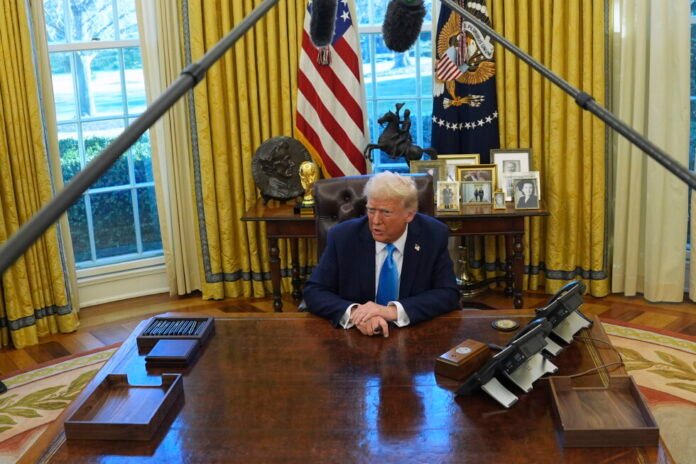
President Trump told the New York Post on Friday that he has left standing instructions for the United States to launch an unprecedented retaliatory strike on Iran if the country succeeds in assassinating him, reiterating claims he has made repeatedly since taking office. The comments came the same day Trump declared that a fragile ceasefire between Washington and Tehran is effectively over, even as he said the United States has agreed to continue diplomatic talks. The remarks add a volatile new dimension to an already tense standoff in the Middle East.
Story Highlights
- Trump told the New York Post he has left instructions to “literally bomb” Iran “at levels that they’ve never seen before” if he is assassinated
- Trump denied recent reports that Israel shared new intelligence about a specific Iranian assassination plot this week
- The comments came as Trump declared the US-Iran ceasefire over while saying negotiations would continue
What Happened
In a phone interview published Friday, President Donald Trump told New York Post reporter Caitlin Doornbos that he has left explicit instructions for a massive American military response should Iran succeed in assassinating him. “I’ve been on their list for a long time. That’s what we’re dealing with,” Trump said. “The only thing is, I’ve left instructions — if anything happens, to just literally bomb them at levels that they’ve never seen before.” The comments echo similar statements Trump has made repeatedly since taking office, including remarks in February in which he said Iran would be “obliterated” and comments to NewsNation host Katie Pavlich in January warning that “the whole country’s gonna get blown up” if he were harmed.
The interview followed reports earlier in the week that Israel had shared intelligence with Washington suggesting Iran had developed a new plan to assassinate the president. Trump directly disputed those reports in his conversation with the Post. “No, no. Israel came up with nothing,” he said, adding, “I’ve been No. 1 [on Iran’s kill list] for a long time, and it’s the way life is, you know.” His remarks suggested he views any current threat as consistent with a years-long pattern rather than the product of newly discovered, specific intelligence.
The comments came against the backdrop of renewed hostilities between the United States and Iran. Trump reiterated Friday that the fragile ceasefire in place since early April is “over,” even as he said Washington has agreed to continue negotiations with Tehran. “The Islamic Republic of Iran has asked us to continue ‘talks.’ We have agreed to do so, but the United States has stated to them, in no uncertain terms, that the ceasefire is OVER!” Trump wrote on Truth Social. The statement appeared to soften an earlier declaration this week in which Trump said flatly, “To me, I think it’s over. I don’t want to deal with them. They’re scum. They’re sick people.”
Diplomatic efforts have continued despite the rhetorical escalation. A Qatari delegation traveled to Iran this week in what is understood to be an effort by Doha to solidify its role as a mediator following a recent flare-up of hostilities in the Gulf region, with the visit reportedly coordinated with the United States. Iran’s IRNA news agency reported Thursday night that a military facility near Bushehr had been struck by “US-Israeli enemy projectiles,” though a US official told CNN that American forces were not currently conducting strikes, and Israeli officials said they were unaware of any Israeli involvement in the reported attack.
The renewed friction follows the burial of Iran’s Supreme Leader Ali Khamenei in Mashhad this week, an event that drew large crowds of mourners even as Iran remains, in the words of observers, “a tale of two peoples” — those who mourn the Islamic Republic’s losses and those who do not.
Why It Matters
Trump’s repeated public statements about ordering a massive retaliatory strike in the event of his assassination represent an unusual approach to presidential security messaging, blending personal safety concerns with explicit military doctrine communicated through the media rather than official channels. Presidents have historically avoided publicly detailing contingency plans of this nature, and Trump’s willingness to do so repeatedly signals both a deterrence strategy and a rhetorical approach that departs from prior administrations.
The timing is significant given the fragile state of the ceasefire with Iran, which Trump has now declared “over” multiple times this week while simultaneously describing continued diplomatic engagement. This apparent contradiction — declaring an end to the truce while also confirming ongoing talks — creates ambiguity for military planners, diplomats, and regional partners attempting to gauge the actual state of U.S.-Iran relations at any given moment.
There are also real, documented threats underlying Trump’s comments. The Justice Department has previously charged an alleged Iranian operative, Farhad Shakeri, with a murder-for-hire plot targeting Trump, and Defense Secretary Pete Hegseth has said U.S. forces killed the leader of an Iranian unit allegedly involved in an earlier assassination attempt. This history lends some substance to Trump’s characterization of himself as a longstanding target, even as he disputes the specific claims about a newly developed plot this week.
For Americans following the situation, the rhetorical volatility surrounding Iran policy — a ceasefire alternately described as intact, dead, and under renewed negotiation within the same week — complicates public understanding of the actual military and diplomatic posture the United States is pursuing in the region.
Economic and Global Context
The Strait of Hormuz remains a central flashpoint in the ongoing tension. Commercial vessel crossings through the critical waterway have dropped recently as shipping companies exercise increased caution amid the unstable security environment, with Iran asserting authority over the strait and requiring vessels to follow routes it has designated. This dynamic threatens to affect global oil markets and shipping costs if the standoff escalates further, given the strait’s role as one of the world’s most important energy transit chokepoints.
Notably, shipping giant Maersk announced this week that it would resume Middle East-to-U.S. East Coast services via the Suez Canal, a route that had been disrupted for years by threats from Iran-backed Houthi forces in Yemen. That decision suggests some shipping companies see improving conditions in parts of the region even as tensions between Washington and Tehran remain unresolved, illustrating the uneven and fragmented nature of regional stability.
Internationally, the reported strikes near Bushehr and the uncertainty over who conducted them — with both American and Israeli officials distancing themselves from direct involvement — underscore the risk of miscalculation in a environment where multiple armed actors are operating in close proximity. Qatar’s continued mediation efforts reflect the value regional powers place on preventing further escalation, even as both Washington and Tehran issue increasingly forceful public statements.
Implications
For U.S. military and diplomatic officials, the coming weeks will likely require clarifying the actual operational status of the ceasefire, particularly given Trump’s repeated but seemingly contradictory public statements. Allies and adversaries alike will be watching closely for concrete actions rather than rhetoric to determine whether the United States is moving toward renewed conflict or continued negotiation.
For Gulf shipping and energy markets, continued uncertainty around the Strait of Hormuz will likely keep insurance costs and shipping caution elevated, even as some carriers signal confidence by resuming alternate routes. Businesses dependent on regional energy supplies and shipping lanes should expect continued volatility until a clearer resolution emerges.
For Iran, the combination of Trump’s rhetoric, reported strikes near Bushehr, and continued U.S. military presence in the region will likely shape internal deliberations over whether to pursue further negotiations with Qatari mediation or risk further confrontation. How Tehran responds to Trump’s latest comments, and whether the reported diplomatic talks yield concrete progress, will be closely watched as a signal of where the broader conflict is headed in the weeks ahead.
Sources
Trump: I’ve Left ‘Instructions’ If Iran Assassinates Me