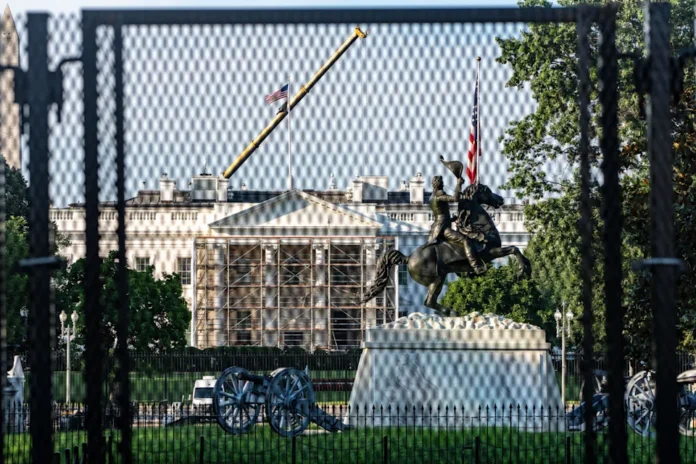
The Trump administration is considering a plan to erect permanent fencing around Lafayette Square and along Pennsylvania Avenue near the White House, a proposal that would fundamentally alter public access to one of the nation’s most iconic civic spaces. The plan follows multiple security incidents targeting President Trump, including a shooting near the White House complex in May, but has already drawn opposition from D.C.’s congressional delegate over concerns about restricting public access to democratic institutions. The decision remains pending final approval from Trump himself.
Story Highlights
- The proposed permanent fencing would run along Pennsylvania Avenue near 15th and 17th Streets NW and around Lafayette Square, replacing temporary barriers used for events.
- The plan follows a shooting near the White House complex in May and reported assassination attempts against President Trump, including one at the White House Correspondents’ Association dinner in April.
- D.C. Congressional Delegate Eleanor Holmes Norton introduced legislation Thursday to prohibit permanent fencing at the park.
What Happened
Trump administration officials are actively discussing a proposal to install permanent fencing along a block of Pennsylvania Avenue near the White House and around Lafayette Square, the historic public park directly across from the executive mansion, according to reporting first published by The Washington Post and confirmed by multiple outlets. The proposed fencing would be located near the intersections of 15th and 17th Streets NW, replacing the temporary barriers currently erected and dismantled for major events and security situations. Under the plan being discussed, the Secret Service and White House would retain authority to open and close sections of the fencing depending on operational and security needs, and officials are considering repurposing existing fencing materials already used regularly for events rather than purchasing an entirely new perimeter system.
As of Friday, the decision remained pending, awaiting final approval from President Donald Trump, and it was not immediately clear whether aesthetic considerations might factor into his decision. The proposal remains preliminary, with no contractors formally hired for the fencing work itself, though separate construction contracts have reportedly been awarded to Clark Construction and AECOM for related White House security upgrades. Those upgrades include ongoing work on the White House’s North Portico front doors, which face Lafayette Square and pedestrian traffic; that project is expected to conclude around mid-September.
The push for permanent fencing follows a series of security incidents that have heightened concerns about the safety of the presidential complex. A shooting occurred near the White House complex in late May close to the 17th Street entrance, and officials have said a separate individual sought to assassinate Trump at the White House Correspondents’ Association dinner in April. Trump himself referenced ongoing safety concerns this week, telling reporters he considers himself “No. 1 on the kill list” for Iran amid escalating tensions following the collapse of the U.S.-Iran ceasefire. The White House currently maintains a 13-foot-high perimeter fence, but officials argue additional permanent barriers along Pennsylvania Avenue and around Lafayette Square would provide greater flexibility to restrict pedestrian access when security concerns arise, without the recurring costs of erecting and dismantling temporary fencing for individual events.
Any permanent fencing plan would require approval from the National Capital Planning Commission and the Commission of Fine Arts before construction could proceed, adding a formal review process to the proposal. D.C. Delegate Eleanor Holmes Norton responded to the reports by introducing legislation Thursday specifically aimed at prohibiting permanent fencing at Lafayette Park. “Public property should be open to the public,” Norton said in a statement. “We should not leave citizens peering at their democracy from behind permanent fences.” She characterized fencing as an imprecise security measure that risks functioning as “security theater” rather than addressing security needs through more modern and effective means.
Why It Matters
The proposal touches on a longstanding tension between presidential security needs and public access to symbolically important civic spaces that has recurred across multiple presidential administrations, with the Secret Service having pushed for similar permanent fencing measures for years under prior administrations without success. Lafayette Square holds particular significance as a historic site for public assembly, protest and civic expression directly facing the White House, meaning any permanent restriction on public access carries symbolic weight beyond its practical security function.
For Washington, D.C. residents and the millions of tourists who visit the White House complex annually, permanent fencing would represent a lasting change to how the public experiences one of the country’s most recognizable civic landmarks, potentially eliminating the currently unobstructed views and pedestrian access that have long characterized the area, except during specific security-driven closures.
The debate also raises broader questions about the appropriate balance between legitimate security concerns, heightened in this case by documented threats against the president, and preserving open public access to government spaces as a matter of democratic principle. Norton’s proposed legislation reflects a view shared by many civic space advocates that permanent physical barriers around symbolically important public areas represent a significant and potentially irreversible shift in how citizens interact with their government’s most visible institutions.
For policymakers and security officials, the proposal illustrates the recurring challenge of calibrating security measures to actual threat levels without permanently altering public spaces in ways that may prove difficult to reverse even after specific security concerns subside, a tension that has played out repeatedly in Washington since the September 11 attacks prompted broader reassessment of federal building security nationwide.
Economic and Global Context
The fencing proposal is part of a broader wave of construction and security investment currently underway across the White House complex and downtown Washington, with reports indicating more than $1.2 billion in related projects currently in progress. This spending reflects a substantial ongoing federal investment in physical security infrastructure at the seat of executive power, funded through appropriations directed toward presidential protection and White House complex maintenance.
The timing of the proposal, arriving amid heightened Middle East tensions following the collapse of the U.S.-Iran ceasefire and explicit threats referenced by Trump regarding his personal safety, reflects how international security dynamics can directly influence domestic infrastructure and security decisions at the highest levels of government, with genuine geopolitical risk factors feeding into calculations about appropriate physical security postures.
Internationally, permanent security fencing around executive residences and government buildings is common practice in many nations, though the comparison is complicated by Lafayette Square’s unique historical role as an active site of public assembly and protest directly adjacent to the White House, a function that distinguishes it from more purely ceremonial or restricted government spaces in other countries.
Tourism and local business impacts remain a consideration for D.C. officials and the broader hospitality industry, given that unobstructed views of the White House and access to Lafayette Square represent significant draws for the millions of annual visitors to the nation’s capital, meaning any permanent restriction could carry modest but measurable effects on local tourism-dependent businesses in the surrounding area.
Implications
The proposal now awaits Trump’s final decision, alongside required approvals from the National Capital Planning Commission and the Commission of Fine Arts, a review process that could extend the timeline for any construction well beyond the preliminary discussions currently underway. Given that no contractors have yet been formally hired for the fencing itself, any construction likely remains months away even if the plan receives full approval.
Norton’s legislation to prohibit permanent fencing at Lafayette Park faces an uncertain path in a Republican-controlled Congress, though its introduction ensures the debate over public access versus security will receive formal legislative attention alongside the administrative approval process the fencing proposal must still navigate.
For Secret Service and White House security officials, the outcome will likely shape future security planning precedents for how permanent versus temporary barriers are deployed around sensitive government facilities, particularly as threat assessments continue evolving amid ongoing domestic and international security concerns.
For D.C. residents, civic space advocates and the broader public, the coming months will determine whether one of the nation’s most historically significant public gathering spaces undergoes a lasting transformation in its relationship to public access, a decision with implications extending well beyond the current administration given the durability of permanent infrastructure once installed.
Sources