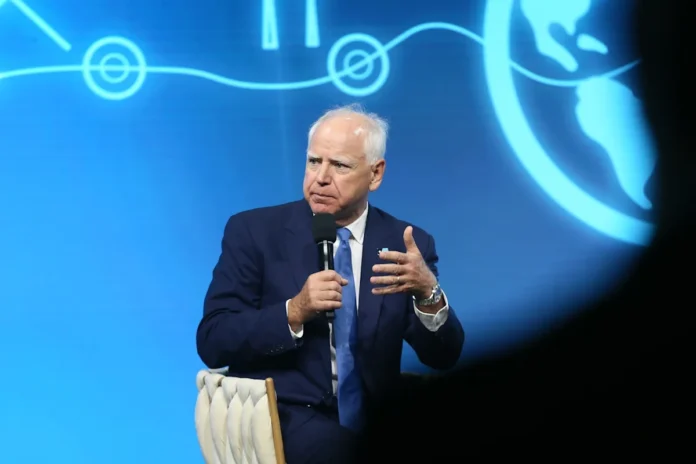
A federal judge delivered a scathing rebuke to the Justice Department after tossing out grand jury subpoenas issued against Minnesota Governor Tim Walz, Minneapolis Mayor Jacob Frey, and other state officials, finding the subpoenas represented an unlawful effort to coerce and punish political opponents over their refusal to cooperate with federal immigration enforcement. The ruling represents one of the most direct judicial rebukes yet of the administration’s use of federal investigative powers against elected officials.
Story Highlights
- U.S. District Judge Patrick Schiltz quashed six grand jury subpoenas targeting Minnesota officials
- Schiltz, a George W. Bush appointee, called the subpoenas “blatantly unlawful and unethical”
- The subpoenas sought a year’s worth of records related to state immigration enforcement cooperation
- The ruling cited Trump’s public threats of “retribution” against Minnesota as evidence of unlawful intent
What Happened
U.S. District Judge Patrick Schiltz, chief judge of the federal district court in Minnesota, issued a 29-page ruling quashing six grand jury subpoenas that the Justice Department had issued against Minnesota Governor Tim Walz, Minneapolis Mayor Jacob Frey, Minnesota Attorney General Keith Ellison, St. Paul Mayor Kaohly Her, and the Hennepin and Ramsey County Boards of Commissioners. The subpoenas, issued January 20, sought an extensive year’s worth of internal communications, including text messages, emails, and policy documents, related to how these officials and their offices had handled cooperation with federal immigration enforcement efforts during the preceding year.
The subpoenas emerged against the backdrop of Operation Metro Surge, a large-scale federal immigration enforcement operation launched in the Minneapolis-St. Paul region in December of the previous year, which deployed more than 3,000 Department of Homeland Security agents in what was characterized as one of the largest civil immigration enforcement operations in the department’s history. The operation drew widespread protests and controversy after reports emerged of aggressive tactics by federal agents, including incidents in which Minnesota residents were killed during enforcement actions, prompting state officials to legally challenge aspects of the federal operation.
In his ruling, Schiltz found “no doubt” that the subpoenas were issued for the improper purpose of coercing Minnesota officials into assisting federal immigration enforcement efforts and retaliating against them for their refusal to do so, rather than pursuing any legitimate criminal investigation. The judge noted that the subpoenas were issued just days after Trump publicly threatened via social media that a “DAY OF RECKONING AND RETRIBUTION” was coming for Minnesota, and that leaked reports of the purported investigation surfaced within days of that threat, establishing what Schiltz described as a clear pattern connecting the subpoenas to presidential statements rather than genuine investigatory purposes.
Schiltz specifically cited the Constitution’s Tenth Amendment anti-commandeering doctrine, which prohibits the federal government from compelling state officials to enforce federal regulatory programs or retaliating against them for declining to do so, as a central basis for his ruling. He characterized the government’s justifications for the subpoenas as having connections to actual criminal conduct that ranged “from extremely weak to nonexistent,” and noted that the department had failed to identify any plausible investigatory justification despite extensive briefing on the matter. Walz, whose office celebrated the ruling as “a victory for the rule of law and our democracy,” has separately ended his campaign for reelection amid an unrelated state fraud investigation, while Frey characterized the federal probe as fundamentally incompatible with core democratic principles protecting the right to criticize government officials.
Why It Matters
The ruling represents one of the most forceful judicial findings to date that the Trump administration has misused federal grand jury and investigative powers to punish political adversaries, carrying significant weight given that Schiltz, the judge who issued the rebuke, was appointed to the federal bench by Republican President George W. Bush, undercutting any characterization of the ruling as reflecting partisan judicial bias.
For American federalism more broadly, the case reinforces constitutional limits on federal power to compel state and local government cooperation with federal enforcement priorities, a principle with implications extending well beyond immigration policy to any future circumstance in which federal and state governments diverge on enforcement priorities across a range of policy areas.
The ruling also carries significant implications for public trust in the grand jury process itself, with Schiltz’s finding that the subpoenas represented a “blatantly unlawful and unethical” use of this traditionally confidential and powerful investigative tool raising broader questions about oversight mechanisms available to check potential abuses of federal investigative authority when directed at political opponents.
For state and local officials nationally who have resisted aspects of federal immigration enforcement policy, the ruling provides a significant legal precedent potentially useful in challenging similar federal investigative actions, while also highlighting the substantial legal resources and institutional support required to successfully challenge such subpoenas, resources not equally available to all officials facing similar federal pressure.
Economic and Global Context
The broader Operation Metro Surge enforcement campaign that preceded the subpoenas carried substantial economic and social costs for the Minneapolis-St. Paul region, with the deployment of thousands of federal agents disrupting local communities and businesses, while separate federal actions freezing approximately $259 million in Medicaid funding for Minnesota added additional fiscal pressure connected to the broader federal-state conflict over immigration enforcement cooperation.
The case’s resolution carries implications for other Democratic-led states and municipalities that have similarly resisted federal immigration enforcement cooperation, with legal and policy analysts monitoring whether the Minnesota ruling will embolden similar legal challenges in other jurisdictions facing comparable federal pressure tied to sanctuary policies and immigration enforcement disputes.
Internationally, the scale and tactics associated with Operation Metro Surge, including the fatalities that occurred during the enforcement operation, drew scrutiny from international human rights observers and foreign media covering U.S. immigration policy, adding a global dimension to what began as a primarily domestic federal-state jurisdictional dispute.
The financial and institutional costs associated with the now-quashed investigation, including the extensive legal resources required by both federal prosecutors pursuing the subpoenas and Minnesota officials defending against them, add to the broader pattern of costs associated with escalating federal-state legal conflicts over immigration enforcement policy under the current administration.
Implications
The Justice Department has not indicated whether it intends to appeal Schiltz’s ruling, though a department spokesperson’s non-committal response to the decision leaves open the possibility of continued legal battles over the subpoenas and the underlying investigation into Minnesota officials’ immigration enforcement cooperation practices.
For Walz personally, the ruling provides significant vindication as he approaches the end of his gubernatorial tenure, though it does not fully resolve the separate state-level fraud investigation that contributed to his decision to end his reelection campaign, meaning his political and legal circumstances remain complex despite this particular legal victory.
For other state and local officials nationally facing similar federal pressure regarding immigration enforcement cooperation, the ruling offers a potential legal roadmap for challenging comparable subpoenas, though the ultimate precedential weight of the decision will depend significantly on whether it withstands potential appellate review.
Looking ahead, the case is likely to remain a significant touchstone in ongoing national debates over the appropriate boundaries of federal investigative power when directed at state and local officials who decline to cooperate with federal policy priorities, with implications extending well beyond Minnesota to similar disputes playing out in jurisdictions across the country.
Sources