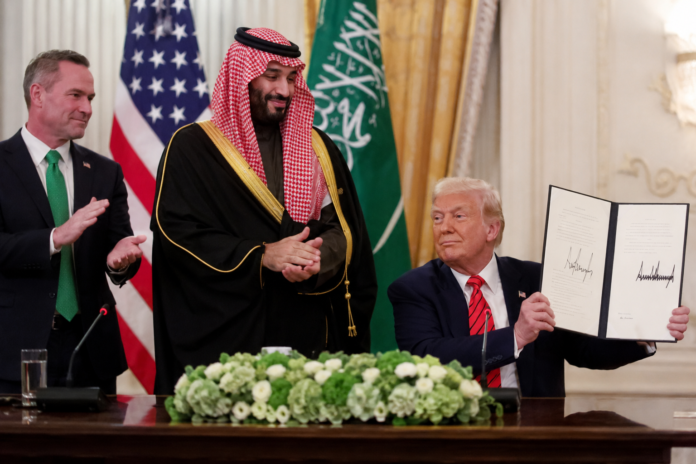
President Trump threw a newly signed civil nuclear agreement with Saudi Arabia into disarray Thursday, declaring on social media that the deal is contingent on Riyadh joining the Abraham Accords and normalizing relations with Israel, a condition that appeared nowhere in the agreement his own Energy Department signed a day earlier. The abrupt reversal, reportedly driven by conservative media criticism and internal White House confusion, has thrown a years-in-the-making energy pact into uncertainty and exposed friction within the administration’s own ranks.
Story Highlights
Trump declared the Saudi nuclear deal “totally subject” to Saudi Arabia joining the Abraham Accords, a condition absent from the agreement signed Wednesday.
Energy Secretary Chris Wright signed the original deal with Saudi counterpart Prince Abdulaziz bin Salman without informing Trump he planned to announce it, sources told CNN.
Trump also denied the agreement would permit uranium enrichment, despite earlier reporting that the deal offered Riyadh a pathway toward enrichment capability.
What Happened
The United States and Saudi Arabia finalized a landmark civil nuclear agreement on Wednesday, granting Riyadh much of what it had sought for years, including a potential pathway toward uranium enrichment capability. Energy Secretary Chris Wright and Saudi Energy Minister Prince Abdulaziz bin Salman signed the arrangement at the Department of Energy in Washington, capping years of negotiation between the two governments. The agreement made no mention of Israel or any requirement that Saudi Arabia normalize diplomatic relations as a condition of the deal.
Less than 24 hours later, Trump upended the agreement entirely. In a social media post Thursday, the president declared approval of the deal was “totally subject” to Saudi Arabia joining the Abraham Accords, the 2020 initiative from his first administration that led the United Arab Emirates, Bahrain, and Morocco to normalize relations with Israel. Trump also denied the deal would permit uranium enrichment, directly contradicting elements of the agreement as reported the day before.
According to sources familiar with the matter cited by CNN, Trump was already frustrated that Wright had unveiled the deal without first informing him, a frustration that intensified after skeptical coverage from conservative outlets, including Fox News and the Wall Street Journal editorial page, which questioned why the administration would grant such concessions without securing normalization with Israel in return. White House officials, according to the same sources, blamed the Energy Department for proceeding despite requests to delay the announcement.
The new condition reportedly surprised the administration’s own nuclear negotiators, who had not been informed the Abraham Accords requirement would be attached. Israeli officials expressed alarm at the original announcement, with Yair Golan, chairman of Israel’s Democrats party, criticizing Prime Minister Benjamin Netanyahu for failing to secure normalization language from the outset, even as Netanyahu publicly praised the prospect of Saudi Arabia eventually joining the Accords.
Why It Matters
The episode illustrates the degree to which major foreign policy agreements within the administration can be unilaterally altered through presidential social media posts, raising questions for U.S. negotiating partners about the durability of commitments made by Cabinet officials on the president’s behalf. For Saudi Arabia, the sudden addition of a politically fraught new condition complicates a deal Riyadh had negotiated in good faith on different terms.
For American energy and national security interests, the reversal introduces uncertainty into a nuclear cooperation agreement that supporters argue is essential to keeping Saudi Arabia’s nuclear ambitions within a framework of U.S. oversight rather than pushing Riyadh toward alternative partners such as China or Russia. Delays or a collapse of the deal could open space for competitors to offer Saudi Arabia nuclear technology with fewer nonproliferation safeguards.
The internal confusion also points to a broader pattern of policy being shaped reactively in response to media coverage rather than through coordinated interagency process, a dynamic that foreign policy experts say undermines the credibility of U.S. commitments abroad and complicates the work of American diplomats and negotiators tasked with implementing presidential directives.
Economic and Global Context
The nuclear agreement represents a substantial economic opportunity for American energy companies, positioning U.S. firms to compete for contracts in Saudi Arabia’s civilian nuclear program as the kingdom seeks to diversify its energy mix beyond oil exports. A collapse or prolonged delay could cost American businesses ground to international competitors pursuing similar arrangements with Riyadh.
Regionally, tying the nuclear deal to Abraham Accords membership raises the stakes considerably, since Saudi Arabia has consistently said it will not normalize relations with Israel absent a credible pathway to Palestinian statehood, a position that predates this dispute and shows no sign of shifting. Linking the agreement to this unresolved diplomatic question could delay it indefinitely or kill it outright.
The uranium enrichment question adds further complexity to nonproliferation policy in the region. Previous U.S. civil nuclear agreements have typically required partners to forgo enrichment capability, and any exception for Saudi Arabia would represent a significant departure from precedent with implications for nonproliferation norms across the Middle East.
Implications
In the coming weeks, expect continued uncertainty as the Energy Department, State Department, and White House work to reconcile conflicting public statements about the deal’s terms, particularly regarding uranium enrichment and the newly imposed Abraham Accords condition. Saudi officials have not publicly responded to the new condition, and their reaction will likely determine whether the agreement survives in any recognizable form.
For Israel, the episode creates both opportunity and risk: while Trump’s demand aligns with Israeli interests in expanding normalization, the chaotic rollout could also delay any near-term progress if Saudi Arabia responds by simply walking away from the nuclear deal rather than accepting new conditions attached after the fact.
For Cabinet officials and agency heads, the incident serves as a pointed reminder of the risks of announcing major policy initiatives without securing explicit presidential sign-off beforehand, a lesson likely to shape how other departments coordinate future rollouts of sensitive international agreements during the remainder of the administration.
Sources
“How Trump upended the Saudi nuclear deal less than 24 hours after its signing”