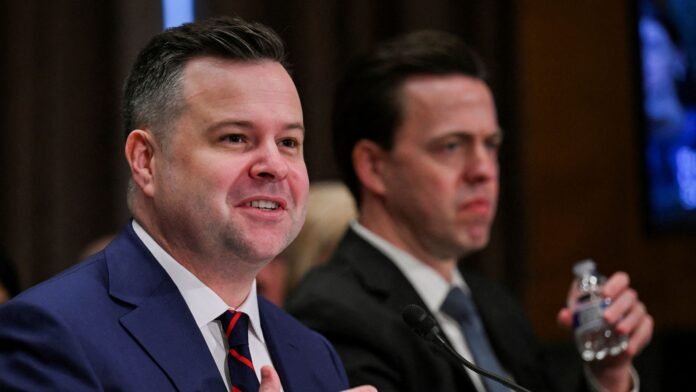
Story Highlights
- Bill Pulte, who has no intelligence or national security background and lacked a security clearance, began firing ODNI staff before his official start date
- Section 702 of the Foreign Intelligence Surveillance Act lapsed on June 12 after Democrats and seven Republicans refused to renew it over concerns about Pulte
- Senator Mark Warner introduced legislation to require future acting DNI officials be filled from existing Senate-confirmed intelligence officials
- Pulte’s cuts have reportedly affected the National Counterterrorism Center workforce, according to lawmakers who say they “feared” exactly this outcome
What Happened
Bill Pulte, who simultaneously serves as director of the Federal Housing Finance Agency and chairman of mortgage giants Fannie Mae and Freddie Mac, was named by President Trump as acting Director of National Intelligence following the resignation of Tulsi Gabbard, who stepped down to care for her husband during his cancer treatment. Pulte, who has no prior intelligence or national security experience and did not previously hold a security clearance, began his new role on June 19. According to reporting from CNN, Pulte arrived at the Office of the Director of National Intelligence the day before his official start date and requested a complete roster of every employee in the office, immediately signaling his intent to move quickly on staff reductions.
Trump made his expectations explicit in a Truth Social post, writing that he had asked Pulte “to execute the immediate and needed downsizing of the office, reverting staff to their home agencies.” The directive followed restructuring already underway under Gabbard’s tenure, during which ODNI had reduced or reassigned approximately 40 percent of its staff and consolidated multiple offices and analytic functions as part of an initiative known as “ODNI 2.0.” Pulte’s additional cuts represent a further reduction layered atop that earlier restructuring.
The appointment immediately drew bipartisan criticism. Senate Intelligence Committee Vice Chairman Mark Warner, a Virginia Democrat, said Pulte’s selection “speaks volumes about what this president expects from the nation’s top intelligence official,” arguing that Pulte appeared to have been chosen specifically because the White House believed “he will provide the narrative it wants, not the intelligence we need.” Senate Majority Leader John Thune, a South Dakota Republican, similarly told reporters, “We don’t need a weaponized DNI, we need professionals there,” and pressed the administration for more information about its long-term plans for the position. Independent Senator Angus King of Maine, who was himself considered for the DNI post in 2020, said the appointment “makes no sense” by any objective measure of experience or qualifications.
The controversy escalated further when Senate Democrats, joined by seven Republicans, voted against a routine three-year extension of Section 702 of the Foreign Intelligence Surveillance Act, a critical national security surveillance authority, specifically citing concerns about Pulte’s appointment. The vote caused the authority to formally lapse on June 12. Trump publicly criticized Democrats for what he characterized as playing “politics with the safety of our Great Country,” while Warner introduced separate legislation that would require any future acting DNI to be filled exclusively from a pool of existing Senate-confirmed intelligence officials, explicitly designed to prevent another appointment like Pulte’s. Lawmakers have also reported that Pulte’s firings have begun affecting the National Counterterrorism Center’s workforce, a development Warner and Representative Jim Himes specifically warned could “jeopardize” the center’s core counterterrorism mission.
Why It Matters
The Director of National Intelligence position oversees eighteen separate intelligence agencies, including the CIA and NSA, and was created specifically in the aftermath of the September 11 attacks to address the kind of interagency intelligence-sharing failures that allowed that attack to occur undetected. Placing someone with no intelligence background, no security clearance, and an extensive public record of pursuing the administration’s domestic political opponents atop this apparatus represents an extraordinary departure from the statutory expectation that the DNI possess “extensive national security expertise.”
The lapse of Section 702 surveillance authority carries genuine national security consequences that extend well beyond partisan political disagreement. This authority has historically been used to monitor foreign terrorist communications and other national security threats, and its absence, even temporarily, represents a real operational gap in the government’s surveillance capabilities at a moment when the United States is simultaneously engaged in active military conflict with Iran and managing numerous other global security challenges.
Reports that Pulte’s cuts have begun touching the National Counterterrorism Center’s workforce deserve particular scrutiny given the stakes involved. Unlike administrative downsizing in other parts of the federal government, reductions to counterterrorism analytical capacity carry direct, potentially severe consequences if they result in missed warning signs ahead of future attacks, the precise institutional failure the DNI position was created to prevent.
This situation also illustrates a broader pattern of concern that extends across multiple federal agencies during the current administration: the placement of personal loyalists without relevant subject-matter expertise into positions of significant institutional authority, often explicitly tied to advancing the president’s preferred political narratives, such as continued efforts to investigate claims about the 2020 election, rather than to the agency’s core statutory mission.
Economic and Global Context
Pulte’s continued simultaneous oversight of Fannie Mae and Freddie Mac, which together back more than $10 trillion in mortgage transactions, while also serving as the nation’s top intelligence official, raises additional questions about potential conflicts of interest and whether any single individual can adequately manage two such consequential and demanding portfolios simultaneously. Pulte has also faced a separate Government Accountability Office investigation, confirmed in December 2025, into whether he misused his FHFA authority to pursue politically motivated mortgage fraud allegations against prominent Democrats and Trump critics, with findings expected in late 2026 or early 2027.
Globally, American allies and intelligence-sharing partners closely monitor the leadership and institutional stability of U.S. intelligence agencies, given the extensive intelligence cooperation arrangements, such as the Five Eyes alliance, that depend on mutual confidence in partner agencies’ competence and security protocols. Significant leadership turbulence and unexplained staff reductions at ODNI carry the potential to affect these international intelligence-sharing relationships if partner nations grow concerned about institutional stability or security clearance vetting standards.
The broader context of Pulte’s appointment, layered atop Gabbard’s earlier 40 percent staff reduction, raises cumulative concerns about whether ODNI retains sufficient institutional capacity to perform its statutory coordination function across eighteen separate intelligence agencies, particularly during a period of significant global instability including the active Iran conflict and ongoing geopolitical tensions with Russia and China.
Implications
In the near term, the Senate’s response to Warner’s proposed legislation restricting future acting DNI appointments will be an important signal of whether bipartisan concern about Pulte’s appointment translates into durable institutional reform or remains limited to public criticism without legislative consequence. Trump’s previously announced, then withdrawn, nomination of U.S. Attorney Jay Clayton for the permanent DNI position suggests continued uncertainty about how long Pulte’s acting tenure, which can legally extend up to 210 days, will ultimately last.
For Congress, restoring Section 702 surveillance authority will likely require some resolution of the underlying dispute over Pulte’s qualifications and conduct, creating an unusual circumstance in which a genuine national security capability gap persists as a direct consequence of an unresolved personnel controversy.
For the intelligence community’s rank-and-file workforce, continued uncertainty about further staff reductions and leadership direction creates significant institutional strain, with potential long-term effects on retention of experienced personnel and the agency’s ability to attract qualified analysts in the future.
For American national security more broadly, the resolution of this standoff, particularly regarding the counterterrorism center staffing concerns, will be an important indicator of whether institutional safeguards remain sufficient to prevent political considerations from compromising core intelligence functions during a period of significant global instability.
Sources
“Bill Pulte’s first days as acting DNI set off alarms with lawmakers”