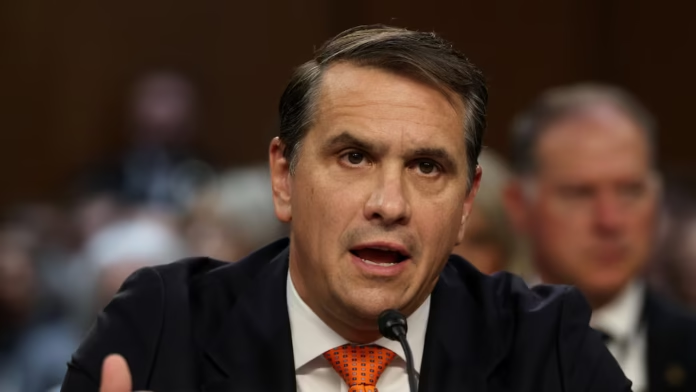
Acting Attorney General Todd Blanche sat through more than five hours of pointed questioning before the Senate Judiciary Committee this week as he seeks permanent confirmation to lead the Justice Department, facing scrutiny over his handling of the Jeffrey Epstein files, a controversial tax settlement benefiting President Trump, and new subpoenas targeting New York Times journalists. Blanche, who served as Trump’s personal defense attorney before joining the administration, needs unanimous Republican support on a narrowly divided committee to advance his nomination. The hearing exposed deep fault lines even within the president’s own party over the direction of federal law enforcement under his leadership.
Story Highlights
- Todd Blanche testified for over five hours before the Senate Judiciary Committee on July 15, facing bipartisan questions about DOJ controversies
- Blanche confirmed under oath that a $1.8 billion “anti-weaponization fund” tied to a settlement benefiting Trump’s tax affairs is “dead”
- His confirmation is not guaranteed, as Republicans hold a single-vote margin on the committee following the death of Senator Lindsey Graham
What Happened
Todd Blanche appeared before the Senate Judiciary Committee on July 15 for his confirmation hearing to become permanent Attorney General, a position he has held on an acting basis since President Trump removed Pam Bondi from the role in April. Blanche, who represented Trump personally in multiple criminal cases before joining the administration as deputy attorney general, struggled at times to separate his prior role from his current one, at one point telling senators he “is” the president’s lawyer before correcting himself to say he “was” Trump’s lawyer and now serves as head of the Justice Department.
Much of the hearing centered on the Justice Department’s handling of the Jeffrey Epstein case files. Blanche acknowledged that mistakes were made during the release of Epstein-related documents, including a failure to redact survivors’ personal information, and issued an apology to victims, though he declined to commit to meeting with them personally. Dani Bensky, an Epstein survivor called to testify by Democrats, along with Elizabeth Oyer, a former Justice Department pardon attorney whom Blanche fired after she refused to endorse restoring gun rights to a man convicted of misdemeanor domestic violence, provided testimony that further complicated Blanche’s path to confirmation.
Senators also pressed Blanche extensively on the now-abandoned $1.776 billion “anti-weaponization fund,” which the Justice Department created in May as part of a settlement resolving Trump’s personal lawsuit against the IRS over his leaked tax returns. The settlement, which Blanche signed as acting attorney general, included a provision permanently barring the IRS from auditing Trump’s past tax filings and those of his adult sons. Under questioning from Senator Adam Schiff of California, Blanche confirmed that the tax immunity provision applied only to past returns and would not shield the president from liability on future filings, though he defended the fund and settlement as appropriate compensation for individuals who claimed to have been unfairly targeted under the Biden administration.
The hearing also unfolded against the backdrop of a separate and escalating controversy: newly issued federal grand jury subpoenas compelling New York Times reporters to testify about their sources for a story questioning the security features of the Qatari-donated Air Force One replacement aircraft. Senators from both parties raised concerns about the subpoenas, which were issued by Manhattan U.S. Attorney Jay Clayton, himself facing a separate Senate hearing this week for his nomination to lead the Office of the Director of National Intelligence. Blanche defended the subpoenas as necessary to identify the source of a leak rather than to target the journalists themselves, telling the committee he believes “it’s extremely important to protect the right of the press to have confidential sources.”
Why It Matters
Blanche’s confirmation hearing represents a critical test of institutional accountability at the highest levels of federal law enforcement. The dual role Blanche has occupied, first as Trump’s personal criminal defense attorney and now as the nation’s chief law enforcement officer, raises fundamental questions about the independence of the Justice Department from the political and legal interests of the president who appointed him. His visible struggle during testimony to correctly characterize his current relationship to Trump was widely noted as symbolic of that underlying tension.
The now-defunct anti-weaponization fund controversy strikes at core principles of equal treatment under the law. A sitting president using a personal lawsuit against a federal agency to negotiate a settlement that simultaneously creates a taxpayer-funded compensation pool and grants himself permanent audit immunity represents an arrangement that drew bipartisan criticism, including from Republican senators like John Cornyn, who indicated he wanted answers on both the fund and the audit provisions before deciding how to vote on Blanche’s confirmation.
For press freedom advocates and government accountability watchdogs, the timing of the New York Times subpoenas, issued to compel testimony on the same day as Blanche’s confirmation hearing began, has drawn particular scrutiny. Legal experts have questioned whether the subpoenas represent a legitimate national security leak investigation or a retaliatory action against journalists whose reporting embarrassed the administration, a distinction with significant implications for the boundaries of executive power over the press.
The narrow committee math adds further weight to the proceedings. With Senator Lindsey Graham’s death leaving Judiciary Committee Republicans with no margin for defection, a single dissenting Republican vote could derail Blanche’s nomination entirely, giving individual senators unusual leverage to extract concessions or commitments from a nominee who otherwise enjoys the president’s full backing.
Economic and Global Context
The financial dimensions of the anti-weaponization fund controversy carry substantial weight independent of the political optics. The $1.776 billion figure, funded by taxpayers, would have represented one of the largest ad hoc compensation programs in modern Justice Department history, exceeding the budgets of many established federal victim compensation funds that operate under statutory frameworks with defined eligibility criteria and congressional oversight, features notably absent from the Trump settlement arrangement.
The audit immunity component carries its own significant fiscal implications. Tax policy experts have estimated the value of permanently barring IRS enforcement against Trump’s historical tax filings could approach $100 million in avoided liability, according to figures cited during House Oversight Committee questioning of Blanche in June, a benefit that critics argue was improperly obtained through litigation against the very agency responsible for enforcing tax compliance.
Globally, the confirmation fight has drawn attention from press freedom organizations monitoring the treatment of journalists in democracies, with the Committee to Protect Journalists specifically calling on senators to hold Blanche accountable for what the organization has documented as a broader pattern of Justice Department actions against reporters, including source protection policy rollbacks, prior grand jury subpoenas related to Iran war coverage, and the search and seizure of a journalist’s personal devices.
Domestically, the controversy has fed into broader debates about the erosion of traditional Justice Department independence norms, a topic that has drawn commentary from legal scholars across the political spectrum concerned about precedents being set for future administrations regardless of party affiliation.
Implications
In the immediate term, the Senate Judiciary Committee must decide whether to advance Blanche’s nomination to the full Senate floor, a process complicated by the committee’s razor-thin Republican margin and the still-unresolved legal status of both the IRS settlement and the New York Times subpoena litigation, either of which could generate further damaging revelations before a final vote occurs.
For the Justice Department’s rank-and-file prosecutors and career officials, the outcome will signal how much latitude Blanche will have to continue policies that have drawn internal and external criticism, particularly regarding leak investigations targeting journalists and the department’s broader approach to cases connected to the president’s personal and political interests.
For press freedom advocates and news organizations, the New York Times’ ongoing legal challenge to the subpoenas will likely proceed regardless of the confirmation outcome, with the case expected to generate important precedent regarding the scope of Justice Department authority to compel journalist testimony in leak investigations connected to national security claims.
For voters and government accountability organizations, the hearing has already added to a growing body of documented controversies surrounding the current Justice Department leadership, material likely to feature prominently in ongoing congressional oversight efforts and in the broader public debate over executive branch accountability heading into the 2026 midterms.
Sources