Story Highlights
- The Los Angeles National Guard deployment cost taxpayers approximately $111.2 million
- A federal court ruled the deployment illegal and ordered troops returned to state control
- Final costs are expected to rise further as outstanding overtime expenses are finalized
What Happened
Records produced in response to a Freedom of Information Act request filed by California Governor Gavin Newsom’s office in August 2025 confirm that the federalization and deployment of California’s National Guard to Los Angeles cost taxpayers an estimated $111.2 million across fiscal years 2025 and 2026. The figures, released by the governor’s office, indicate the true total is likely to climb further once final overtime and demobilization costs are fully calculated and incorporated into the federal accounting.
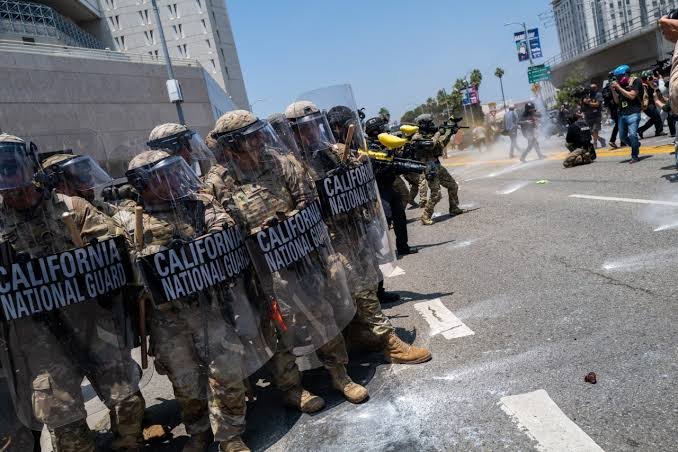
The deployment began in June 2025, when President Trump, against the objections of Governor Newsom, seized federal control of California’s National Guard and deployed more than 4,000 troops alongside Marine Corps units to Los Angeles, citing the need to protect federal immigration enforcement officers and facilities amid protests. The action represented an unprecedented assertion of federal authority over a state’s military forces without gubernatorial consent and became the first in a pattern of similar deployments to Democratic-led cities throughout the remainder of 2025.
California Attorney General Rob Bonta and Governor Newsom filed suit shortly after the deployment began, seeking to block what they characterized as an illegal militarization of Los Angeles streets. U.S. District Judge Charles Breyer ultimately ruled that the federalization of the California National Guard violated the Tenth Amendment and exceeded the authority granted under Title 10 of the United States Code, finding no evidence that “regular forces” were unable to execute federal law, the legal precondition required to justify such an extraordinary deployment. Breyer’s ruling was initially stayed pending appeal, but the deployment was ultimately deemed unlawful following a related U.S. Supreme Court decision involving a similar dispute over the deployment of Illinois National Guard troops to Chicago.
Following the Ninth Circuit Court of Appeals ruling and the Supreme Court’s related decision, the administration was compelled to return command and control of the California National Guard to the state. Newsom’s office subsequently directed the returning service members back to their previously interrupted assignments, including wildfire response crews and counterdrug operations, which had been diverted to support the Los Angeles deployment. The governor’s office noted the irony of the deployment’s financial toll emerging during Military Appreciation Month, characterizing the operation as a politically motivated action that pulled resources away from genuine public safety priorities.
Why It Matters
The confirmed $111.2 million price tag provides concrete evidence of the substantial financial cost borne by taxpayers for a domestic military deployment that courts ultimately determined violated constitutional and statutory limits on presidential authority. For California residents specifically, the diversion of National Guard resources away from wildfire response and counterdrug operations during the deployment period raises legitimate public safety concerns, given the state’s ongoing vulnerability to wildfire emergencies.
For taxpayers nationally, the episode illustrates the financial consequences of executive actions that exceed legal authority, with courts at multiple levels, including the Supreme Court, ultimately rejecting the legal theory underpinning the deployment. The Congressional Budget Office separately estimated that combined National Guard deployments to Los Angeles, Memphis, Portland, Chicago, and Washington D.C. cost approximately $496 million between June and December 2025 alone, with potential costs of $93 million per month if all deployments had continued through 2026.
For state and local officials, the ruling and associated cost disclosures reinforce arguments that domestic military deployments without gubernatorial consent represent both a constitutional overreach and a fiscally irresponsible use of public resources, particularly when courts later determine such deployments lacked proper legal foundation from the outset.
The case also carries broader implications for the separation of powers between federal and state authority over military resources, with legal experts noting that the courts’ rejection of the administration’s underlying legal theory, that federalized National Guard troops were exempt from Posse Comitatus Act restrictions, establishes an important precedent limiting similar future actions.
Economic and Global Context
The Los Angeles deployment’s cost represents just one component of a broader pattern of domestic military deployments pursued throughout 2025 and into 2026, with similar operations in Memphis, Portland, Chicago, and Washington D.C. collectively costing hundreds of millions of dollars in taxpayer funds, according to Congressional Budget Office estimates. The Washington D.C. deployment alone has continued well into 2026, with more than 2,200 National Guard troops from several Republican-led states remaining in the capital despite the original crime emergency declaration having expired months earlier.
Economically, the diversion of National Guard personnel from their traditional state-level responsibilities, including disaster response, counterdrug operations, and emergency management, carries opportunity costs beyond the direct dollar figures disclosed in the FOIA records, particularly in states like California that face recurring wildfire emergencies requiring rapid mobilization of trained personnel.
The broader legal and financial fallout from these deployments has also drawn attention from international observers studying the use of domestic military forces in democratic societies, with legal scholars noting that the Posse Comitatus Act’s restrictions on military involvement in civilian law enforcement represent a long-standing American legal tradition dating to the post-Reconstruction era, one that courts have now reaffirmed against significant executive pressure to circumvent it.
State governments that successfully challenged the deployments, including California, Oregon, and Illinois, have indicated they will continue pursuing reimbursement or accountability measures for costs incurred during deployments later ruled unlawful, though the legal mechanisms for recovering such costs from the federal government remain limited and largely untested.
Implications
For Governor Newsom and Attorney General Bonta, the cost disclosures provide additional political and legal ammunition in their ongoing efforts to constrain future federal military deployments within California, reinforcing arguments made in over fifty lawsuits Bonta’s office has filed against the Trump administration during the current term.
For Congress, the documented costs may prompt renewed calls for legislative clarification of the circumstances under which a president may federalize state National Guard units, potentially closing ambiguities in 10 U.S.C. § 12406 that the administration sought to exploit during the 2025 deployment campaign.
For other states that have faced or may face similar deployment threats, the Los Angeles case, combined with the Supreme Court’s related ruling on the Illinois deployment, establishes important legal precedent limiting the administration’s ability to unilaterally deploy military forces domestically without meeting strict statutory conditions.
For voters, the financial accounting adds a concrete fiscal dimension to the broader debate over executive overreach in domestic military deployments, providing a measurable cost figure that lawmakers and advocacy groups are likely to reference throughout ongoing political and legal debates heading into the 2026 midterm elections.
Sources