Story Highlights
- CIA operatives from the agency’s elite Ground Branch unit have directly participated in multiple fatal operations against cartel members in Mexico since at least 2025, according to CNN’s sources
- A March 2026 car bombing on the Mexico-Pachuca Highway near Mexico City killed alleged Sinaloa Cartel member Francisco Beltrán; CNN reports CIA officers facilitated the attack
- Both the CIA and Mexican Security Secretary Omar Garcia Harfuch denied the report; Trump’s ambassador to Mexico is a former Army Green Beret and veteran CIA officer
What Happened
A CNN investigation, published Tuesday and reported by Natasha Bertrand, Zachary Cohen, Evan Perez, and Mauricio Torres, revealed that the CIA has significantly escalated its covert involvement in anti-cartel operations inside Mexico. According to multiple unnamed sources familiar with the matter, the agency’s elite Ground Branch paramilitary unit has been directly participating in targeted assassinations of cartel figures, going well beyond traditional intelligence sharing or advisory roles that have historically defined American cooperation with Mexican law enforcement.
The most detailed example in the report involves a March 28, 2026, attack on a Toyota truck traveling on the Mexico-Pachuca Highway near Tecámac in the State of Mexico, just outside Mexico City. The vehicle exploded, killing Francisco Beltrán, known as “El Payín,” an alleged mid-level operative with the Sinaloa Cartel, and his driver. Mexican authorities publicly described the incident as an “attack” but maintained secrecy about its details. CNN’s sources told the network the explosion was a targeted assassination facilitated by CIA operations officers who had placed an explosive device inside the vehicle. Video footage shared on social media at the time showed the truck erupting in flames.
The report describes a broader campaign that began after President Donald Trump designated major Mexican drug trafficking organizations — including the Sinaloa Cartel, La Nueva Familia Michoacana, and others — as foreign terrorist organizations, providing expanded legal authority for covert lethal action in Latin America. The CIA’s U.S. ambassador to Mexico, Ronald Johnson, a former Army Green Beret and veteran CIA officer, is described in the reporting as integral to the expanded American presence.
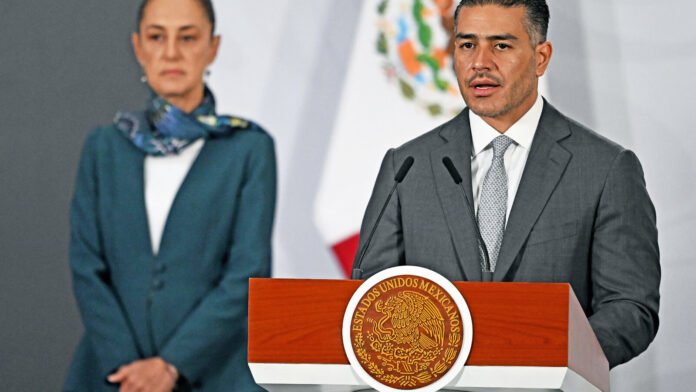
The reaction was swift and categorical. CIA spokesperson Liz Lyons called the CNN report “false and salacious reporting that serves as nothing more than a PR campaign for the cartels and puts American lives at risk,” without specifying which elements of the reporting were inaccurate. Mexican Security Secretary Omar Garcia Harfuch issued a statement on social media rejecting “any version that seeks to normalize, justify, or suggest the existence of lethal, covert, or unilateral operations by foreign agencies on national territory.” The denials from both governments were simultaneous and coordinated in tone, though neither engaged with the specific factual claims in the reporting.
Why It Matters
If the CNN reporting is accurate, the United States government has been conducting extrajudicial killings on the territory of a sovereign allied nation without the knowledge or consent of that nation’s government — a profound violation of international law, Mexican sovereignty, and the constitutional requirement that Congress authorize lethal military or paramilitary operations abroad. The Trump administration has expanded presidential war powers in Iran and elsewhere, but those operations involve designated enemies. Mexico is a NATO-adjacent ally and a signatory to treaties with the United States that explicitly govern how American law enforcement and intelligence agencies operate on Mexican soil.
The Mexican law in question, passed in 2020, requires all foreign agents to disclose their whereabouts to the federal government and file monthly activity reports. Mexican President Claudia Sheinbaum suggested earlier in April that CIA personnel in Chihuahua, who came to light after a car accident killed two CIA operatives and two Mexican law enforcement officers, may have violated that law. At the same time, a senior researcher at the National Autonomous University of Mexico told CNN that the Mexican government is “acutely aware” of the CIA’s presence but has not decided how aggressively to try to control it, or how transparent to be with the public. That ambiguity suggests an informal accommodation that is politically explosive once surfaced publicly.
The accountability dimension is significant. Under existing U.S. law, covert lethal operations abroad require a presidential finding — a classified presidential authorization — as well as notification to congressional intelligence committees. It is not known whether such a finding was issued, whether Congress was properly notified, or whether the operations stayed within those legal parameters. None of those questions have been answered by the administration.
For American governance, the story raises the same structural question that the Iran war subpoenas raise from a different angle: is the executive branch conducting consequential military and paramilitary operations in ways that are invisible to Congress, the public, and allied governments? The accumulation of such episodes — each individually deniable — creates a pattern of unchecked executive action that should concern any citizen committed to constitutional governance.
Economic and Global Context
Mexico is the United States’ largest trading partner. Bilateral trade exceeds $800 billion annually, and the economic relationship is deeply integrated across supply chains in manufacturing, agriculture, and energy. Operations that destabilize Mexico’s security environment, provoke diplomatic ruptures, or undermine the legitimacy of the bilateral relationship carry real economic costs. If Sheinbaum were to respond to confirmed CIA assassination operations by suspending security cooperation or escalating diplomatic confrontations, those costs would be felt in American markets.
The Trump administration has simultaneously pursued a broader anti-drug trafficking campaign that, according to reporting, has included dozens of air strikes on vessels in the Caribbean Sea and Pacific Ocean suspected of drug transport, killing more than 190 people. The scale of those operations, combined with the cartel designations as terrorist organizations, reflects a doctrine that treats drug trafficking networks as military rather than law enforcement targets — a significant legal and strategic threshold with consequences that extend well beyond Mexico.
Since Trump returned to the White House in January 2025, the broader relationship with Mexico has been a consistent flashpoint. Tariff threats, border enforcement confrontations, and now covert operational activity have all strained a partnership that had been carefully managed under previous administrations. Each additional disclosure of unilateral American action inside Mexican territory reduces the space for functional cooperation on the shared interests both countries have in reducing drug trafficking and border violence.
Implications
The immediate diplomatic implication depends on how aggressively Sheinbaum chooses to respond. She has domestic political incentives to push back publicly against CIA operations on Mexican soil, particularly if the March bombing occurred in a densely populated area outside Mexico City. But Mexico also has strong economic and security incentives to avoid a full-blown confrontation with Washington. The government’s public denial of the CNN report may be partly aimed at creating diplomatic space to continue managing the situation privately rather than escalating openly.
For Congress, the story adds another dimension to the oversight burden around the Trump administration’s covert activities. Intelligence committees have classified access to presidential findings authorizing covert operations, but their ability to publicly challenge those findings is constrained. Members who believe the operations exceed legal authority face the same structural problem they face with the Iran war: the administration claims all necessary authorities, and effective congressional oversight requires either classified action or public confrontation.
For the American public, the story tests a familiar tension between ends and means. Many Americans support aggressive action against drug cartels that have flooded American communities with fentanyl and other lethal drugs. But support for outcomes does not automatically translate into support for any means of achieving them, especially when those means involve covert lethal operations on the soil of an allied country without legal authorization or public accountability.
The CIA’s flat denial, without specifying what was false, leaves significant factual uncertainty. The history of such denials — across administrations of both parties — suggests that categorical official denials of reported covert activities do not reliably track with the underlying truth. That history is relevant context for citizens trying to assess what their government is doing in their name.
Sources
“Exclusive: CIA escalates secret war on cartels with deadly operations inside Mexico”