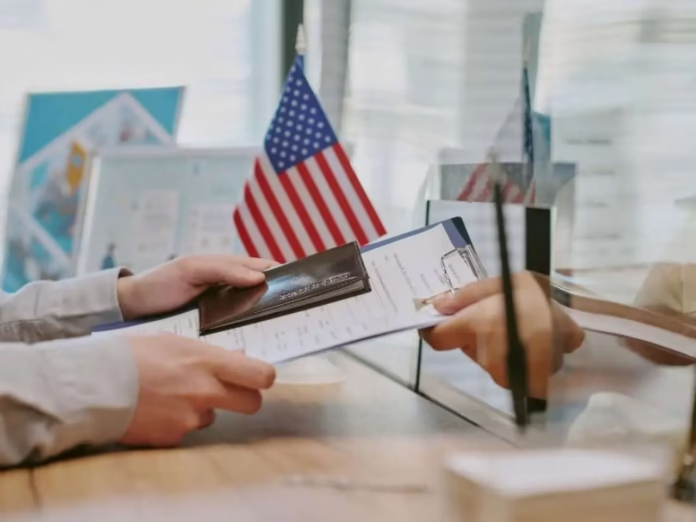
The Trump administration finalized a rule Thursday that ends a decades-old system allowing foreign students, cultural exchange participants, and journalists to remain in the United States for the duration of their programs or assignments. Under the new Department of Homeland Security regulation, international students and exchange visitors will generally be capped at four years, while foreign journalists face a maximum stay of 240 days, or just 90 days for Chinese nationals. The change, which could affect college admissions as early as this fall, marks one of the most significant shifts in nonimmigrant visa policy in years.
Story Highlights
- Student and exchange visitor visas (F and J classifications) will be capped at four years instead of open-ended “duration of status”
- Journalist visas (I classification) will be limited to 240 days, or 90 days for Chinese nationals, down from durations that could span years
- The rule shortens the departure window for students who complete their programs from 60 days to 30 days
- International student admissions already fell by roughly 52,000 in June 2026 compared with June 2025, and USCIS extension processing currently averages 3.3 months
What Happened
The Department of Homeland Security announced Thursday that it has finalized a rule imposing fixed time limits on visas for international students, cultural exchange visitors, and foreign journalists, formally ending a system that has allowed many visa holders to remain in the country indefinitely as long as they remained enrolled in a program or employed in a qualifying role. The rule establishes new caps for three visa categories: F visas for international college and university students, J visas covering cultural exchange participants including researchers, teachers, and interns, and I visas issued to foreign media personnel.
Under the new framework, F and J visa holders will generally be limited to a four-year stay, while I visa holders, journalists, will face a maximum admission period of 240 days per stay, shortened further to 90 days for citizens of China. Previously, journalist visas could be renewed for years at a time. Anyone seeking to remain beyond these new limits will need to apply for an extension through U.S. Citizenship and Immigration Services or leave the country and reapply for admission.
DHS Secretary Markwayne Mullin defended the change, stating that thousands of foreign students had been allowed to remain in the U.S. “indefinitely” by continuously enrolling in courses to avoid departure, and that the new caps would restore the department’s ability to “properly screen, vet, and monitor individuals within our borders.” The rule also shortens the grace period students have to leave the country or secure employment authorization after completing their studies, cutting that window from 60 days to 30 days.
The regulation takes effect 60 days after publication in the Federal Register, subject to congressional review, meaning the changes could begin affecting new arrivals as early as the fall college admissions cycle. According to the rule’s supporting data, there were more than 1.8 million student visa admissions in 2024 alone, an 11 percent increase over the prior year, a volume DHS said poses challenges for adequately monitoring visa holders during their time in the country.
Immigration policy analysts have raised concerns about implementation. Cecilia Esterline, a senior immigration policy analyst at the Niskanen Center, noted that USCIS has struggled with processing delays in recent months, and that the median processing time for extension applications students and journalists would now be required to file stood at 3.3 months as of May. International student and exchange visitor admissions had already declined by approximately 52,000 in June 2026 compared with the same month a year earlier, a trend some observers link to broader uncertainty around U.S. immigration policy.
Why It Matters
The rule represents a fundamental restructuring of how the United States manages nonimmigrant academic and professional visitors, populations that have historically been treated differently from typical temporary visa categories due to the multi-year nature of degree programs and journalistic assignments. For universities, particularly research institutions reliant on international graduate students and postdoctoral researchers, the shift introduces new administrative burdens and uncertainty that could affect recruitment and retention.
For the journalism industry, the sharp reduction in visa duration, especially the 90-day limit for Chinese nationals, raises questions about the ability of foreign correspondents to maintain consistent U.S.-based coverage, particularly during major news cycles like national elections or economic events that require sustained on-the-ground reporting.
The policy also intersects with broader concerns about USCIS capacity. With processing times already averaging more than three months for many extension applications, immigration attorneys warn that visa holders in good standing could inadvertently fall out of status simply due to bureaucratic delays, a risk that carries serious consequences including deportation proceedings.
Economic and Global Context
International students contribute significantly to the U.S. economy, both through tuition payments and local spending, and universities have expressed concern that added administrative uncertainty could accelerate the recent decline in enrollment. The reported drop of 52,000 students and exchange visitors between June 2025 and June 2026 suggests the policy shift is occurring against a backdrop of already softening demand for U.S. higher education among international applicants, who increasingly have options in countries such as the United Kingdom, Canada, and Australia.
The rule’s particular focus on Chinese nationals, both in the student visa monitoring rationale and the shortened 90-day journalist visa window, reflects the broader strategic competition between Washington and Beijing that has shaped immigration, trade, and technology policy throughout the Trump administration’s second term. Chinese state media and academic exchange organizations are likely to characterize the rule as part of a broader pattern of restrictive measures targeting Chinese citizens specifically.
Globally, the change could affect the competitive positioning of American universities and research institutions, which have long relied on their ability to attract top international talent as a core economic advantage. Nations competing for the same pool of students and researchers may use the new U.S. restrictions as a recruiting point in their own higher education marketing.
Implications
In the coming weeks, universities and exchange program administrators will need to update guidance for incoming and current international students ahead of the rule’s effective date, particularly given the shortened departure window and new extension requirements. Institutions with large international enrollments may see increased demand for legal and compliance support as students navigate the new system.
For journalists and news organizations operating U.S. bureaus, particularly outlets employing Chinese nationals, the rule will likely require restructuring of staffing plans to accommodate the shortened visa windows, potentially involving more frequent rotations or applications for extensions well in advance of expiration.
Congressional review of the rule remains a wildcard, as lawmakers could theoretically seek to block or modify the regulation, though such efforts would face significant hurdles given Republican control of both chambers. Immigration advocacy groups are expected to monitor implementation closely and may pursue legal challenges if USCIS processing delays result in visa holders losing status through no fault of their own.
Sources
“Trump limits length of visas for students, exchange visitors, journalists”