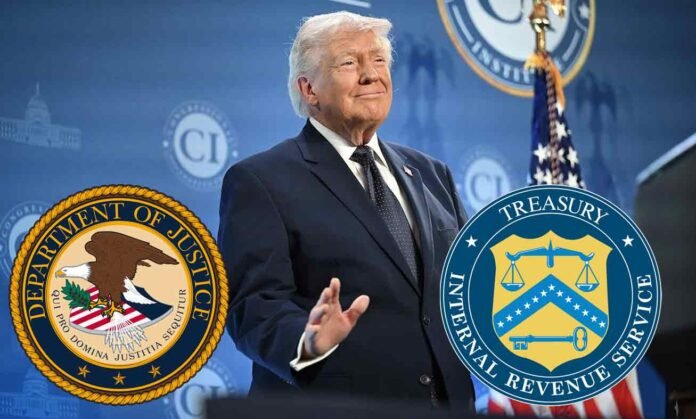
Story Highlights
- The U.S. government agreed to permanently drop tax claims against President Trump as part of a settlement document made public Tuesday, in what observers described as an extraordinary use of executive power.
- The document was signed by Acting Attorney General Todd Blanche, who previously served as Trump’s personal criminal defense lawyer, and was posted without any official announcement or press release.
- Democratic lawmakers blasted the move, which followed the establishment of a controversial Anti-Weaponization Fund worth approximately $1.8 billion.
What Happened
The U.S. government agreed Tuesday to permanently drop tax claims against President Donald Trump in a settlement document made public in an extraordinary use of executive power that could effectively shield the president from further examination of his finances and legal conduct.
The addendum blocks the U.S. from seeking damages that could have been asserted against Trump, his sons Donald Trump Jr. and Eric Trump, and their company, as well as other family members and their companies in “any matters currently pending or that could be pending, including tax returns filed before the Effective Date before Defendants or other agencies or departments.” The effective date is May 18, 2026.
Acting Attorney General Todd Blanche signed the one-page order, which states the IRS “releases, waives, acquits” any pending claims against Trump, his family, or the Trump Organization and is “forever barred and precluded” from pursuing claims tied to tax returns filed before the settlement agreement.
The document stems from Trump’s now-dismissed $10 billion lawsuit against the IRS over the leak of his confidential tax records. Blanche, in testimony before a Senate subcommittee on Tuesday, would not rule out the Anti-Weaponization Fund making payments to people convicted of assaulting police officers during the January 6, 2021, riot at the U.S. Capitol.
The White House referred Associated Press inquiries to the Justice Department, and the U.S. Treasury did not respond to requests for comment.
Why It Matters
This settlement addendum represents a dramatic departure from norms governing the relationship between the presidency and federal tax enforcement. No sitting president in modern history has used the Justice Department to preemptively extinguish not just current tax disputes, but any claims that could have been brought against himself, his family, or his business empire.
Richard Painter, the chief White House ethics lawyer under former President George W. Bush, said exempting Trump from any tax obligations would be unconstitutional. “If the president or his family owe the IRS money, this is a violation of the domestic emoluments clause of the U.S. Constitution, which specifically says that the president cannot receive any profits or advantages from the U.S. government other than his salary appropriated by Congress,” Painter told Al Jazeera.
Like other citizens, U.S. presidents are legally required to file tax returns and can be audited, and they are entitled to the same privacy protections as other taxpayers. Every major-party presidential nominee dating back to 1980 voluntarily released their tax returns until Trump broke with that tradition during his 2016 campaign.
The decision to post this document without a press release or official statement is itself significant. Quietly amending a major legal settlement in a way that affects presidential accountability is the kind of governance action that typically warrants public explanation. The silence around the addendum suggests the administration understands its political sensitivity.
Economic and Global Context
The IRS audit protection lands in the context of a broader administration effort to compensate those it considers victims of politically motivated government action. The Department of Justice released the settlement addendum just one day after the administration unveiled a $1.776 billion Anti-Weaponization Fund geared toward alleged victims of government abuse.
The fund and the audit shield together represent a significant redirection of federal legal and financial resources. Critics argue these actions use taxpayer money and federal authority to benefit the president and his allies personally, while creating legal precedents that could be used in future administrations. Supporters contend that Trump was genuinely subjected to politically motivated IRS targeting and is entitled to redress.
For financial markets and business accountability frameworks, the implications are also notable. The Trump Organization operates across real estate, hospitality, and licensing ventures. Permanently shielding its tax history from audit reduces one of the last remaining avenues for independent scrutiny of how those businesses have been run during a period of significant government contracting activity.
Implications
Congressional Democrats moved quickly to condemn the settlement addendum. The move is likely to fuel ongoing debates about whether the Justice Department has been sufficiently independent from the White House under Trump’s second term. Calls for congressional hearings are expected, though the Republican-controlled House may decline to take action.
For the legal community, this settlement raises foundational questions about the separation of powers. The executive branch has effectively used its control of the Justice Department to close off a legal avenue that another branch of government — and ordinary Americans — relies upon for fiscal accountability.
The document stipulates that the waiver applies to inquiries “currently pending or that could be pending,” a sweeping construction that goes beyond resolving specific disputes and instead forecloses entire categories of future government action. Legal scholars will likely contest whether such a prospective waiver is enforceable, potentially setting the stage for court challenges.
For voters heading into the 2026 midterms, the episode touches a nerve on fairness: whether the president who controls federal agencies can use that control to permanently protect himself from the kind of scrutiny every other American taxpayer faces.
Sources
“Trump and his sons ‘forever’ exempt from tax audits under IRS addendum”