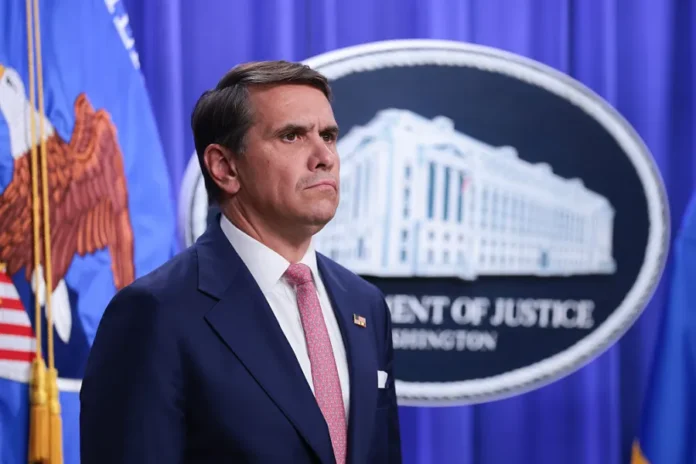
The Justice Department has told a federal judge it will not fully comply with a court order to release additional unredacted Epstein files, opting instead to appeal, in a case that could force Acting Attorney General Todd Blanche to publicly defend the decision. The standoff centers on documents that include email exchanges referencing a “torture video” and interview notes involving an accuser’s allegations against President Trump, deepening a monthslong transparency fight over the government’s handling of the Epstein files.
Story Highlights
- The DOJ told District Judge Emmet Sullivan it will not release unredacted versions of documents covered by a court order, choosing to appeal instead.
- The disputed records include eight email exchanges referencing a “torture video” and FBI interview notes involving an accuser’s claims against President Trump.
- Former Attorney General Pam Bondi testified before the House Oversight Committee but declined to directly answer questions about which names remain hidden.
What Happened
The dispute traces back to a lawsuit filed by attorney and independent journalist Katie Phang, who alleged the Justice Department violated the Epstein Files Transparency Act by improperly withholding and redacting records related to the government’s investigation into Jeffrey Epstein. U.S. District Judge Emmet Sullivan sided with Phang in June, ordering the department to release unredacted versions of at least a dozen documents, or formally explain to the court why it could not.
Among the disputed records are eight email exchanges in which senders’ and recipients’ names were blacked out, including correspondence referencing what has been described as a “torture video” and discussions of sexual activity involving young women, some described as minors. The order also covers a 2007 draft indictment of Epstein listing potential co-conspirators, with all but one name, Ghislaine Maxwell’s, redacted, and FBI interview notes underlying claims from a woman who alleges she was abused by President Trump as a minor in the 1980s after being introduced to him by Epstein.
Rather than comply, the Justice Department, through Acting Attorney General Todd Blanche and Associate Attorney General Stanley Woodward, told the court that releasing unredacted versions of many of the disputed records would run contrary to the proper application of the Epstein Files Transparency Act. Department attorneys said they had reviewed more than six million documents in the course of complying with the law. The filing came in the final hours of the court-ordered deadline, and officials confirmed the department plans to appeal Sullivan’s ruling to the D.C. Circuit rather than release the material.
The legal fight has spilled into Congress as well. Former Attorney General Pam Bondi appeared before the House Oversight Committee, where lawmakers pressed her on which names in the files remain concealed and why, but she did not directly answer their questions. Democratic Representative Ro Khanna and Republican Representative Thomas Massie, co-authors of the original transparency legislation, have both publicly criticized the administration’s handling of the files, and the House Oversight Committee has separately released additional material from Epstein’s estate.
Why It Matters
The standoff raises fundamental questions about executive branch compliance with a law that Trump himself signed. The Epstein Files Transparency Act specifically bars the department from withholding information on the basis of embarrassment, reputational harm, or political sensitivity, making the department’s continued refusal to release material touching directly on allegations against the president a pointed test of that statutory language.
The dispute also carries implications for how courts respond when a federal agency declines to comply with a judicial order. Judge Sullivan has previously indicated he would not pause his ruling to accommodate an appeal, and legal observers note he retains the authority to issue a show-cause order requiring Blanche to personally appear and explain the department’s noncompliance, a step that would be highly unusual for a sitting acting attorney general.
For survivors and advocates who pushed for the transparency law’s passage after years of DOJ reluctance to release Epstein-related material, the continued withholding of documents represents a direct test of whether the legislation functions as intended or can be circumvented through prolonged litigation and appeals.
Economic and Global Context
While the Epstein files dispute carries no direct market impact, it intersects with broader questions about institutional accountability that have shaped public confidence in federal law enforcement. The department has previously acknowledged releasing roughly 3.5 million pages of material, including more than 2,000 videos and 180,000 images, out of a broader collection exceeding six million documents, with officials maintaining the remainder consists of duplicates, unrelated material, or legally privileged content.
The controversy has drawn continued bipartisan attention in Congress, reflecting rare cross-party consensus on the underlying transparency principle even as partisan disagreement persists over the administration’s implementation. International interest in the case has also grown, given that some of the withheld material reportedly references associates and business figures connected to Epstein’s network beyond U.S. borders.
Implications
For the Justice Department, the coming weeks will determine whether its appeal succeeds in delaying disclosure indefinitely or whether Judge Sullivan’s order is upheld, potentially forcing release of material directly touching on allegations against the president. A ruling against the department could also expose Blanche to a formal court appearance to justify the agency’s noncompliance.
For Congress, the continued standoff is likely to fuel further oversight hearings and legislative pressure, particularly from the bipartisan coalition of lawmakers who authored the original transparency law and have expressed frustration with the pace and completeness of disclosures.
For the public and Epstein survivors, the outcome of the appeal will shape whether the transparency law achieves its intended purpose or becomes a prolonged legal battle that delays accountability indefinitely.
Sources
Justice Department defends decision not to release, unredact more Epstein files