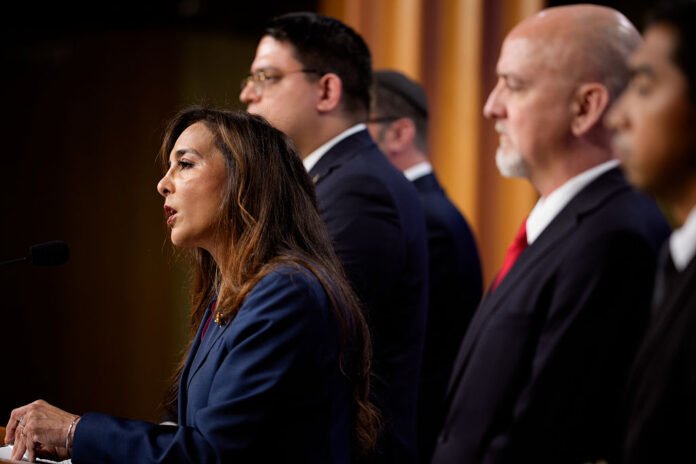
The Justice Department announced this week it will deploy federal election monitors to 15 jurisdictions across six states for the 2026 primary season, targeting cities including Boston, Detroit and Minneapolis. The move came the same day the department sent letters to election officials in all 50 states threatening potential criminal prosecution over noncitizen voter roll maintenance, escalating a pressure campaign that has already drawn pushback from state officials and congressional Democrats. Critics say the coordinated actions represent an unprecedented federal effort to influence the administration of state-run elections ahead of the midterms.
Story Highlights
- DOJ Civil Rights Division chief Harmeet Dhillon announced monitors will be sent to jurisdictions in Arizona, Michigan, Massachusetts, Minnesota, New Hampshire and Virginia.
- The same day, DOJ sent letters to election officials in all 50 states and Washington, D.C., warning of possible criminal liability for retaining noncitizens on voter rolls.
- Maryland’s top election official publicly described a similar letter as an attempt to “intimidate and scare election officials.”
What Happened
The Justice Department’s Civil Rights Division, led by Assistant Attorney General Harmeet Dhillon, announced this week that federal election monitors will be deployed to 15 jurisdictions across six states during the 2026 primary season: Arizona, Michigan, Massachusetts, Minnesota, New Hampshire and Virginia. Specific jurisdictions named include Boston and New Bedford in Massachusetts, Maricopa and Pima counties in Arizona, Detroit, Lansing, East Lansing and Hamtramck in Michigan, Hennepin and Ramsey counties in Minnesota, Manchester and Nashua in New Hampshire, and Fairfax and Prince William counties in Virginia. Dhillon described the effort as routine, noting the Biden administration sent monitors to nine jurisdictions during the 2022 primaries and 27 jurisdictions during the 2024 election cycle.
The monitoring announcement came the same day the department sent letters to election officials in all 50 states and the District of Columbia warning that officials could face criminal prosecution if they knowingly retain noncitizens on state voter registration lists or facilitate noncitizen voting. The letters stated that “any election officer, including the chief election officer of the state, who knowingly retains noncitizens on the state’s SVRL or facilitates noncitizens in receiving and casting ballots could be subject to criminal liability.” Dhillon gave officials five days to respond detailing how their states intend to ensure compliance with federal voter roll maintenance requirements.
Maryland Elections Administrator Jared DeMarinis publicly pushed back after receiving the letter, calling it “a nice love letter from the Department of Justice threatening my arrest.” The letter arrived one day after Justice Department attorneys signaled intent to appeal a case in which a federal judge had already dismissed the department’s lawsuit seeking Maryland’s complete voter registration list. “This letter here is for one purpose, and one purpose only, and that is to intimidate and scare election officials,” DeMarinis said, adding that the department had “lost in court to get the voter rolls” and was now resorting to threats. Similar letters were sent to officials in states including Utah, where Republican Lieutenant Governor Deidre Henderson has also resisted the administration’s demands for voter data.
Dhillon defended the monitoring program and the accompanying letters as necessary to protect election integrity, telling reporters that “every American’s vote that is canceled out by the vote of a noncitizen voting is a problem.” She noted the department has secured convictions in noncitizen voting cases since Trump returned to office, citing a recent case in Louisiana involving an Australian national accused of voting in multiple elections. Dhillon also indicated the monitoring program would expand significantly ahead of the November general election, describing the current primary season deployment as a starting point for a larger operation.
Why It Matters
The coordinated timing of the monitor deployment announcement and the nationwide criminal liability warning letters represents one of the most significant federal interventions into state-administered elections in recent memory, raising fundamental questions about the balance of power between federal and state authority over election administration, a function the Constitution has traditionally left primarily to the states. Democratic officials and voting rights advocates argue the combined pressure campaign is designed to intimidate election administrators rather than address genuine, documented instances of widespread noncitizen voting, which remains exceptionally rare according to virtually all independent studies of American elections.
For state election officials, the threat of personal criminal liability for administrative errors or disagreements over voter roll maintenance procedures introduces significant new pressure into an already demanding role, particularly for officials who have successfully defended their states in court against federal data requests. DeMarinis’s public characterization of the letter as an intimidation tactic reflects broader concerns among election administrators nationwide about whether routine administrative judgment calls could now expose them to federal prosecution.
The selection of jurisdictions for monitoring, which critics note skews heavily toward Democratic-leaning cities and counties including Boston, Detroit, Minneapolis and St. Paul, has drawn accusations that the program’s stated nonpartisan purpose masks a more targeted political effort. Michigan Attorney General Dana Nessel responded to the announcement by noting that “the courts have been clear time and time again: states run elections, not the federal government,” reflecting broader Democratic pushback against what they characterize as federal overreach.
For voters nationwide, the dual actions arrive amid heightened public attention to election administration ahead of the 2026 midterms, a period when public confidence in the electoral process carries direct consequences for participation rates and post-election acceptance of results across the political spectrum.
Economic and Global Context
Federal election monitoring and voter roll enforcement actions carry direct financial and administrative costs for state and local governments, which must divert resources toward responding to federal inquiries, potential litigation, and compliance documentation, on top of routine election administration expenses. Maryland’s ongoing legal battles with the Justice Department over voter roll access illustrate the resource burden such disputes place on state election offices already operating with constrained budgets.
The pressure campaign follows a pattern of escalating federal-state tension over election administration that has intensified significantly since the current administration returned to office, with the Justice Department having already lost multiple legal challenges seeking to compel states to turn over comprehensive voter registration data, including in Maryland, New Hampshire and other jurisdictions that have successfully resisted such demands in federal court.
Internationally, the scale of direct federal involvement in state-level election administration remains unusual compared with other federal democracies, where election administration responsibilities are often more centrally coordinated at the national level, reducing the kind of jurisdictional friction currently playing out between Washington and individual U.S. states.
Financial markets have shown no direct reaction to the election monitoring developments, reflecting their primarily political and administrative nature, though the broader pattern of election-related litigation and federal-state conflict may factor into longer-term assessments of institutional stability that some governance-focused analysts track as part of broader political risk evaluation.
Implications
The expanded monitoring program is expected to grow substantially ahead of the November general election, according to Dhillon’s own statements, meaning the current primary season deployment likely represents an early phase of a considerably larger federal presence in state election administration by the fall. State election officials in targeted jurisdictions should expect continued federal scrutiny and potential additional correspondence from the Justice Department in the coming months.
Legal challenges to both the monitoring program and the criminal liability warning letters remain possible, particularly given the Justice Department’s mixed track record in court on related voter roll data requests. Any successful legal challenge could establish clearer boundaries around the scope of federal authority to threaten criminal prosecution against state officials exercising discretion in election administration.
For congressional Democrats, the coordinated DOJ actions are likely to fuel continued oversight efforts and public statements condemning what they characterize as federal intimidation of election officials, adding to broader midterm election messaging about protecting voting rights and election administration independence from federal political pressure.
For voters and election administrators alike, the coming months will likely bring continued uncertainty about the practical scope of federal monitoring and enforcement actions, with the ultimate resolution of ongoing legal disputes likely to shape how aggressively the Justice Department can pursue similar strategies heading into the higher-stakes November general election.
Sources