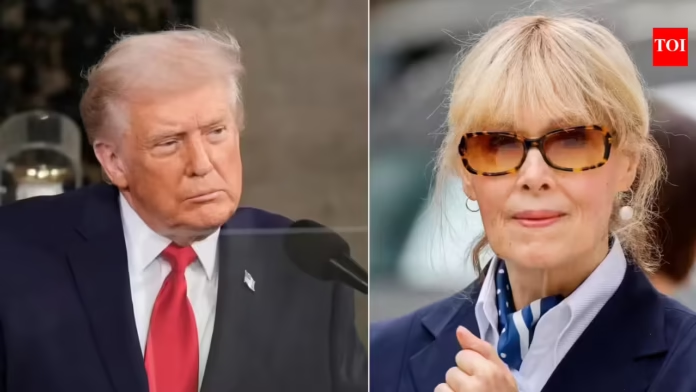
Writer E. Jean Carroll is pressing a Manhattan federal judge to immediately release nearly $5.8 million owed to her from a 2023 civil verdict, after the Supreme Court declined to hear President Trump’s appeal and his legal team moved to delay payment further. The dispute marks the latest chapter in a yearslong legal battle stemming from Carroll’s allegations that Trump sexually abused her in the 1990s and defamed her when she went public.
Story Highlights
- The Supreme Court denied Trump’s petition to hear his appeal of the $5 million verdict without noting any dissents.
- Carroll’s lawyers say the award, with accrued interest, now totals nearly $5.8 million and that Trump is unjustly delaying payment.
- Trump’s attorneys argue funds cannot be released until the Supreme Court resolves a rehearing petition, a request rarely granted.
What Happened
The case dates to a May 2023 jury verdict in which a Manhattan federal jury found President Trump liable for sexually abusing writer E. Jean Carroll in a department store dressing room in the mid-1990s and for defaming her in 2022 when he denied the allegations after she went public with them in 2019. The jury awarded Carroll $5 million in compensatory and punitive damages. Trump appealed, and funds to satisfy the verdict were placed in escrow with the court pending the outcome.
On June 29, the Supreme Court denied Trump’s petition asking the justices to hear his appeal, doing so without noting any dissents among the nine justices, including three Trump appointees. Carroll’s attorney, Roberta Kaplan, subsequently filed papers with District Judge Lewis Kaplan, who is not related to her, arguing that the denial satisfied the conditions under which the escrowed funds should be released, and asked the court to order immediate disbursement. With accrued interest, Kaplan’s filing states the total owed has grown to nearly $5.8 million.
Trump’s legal team, however, urged the court not to release the money, arguing that a pending long-shot petition asking the Supreme Court to reconsider its denial means the funds cannot yet be disbursed under the terms of the parties’ original stipulation. Such rehearing petitions are rarely granted by the high court. Judge Kaplan ordered Trump’s lawyers to respond to Carroll’s motion, and the matter is being handled on an expedited basis.
Carroll’s attorneys have characterized the request for further delay as part of a pattern, noting that Carroll has previously agreed to multiple requests from Trump’s legal team to postpone payment. In their filing, they wrote that Trump’s continued efforts to avoid payment, all of which have been rejected by courts, mean their cooperation with further delays has ended. A spokesperson for Trump’s legal team responded that the administration considers the case part of a broader pattern of politically motivated litigation.
Why It Matters
The case represents one of the clearest tests of whether ongoing civil judgments against a sitting president can be enforced without extraordinary delay through repeated appeals and procedural maneuvers. Carroll’s legal team has framed the dispute as emblematic of a broader pattern in which Trump has used the legal system to postpone accountability for adverse verdicts, a dynamic Judge Kaplan has previously acknowledged in prior proceedings related to the case.
The $5 million verdict is separate from, though related to, a much larger $83.3 million defamation judgment a different Manhattan jury awarded Carroll in January 2024, which Trump continues to appeal. Both cases stem from the same underlying allegations but involve different statements Trump made about Carroll at different points, including comments made while he was out of office in 2022 and later while serving as president.
For the broader public, the case underscores the practical limits of civil accountability mechanisms when applied to a president who continues to hold office, as enforcement actions must navigate both the ordinary appeals process and the unique political and procedural considerations that accompany litigation involving a sitting head of state.
Economic and Global Context
The $5 million verdict, along with the separate $83.3 million judgment, is formally listed as a liability on Trump’s 2025 financial disclosure report, made public by the U.S. Office of Government Ethics. While the amounts involved are not large enough to carry broader market implications, the case has drawn sustained public attention as a marker of how civil litigation against a president proceeds alongside official duties.
The dispute also intersects with ongoing debates about presidential immunity, as Trump’s legal team has argued in related proceedings that immunity considerations affecting other cases could potentially undercut the evidentiary basis for the $5 million verdict, since Carroll’s attorneys introduced overlapping statements as evidence across both cases.
Implications
For Carroll, the coming days will determine whether Judge Kaplan orders immediate release of the funds or grants Trump’s request for further delay pending the unlikely rehearing petition, a decision that will signal how courts intend to handle similar delay tactics going forward.
For Trump, continued efforts to postpone payment carry reputational and legal costs, particularly given Judge Kaplan’s past characterization of the litigation strategy, even as the underlying $83.3 million judgment remains under separate, ongoing appeal.
For the broader legal system, the outcome will offer a signal about how aggressively courts are willing to enforce judgments against a sitting president when procedural delay tactics are employed, a question with implications extending well beyond this particular case.
Sources
Trump opposes E. Jean Carroll getting damages award