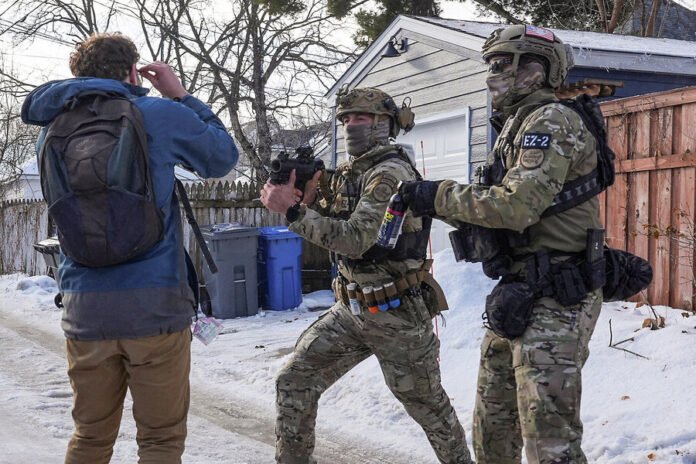
The FBI will no longer investigate claims that federal immigration agents were assaulted before opening fire, according to a new report, a policy shift that arrives just days after an ICE agent fatally shot a Colombian national in Maine. The change removes a layer of independent scrutiny from incidents in which ICE agents use lethal force, at a moment when fatal encounters tied to the Trump administration’s immigration crackdown continue to mount. Critics say the move strips away one of the few remaining external checks on agency accountability.
Story Highlights
- The FBI has told field offices it will no longer investigate claims that ICE agents were assaulted before using lethal force
- The policy change follows the fatal shooting of Joan Sebastian Guerrero, a Colombian national, by ICE agents in Biddeford, Maine
- At least 11 fatal shootings have involved federal immigration officers since January 2025, according to reporting
What Happened
According to a report from The New York Times, FBI managers received written notice on Thursday that the bureau will no longer investigate claims made by Immigration and Customs Enforcement agents that they were assaulted prior to using lethal force in the field. Some ICE agents around the country were informed of the change directly by their FBI counterparts, according to sources familiar with the matter. In cases where ICE agents have shot and killed individuals, the FBI had previously been responsible for independently determining whether the agent’s claim of having been assaulted was accurate, a process that provided an outside check on the agency’s own internal accounts.
The policy shift comes just days after ICE agents fatally shot Joan Sebastian Guerrero, a 26-year-old Colombian national, in Biddeford, Maine. Guerrero’s death marked at least the eleventh fatal shooting involving federal immigration officers since January 2025, according to reporting from U.S. News & World Report. It was also the second fatal shooting by ICE agents in July alone, following the killing of Mexican immigrant Lorenzo Salgado Araujo in Houston earlier in the month. The Maine shooting sparked vigils and protests, with demonstrators and local officials calling for investigations into the incident free from federal interference.
A DHS spokesperson pushed back on characterizations of the change, stating that “the relationship between DHS and DOJ in investigating assault on federal officer cases has not changed” and that the FBI would “continue to investigate in accordance with agency policy.” However, the Times report indicates a clear shift in practice, with evidence gathered during past FBI investigations of assault claims having previously been available for use in subsequent civil rights investigations or prosecutions of ICE agents, a potential accountability mechanism that critics say is now effectively closed off.
The change follows a broader pattern of the administration defending aggressive immigration enforcement tactics even as fatal encounters accumulate. Earlier this month, ICE lifted a temporary pause on vehicle stops after President Donald Trump publicly praised the tactic as an essential enforcement tool, according to reporting from The Washington Post. Nayna Gupta, national director of policy for the American Immigration Council, has described the pattern of shootings as part of “increasingly widespread aggression and violence in immigration enforcement,” while also noting that ICE has historically operated with low levels of oversight and accountability, even before the current administration.
Why It Matters
The removal of independent FBI review over assault claims made by ICE agents strips away one of the only external mechanisms available to verify agency accounts of lethal force incidents. Without this oversight, the public and affected communities are left largely dependent on ICE’s own internal reporting to understand the circumstances surrounding fatal shootings, raising serious concerns about transparency and due process, particularly for the families of those killed.
For communities living in areas with active ICE enforcement operations, the policy change arrives at a moment of already heightened tension and fear. The string of fatal shootings, now at least eleven since January 2025, has fueled growing public anguish and distrust toward federal immigration enforcement, and the elimination of independent assault investigations is likely to deepen that distrust further rather than ease it.
For members of Congress and oversight bodies, the shift raises pointed questions about executive branch accountability. Advocates and Democratic lawmakers have already struggled to obtain meaningful reporting and answers from ICE regarding its operations, according to policy experts, and removing FBI involvement in assault investigations further narrows the avenues available for independent scrutiny of the agency’s conduct.
Economic and Global Context
While the policy shift is primarily a domestic law enforcement and civil rights matter, it carries broader implications for how the United States is perceived internationally on questions of human rights and due process in immigration enforcement. Foreign governments, including those of nationals killed in ICE encounters such as Colombia and Mexico, have increasingly voiced concern over the treatment of their citizens in U.S. custody or during enforcement actions, adding a diplomatic dimension to what might otherwise be treated purely as a domestic policy matter.
Domestically, the continued expansion and intensity of immigration enforcement operations carries significant budgetary implications, with ICE receiving substantially increased funding and personnel resources under the current administration. The economic costs associated with expanded detention capacity, enforcement operations, and related litigation continue to grow, even as questions about oversight and accountability remain unresolved.
The broader immigration enforcement push, which has included large-scale operations in cities such as Minneapolis-St. Paul and New York, has also generated significant local economic disruption, from business closures in heavily targeted communities to increased security costs for local governments responding to protests and demonstrations tied to enforcement actions.
Implications
In the near term, expect continued legal and political pressure on the FBI and DHS to clarify the scope and rationale behind the policy change. Civil rights organizations and members of Congress are likely to formally request documentation of the new directive, and litigation challenging the policy’s legality is a realistic possibility given the pattern of fatal encounters already under scrutiny.
For ICE agents themselves, the removal of FBI oversight could be seen as providing greater operational latitude, though it may also increase legal exposure over time if future civil rights cases proceed without the benefit of independent, contemporaneous investigative findings. Agency leadership will likely face continued questions about training, use-of-force policies, and de-escalation practices as the number of fatal incidents continues to draw public attention.
For affected communities and advocacy groups, the coming weeks are likely to bring renewed calls for state and local investigations into ICE shootings, particularly in jurisdictions where trust in federal oversight has already eroded. Whether Congress moves to reassert oversight authority over ICE’s use-of-force policies will be an important signal of how seriously lawmakers intend to respond to the growing pattern of fatal encounters.
Sources
“FBI will no longer investigate ICE confrontations, The New York Times reports”